

See my notes above in REDDRAFT DESCRIPTION OF THE CTE PROCEDURE
For a “thick hit” (a small cut angle less than 15 degrees) to the left:
For a “half-ball hit” (close to 30 degrees) to the left:
- Align the cue 1 tip to the right of the CB center through the right edge of the OB.--- Not true.
- Place the bridge hand down with the cue exactly along this line, using a 10-12 inch bridge length-- Not true. Bridge length mentioned is usually the range - but not always, esp. closer shots.
- Pivot the cue (without shifting the bridge at all, so the cue rotates about the fixed bridge-pivot point), until the cue is pointed directly through the center of the CB. Almost never. You almost never turn from the bridge - depends on the length of shot. The edge used can affect your pivot.
- Stroke perfectly straight along this line. True. You can also "crash" the vertical planes together with the turned cue.
For a “thin cut” (more than 45 degrees) to the left:
[*]Align the cue through the center of the CB and through the right edge of the OB.
[*]Place the bridge hand down with the cue exactly along this line. The bridge length can be anything for this shot since there is no pivot.
[*]Stroke perfectly straight along this center-to-edge line.
Although this is true to make the ball - it's not true for the system. Since this part isn't a secret, you should pivot on ALL shots - even this one. Reason being: How do you KNOW it's a 1/2 ball hit? Some 1/2 balls hits you can't perceive. You can pivot either from right to left or left to right.
- Align the cue 1 tip to the left of the CB center through the right edge of the OB. Not true.
- Place the bridge hand down with the cue exactly along this line, using a 10-12 inch bridge length. Mostly; however, it depends on the shot length
- Pivot the cue (without shifting the bridge at all, so the cue rotates about the fixed bridge-pivot point), until the cue is pointed directly through the center of the CB. Almost never.
- Stroke perfectly straight along this line. Yes, true. Or, you can crash the vertical planes together.
If you follow the procedures above exactly, you will make shots within certain limited ranges of angles.
True - because you're pivoting "randomly."
However, you will miss most shots outside of these limited ranges, unless the OB is very close to the pocket and/or the pockets are huge (so significant "pocket cheating" is possible).
True - based on the technique you mentioned.
Now, you can make the procedures work if you compensate a little as the cut angle changes. For example, you can adjust your bridge length (this has a huge effect on the results of the pivot step per Diagram 4 in my December ‘08 BD article, which is included below),
Never wanna mess with that unless it's tight quarters
modify the starting tip position a little, pivot slightly less or slightly more relative to the CB center,
Nah - it should always be the same.
and/or you can shift your bridge hand slightly during the pivot (e.g., by pivoting with your hips or body) to create a different effective pivot point farther back or closer up from the bridge.
This happens inside of your bridge--- your bridge hand shouldn't shift - but you SHOULD do the above mentioned technique. That's where people get lost - they always rotate the cue from the bridge (which almost never happens).
You can also “air pivot” where you make subtle changes to all of this stuff intuitively as you come down into the shot (in which case you place your bridge and cue along the required line of aim of the shot with center-ball alignment, without using the separate tip-offset-and-pivot steps). Then, the system can work perfectly for any shot at the table, provided you can judge, perceive, and apply the subtle differences from one shot to another (in which case you don’t need an aiming system).
This is developed over time - you actually turn the cue while standing, it's hard to explain. You do the tip offset and pivot steps--you do everything, just not on the table. Hard to explain to someone who hasn't done this for years. This is advanced stuff... not something taught to beginning people.
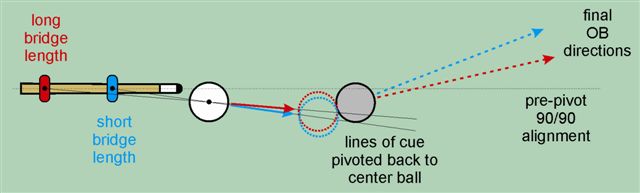
Hopefully, this is enough of a start to create some useful discussion. I look forward to input from you and others so we can refine this procedure to have it better represent what you think CTE is.
Thank you for your time,
Dave
PS: I put a lot of time into this, so please respond in a constructive way (even if critically constructive), so we can make some progress. In other words, please contribute some of your knowledge and information.
I see you put together a lot of time. This was excellent because it shows how much is missing. The tip positions aren't good, the pivot isn't correct and the bridge length is not always 10-12" (for many shots that'll work though).
Tip position is a constant, the pivot is a variable, the bridge length is usually constant until you get close-up. The side of the ball from which you setup is a variable "traditionally" but it can be one side or the other all of the time based on whether you're a right hander or left once you learn a more advanced pivot.
There's no mentioned of edges here and there's a ton to say. There's technically an infinite number of edges to a circle; but for simplicity's sake - let's just say there are 360. The moment your body/head moves slightly to the left or right--- you're seeing a different edge. Your body's relation to the "reference line" is a variable.
Someone can read what I write and say, "WOW - there's a lot there... not just as simple as pivot and make!"
There is a lot to know with CTE if you really wanna learn the guts of it. It's not a 2 min lesson. It's like poker-- I can teach you the hands in 2 minutes but you'll never win a bracelet for a long time. HOWEVER, the variables are based on absolute references instead of invisible points in 3-D space. That's what makes it so repeatable - and so impressive. However, you run through the steps instantly when you know them. At the highest level --- you think: which side of the CTEL, how close is the OB...ok, pivot.
Once you understand how your eyes see the reference lines and you can make a sighting correction (unless you're lucky-- which is a body adjustment not a system adjustment), which is a constant on every single shot. Many people think they "SEE" the CTEL, but they don't. That's what I mean.
I hope this gives you a better insight.
Last edited:


