👺🧡💯✊🫷💁🧑‍🦽

Paul_#_

Well-known member
The Rempe training ball is great for showing someone else how far off center they can hit the ball as well as all the in-between. Then they can visualize what you are telling them.

It is good to use a striped ball, as the cue ball, with the stripe pointed vertical - to see if you are hitting dead center or not. Also this will show you draw.

Personally I like playing with the measles (Pro Cup) cue ball because I can see what the cue ball is doing when it is down table. It gives me feedback on my shooting.


I also just use a striped ball and follow the Byrne theory that the top of the stripe or 70% is as much as you'd need to really hit it if you stroke it right.
First I place one of those sticky rings - the kind used to reinforce the holes in loose leaf paper - at the spot where I want the object ball. I then place the elephant ball on the ring with the seam where the white and red meet aimed straight for the pocket I'm shooting at. This gives me a good view of the contact point and the path the ob must tak
 
Some training balls don’t help find where to hit cue ball to add spin

The miscue limit is the distance from cue-ball center that a player can hit without miscuing. The distance is generally accepted to be one-half a billiard-ball radius, 9/16" (14.3mm) or 0.5R. Some billiard-ball stripes are that width. For beginners, a more practical maximum may be 0.4 to 0.45R. DrDave found a maximum miscue limit of 0.55R.

The Rempe training ball shows an area to apply spin that has a miscue limit of 0.7R. It instructs players hit the Rempe ball and to note chalk marks to determine where spin was applied. That's a disaster, though, for beginners who would miscue hitting the ball at about 0.5R length and for experienced players above 0.55R. Rempe's instructions should state that miscues are likely cue hits ball and smudges ball at markings above 3.2 (that is 0.5R).

The CueSight Training ball instructs players to “stay inside the white circle and you will not miscue”. That white circle can mean hitting the cue ball at 0.61R — impossible to reach for beginners or DrDave. It should state that players should hit the ball within 0.5R --- that is about 3mm inside the white circle (this is the outer-most small circle --- see photo below).

The Elephant training ball is fine --- it has a red circle that corresponds to a 0.5R. Its' area for applying spin is much smaller than CueSight's or Rempe's. I, a beginner, miscued hitting its red circle, but that’s me and not Elephant Ball's fault.

Experienced players --- not beginners --- know some of this. DrDave has videos of miscues and used a Rempe ball showing a miscue occurred at a Rempe marking of 4 (0.6R; see photo below). When YouTuber Ron the Pool Student indicates where to hit on a Rempe ball, he advises, for example, to hit low right spin at a Rempe 3 marking (0.5R; figuring contact would occur at one side of cue tip; see photo below).

Training balls_four.jpg
_
Miscue on Rempe ball.jpg
_
Ron Pool Student smudge at 2.8.jpg
Manual Elephant ball.jpg
 
Last edited:


Nice vintage Dufferin Phantom Green Leaf. 58 inches, 12.2mm tip, 19.50 oz. in very nice condition as the pictures show. Has a slight ding in the shaft 9.5 inches from the top and some very minor scratches here and there, but far better than expected for its age. This is a vintage Phantom, made in Canada. I'm not sure why the green leaf is so much harder to find, but this is a nice one to have if you appreciate these cues and like the wood-to-wood hit. Has some taper roll but nothing that affects play. Tried to get the ding in the second to last picture. If interested, I also have a vintage Valley Supreme II sneaky that I will list separately.
$old shipped CONUS.
IMG_2584.JPG
 
FROM post #1

Visiting Ron Vitello this weekend, I learned of something I did not believe at first. Can an object ball be thrown? I've always assumed "of course", as just about any book you read explains how to throw a ball. You put spin on the cueball, it strikes the object ball, transferring the spin and the object ball moves off its natural course. However, Ron claims it is impossible to throw an object ball

FROM post #9:

99 Critical shots in pool dedicates a few pages to Throw Shots.
I have practiced them, and have made shots that I considered throw shots due to a blocking object ball.
Maybe I was just cutting a difficult shot in but I will just pretend that I can utilize throw sho

FROM post #330

help me see the history of AZB. You all have been arguing the same $hit for a long time! LOL

FROM post #338
So you’re saying when I apply spin to the cue ball it doesn’t change the natural line of the object ball? hahahahaahaha You can’t see with your own eyes and actions that that is ridiculous lo


FROM post #345:

give me one reason to believe there is throw

when one of the foremost pool instructors tells us, and demonstrates that the earth is flat.

then dave comes along out of no where, and tells us that pool balls throw,


=======================


1774299201875.png
 
Last edited:
From Becue's website:
Wood applied to carbon as a natural veneer, a real layer of timber wrapped around the monolithic carbon fiber structure that defines every Becue cue.
This is not a wood cue with a carbon core.
The carbon structure is intact, uninterrupted, carrying every vibration, every impact exactly as our other cues do.
The wood is real — a genuine wood veneer, not a print, not a texture — but it carries no mechanical role. It does something more subtle: it breathes warmth into your hands.

Becue's is a wood & CF butt. As far as wood &CF shafts: Wood/CF bunch follows
Predator Centro and C8; Mezz EX Pro; McDermott G-Core, i-Pro, i-Pro Slim, i-1 Big Boy, i-2, i-3; Pure X FUZE Kielwood Carbon Fiber InFUZED Solid Shaft; Lucasi Pro Carbon InFUZED 10S; Bear RB-1; Fury LC series, Fury ST2 Hybrid series, Fury Merlin; CueLees EX Solid (combo extraordinaire with CF-only on bottom few inches and wood/CF for rest of shaft), CT-1 & CT-2; OB Cues Fusion (no longer available); Predator BK3 Sport Break cue and its BK3CF shaft (not available on Predator website); Predator BK2 break shaft; Cuetec R360 (note its fiberglass ---not CF--- inside; JFlowers SMO-W; Fiberglass exterior/Wood inside shafts: Cuetec Avid​


[/
Deflection 4 costly shafts results.jpg
Deflection 4 cheap CF shafts results.jpg
SPOILER]
 
Last edited:
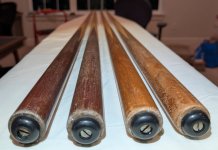
Four one-piece cues about 100-years old for sale — $400 shipped

Cues by O.L. Briggs & Son company of Boston MA made sometime between 64 and 125 years ago during that business's existence (it had been O.L. Briggs since 1870).

The 16 and 17 ounce cues appear to be made of mahogany and maple, while the 18 and 19 ounce cues, purple heart and maple.

Cue lengths 57" to end of tenon. No ferrules on the cues but buffalo-horn ferrules included for installation.

Butt diameters at bottom for the 16, 17, 18, and 19 ounce cues: 1.35", 1.37", 1.39", and 1.39" diameter, respectively.

Butt diameters about twelve inches from the first splice near butt end are 1.22" for all cues.

Diameters below ferrule bottom (if a ferrule was on cue): 12.1, 12.3, 12.6, 12.5 mm, resp.

Tenon diameters: 6.5 diam.x14.6mm length, 6.5x11mm, 6.2x13.1mm, 6.6x14mm, resp.

Also included are parts likely used a hundred years ago: i) six buffalo horn ferrules (four 17x27mm with 6mm tenon & air holes and two 17x33mm undrilled ferrules from Cue Components); and ii) five Champion 13mm cue tips.

Some wobble to the cues.


O.L. Briggs on side in sun.jpg
_
Tips w.o. ferrules.jpg
Weights w. duckies in 16 to 19 order.jpg
PXL_20260419_235658470.jpg
_
PXL_20260419_235611300.jpg
__
PXL_20260419_235721963.jpg
Butts w duckies.jpg
_
Ferrules and tips.jpg
Ferrules on tenons.jpg
 

Attachments

  • PXL_20260420_000447171.jpg
    PXL_20260420_000447171.jpg
    132.3 KB · Views: 11
Last edited:
  • Like
Reactions: bbb
The sale item is now live:
 
Back
Top