
You are using an out of date browser. It may not display this or other websites correctly.
You should upgrade or use an alternative browser.
You should upgrade or use an alternative browser.
WTB Southwest Cues-Fancy Woods
- Thread starter Mgunter
- Start date
LibraryFool77
Active member
If your buying as an investment beware, unless it’s a ten year plan. Cue collectors and aficionados are leaving daily and not being replaced. Honestly I’d recommend anyone w a collection to sell now, if they didn’t have a passion for ownership.

If your buying as an investment beware, unless it’s a ten year plan. Cue collectors and aficionados are leaving daily and not being replaced. Honestly I’d recommend anyone w a collection to sell now, if they didn’t have a passion for ownership.


To be honest, the value of a custom cue tends to increase over time for a few reasons.If your buying as an investment beware, unless it’s a ten year plan. Cue collectors and aficionados are leaving daily and not being replaced. Honestly I’d recommend anyone w a collection to sell now, if they didn’t have a passion for ownership.
First, custom cue makers aren’t getting any younger. As their careers progress and fewer of their cues become available, the value of their work often increases, especially for well-known makers.
Second, the cost of materials continues to rise. Rare woods such as burl, tulipwood, and Brazilian rosewood are becoming increasingly expensive and harder to source. The same applies to other premium materials that are limited in availability such as Ivory.
Generally speaking, a quality custom cue can appreciate around 3–4% per year, although some highly sought-after makers can increase much more than that. For example, a Gus Szamboti from 1991 may have originally sold for around $1,100, while today, a comparable cue could be worth around $7,500.
So, I wouldn’t look at a custom cue as a 10-year investment or a way to make quick money. It’s more of a long-term investment that can hold or increase its value over time, especially if you buy the right cue from the right maker and take good care of it.


@itzel0101 check your DM’s and let me know.


2018
Attachments
-
 20260814_150738.jpg362.6 KB · Views: 71
 -
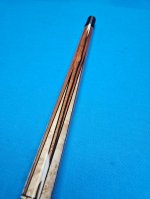 20260814_150831.jpg222.6 KB · Views: 67
 -
 20260814_150825.jpg212.9 KB · Views: 62
 -
 20260814_150847.jpg306.4 KB · Views: 76
 -
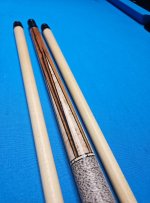 20260814_150742.jpg219 KB · Views: 73
 -
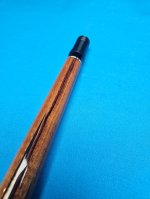 20260814_150821.jpg205.7 KB · Views: 65
 -
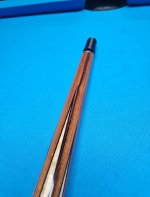 20260814_150815.jpg209.3 KB · Views: 62
 -
 20260814_150735.jpg298.5 KB · Views: 78

To be honest, the value of a custom cue tends to increase over time for a few reasons.
First, custom cue makers aren’t getting any younger. As their careers progress and fewer of their cues become available, the value of their work often increases, especially for well-known makers.
Second, the cost of materials continues to rise. Rare woods such as burl, tulipwood, and Brazilian rosewood are becoming increasingly expensive and harder to source. The same applies to other premium materials that are limited in availability such as Ivory.
Generally speaking, a quality custom cue can appreciate around 3–4% per year, although some highly sought-after makers can increase much more than that. For example, a Gus Szamboti from 1991 may have originally sold for around $1,100, while today, a comparable cue could be worth around $7,500.
So, I wouldn’t look at a custom cue as a 10-year investment or a way to make quick money. It’s more of a long-term investment that can hold or increase its value over time, especially if you buy the right cue from the right maker and take good care of it.
People (not specifically @KenneyTran, if at all) need to be careful about conflating increases in price with increases in value. A quality custom cue that appreciates in price by 3-4% per year is barely outpacing inflation; its value is not increasing much.
The Gus Szamboti cue example that cost $1100 in 1991 cost about $2700 in 2026 US dollars. While its (hypothetical) price increased by over 580%, its value only increased by about 180%. It would have been a fantastic store of value, but not a very good investment. The same $1100 invested into a S&P index fund in 1991 would be worth over $50,000 today. The actual increase in value (i.e., inflation adjusted) would be over 1750%.
As a general rule, collectibles outside of art and Rolexes (and often those too) are poor investments.
Edit: My apologies to @Mgunter for posting this in their Wanted thread.
Last edited:
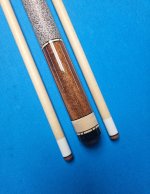
I have a beautiful Macasar Ebony and Maple Sw
I don’t necessarily have the collection as an investment. Granted I’d hate to lose money. It I just buy because I like collecting and they hold a special place with me and when I’m playing with one takes me back 30 years when life was simpler. Some great memories from back then. Happy to be playing again after being off the table for 30 years. Shit goes downhill quickPeople (not specifically @KenneyTran, if at all) need to be careful about conflating increases in price with increases in value. A quality custom cue that appreciates in price by 3-4% per year is barely outpacing inflation; its value is not increasing much.
The Gus Szamboti cue example that cost $1100 in 1991 cost about $2700 in 2026 US dollars. While its (hypothetical) price increased by over 580%, its value only increased by about 180%. It would have been a fantastic store of value, but not a very good investment. The same $1100 invested into a S&P index fund in 1991 would be worth over $50,000 today. The actual increase in value (i.e., inflation adjusted) would be over 1750%.
As a general rule, collectibles outside of art and Rolexes (and often those too) are poor investments.
Edit: My apologies to @Mgunter for posting this in their Wanted thread.

With regards to your comment about Rolexes, a majority of them will be money in the bank going forward if for no other reason than Rolex issues a retail price increase at least once a year. I know these things because it’s actually the business I’m in
 are there some dogs? I had to buy this dog and take a loss to get 2 other pieces that made it back plus about $10k. But as a whole you’re money is safe in Rolex.
Attachments

Send pics and price. Not really looking for anything maple but if price is right, I may purchase anywayI have a beautiful Macasar Ebony and Maple Sw
One on Far right
2. 13.1mm Shafts
2. 13.1mm Shafts
Attachments
-
 20260904_181451.jpg352.9 KB · Views: 42
 -
 20260904_181500.jpg289 KB · Views: 47
 -
 20260904_181448.jpg337.5 KB · Views: 50
 -
 20260904_181457.jpg260.3 KB · Views: 43
 -
 20260904_181513.jpg219.5 KB · Views: 46
 -
 20260904_181517.jpg205.9 KB · Views: 36
 -
 20260904_181505.jpg257.6 KB · Views: 38
 -
 20260904_181454.jpg301.8 KB · Views: 40
