Another T-plate question?

Cue Crazy

AzB Silver Member
Silver Member
Wondering If anyone can give me an idea of how hard 360 brass is? I decided to transfer some of My wooden templates over to metal, and I'm looking into buying some brass for It.
I found out that My machine is tight enough to cut them from aluminum, but that's with small depth ajustments, and keeping the cutting tip oiled as I'm cutting them. The results were very good, but It was a somewhat slow going process, and has to be harder on the machine, so I'm looking into the brass.
I'm basically wondering If I will see a significant difference in how easy the 360 cuts over aluminum? I understand there are even softer materials I can try, and will in the future, but this is what I am wanting to experiement with at the time.

Thanks:) , Greg C
 
Cue Crazy said:
Wondering If anyone can give me an idea of how hard 360 brass is? I decided to transfer some of My wooden templates over to metal, and I'm looking into buying some brass for It.
I found out that My machine is tight enough to cut them from aluminum, but that's with small depth ajustments, and keeping the cutting tip oiled as I'm cutting them. The results were very good, but It was a somewhat slow going process, and has to be harder on the machine, so I'm looking into the brass.
I'm basically wondering If I will see a significant difference in how easy the 360 cuts over aluminum? I understand there are even softer materials I can try, and will in the future, but this is what I am wanting to experiement with at the time.

Thanks:) , Greg C
I have not kept up with the #s on brass. But if you ask for soft machineable brass it will cuts easier than aluminum does with small end mills, but will not gum up the bit. It last longer in templates and is easier to machine, so soft brass is a much better choice.
Chris
www.cuesmith.com
www.internationalcuemakers.com
 
cueman said:
I have not kept up with the #s on brass. But if you ask for soft machineable brass it will cuts easier than aluminum does with small end mills, but will not gum up the bit. It last longer in templates and is easier to machine, so soft brass is a much better choice.
Chris
www.cuesmith.com
www.internationalcuemakers.com


Thank You,
Yes, I'm not up on the numbers either, but seem to run accross alot of 360 in the correct thickness & sizes for the t-plates, so I thought I ask here first, before researching It. I have seen alot of It, just never used any, so not sure if It's the soft type. I could tell If I had it in hand, just don't want to order then find out the hard way.

I was going to contact You & ask but did'nt want to bother you with petty questions right now. However If you do see this again, I would be curious If you have any tips on the difference in scale size between the V-groove and the flatbottom, and how to easily come up with them so I can use the same cutters I use with the template you supplied. These templates are in the same style as Yours (1) in 60 deg V & (1) pocket style.
What I'm wondering is If I take a standard flat stylus, and use It on My wooden template with a 60 deg v cutting My permanent T-plate, then want to cut the next one in the pocket style, what changes do I need to make? Is It as simple as a cutter change or do I need to make a stylus change also? I expect to make a stylus change for hogging It out, but what about the edge, and just using a smaller cutter with the same stylus that I originally cut the v groove side with.
I would'nt even mind having them on 2 seperate plates if that means I can just take the permanent v-groove side with a 60 stylus to cut the pocket side out. If that would work, then wondering what size cutter I need to make It the correct size?

To try and put It simply, I have already turned several styles, and have My cutter sizes worked out, so that they work good with yours. I'm just trying to avoid cutting more size styluses, and doing more figuring If I don't need to. The 2 look fairly close in size on your plate, so I am hoping there's an easier way using what I already have. I hope I'm not being too confusing:o , but I figure your the guy to ask in My situation.
Feel free to PM & Thanks Again:) ,

Greg
 
Cue Crazy said:
Thank You,
Yes, I'm not up on the numbers either, but seem to run accross alot of 360 in the correct thickness & sizes for the t-plates, so I thought I ask here first, before researching It.
Greg

360 is free machining brass and would be great for making panto templates.
 
Cue Crazy said:
Wondering If anyone can give me an idea of how hard 360 brass is? I decided to transfer some of My wooden templates over to metal, and I'm looking into buying some brass for It.
I found out that My machine is tight enough to cut them from aluminum, but that's with small depth ajustments, and keeping the cutting tip oiled as I'm cutting them. The results were very good, but It was a somewhat slow going process, and has to be harder on the machine, so I'm looking into the brass.
I'm basically wondering If I will see a significant difference in how easy the 360 cuts over aluminum? I understand there are even softer materials I can try, and will in the future, but this is what I am wanting to experiement with at the time.

Thanks:) , Greg C

I've made templates for a few of the big names. PM me if you need some help. My CNC machine stays pretty busy but I can work a few in here and there.
 
Murray Tucker said:
I've made templates for a few of the big names. PM me if you need some help. My CNC machine stays pretty busy but I can work a few in here and there.


Thank You for the offer Murray, very generous, alot of good folks on here,that including yourself. I may get a hold of you when I get ready for more custom plates and see how busy you are. Making them By hand out of birch was fun at one time, but only a small percentage come out nice & straight enough to save & I'm limited on design. That's what I'm doing now, just transfering what's worth saving.
Right now I'm afraid My file drawing skills are'nt so hot though, I have'nt had the extra time to try and teach Myself, not mention most people take classes for it:p :D , so probably not easiest self taught thing to learn. I can sketch on graphpaper though, the old school way, If there's possibly someway of scanning, importing to file, and ajusting all the properties so they are equal, and without going through too much extra trouble. Seems like I have heard of something being done like that, but I'm sure that depends on the sofware & setup. Most anything I think up is fairly basic though since I am using a panto.
The cad program I have tried seemed really complex, and overkill for a simple drawing, so I'm thinking of looking for something that's easier to learn, but I can still use later on when I finally have an automated machine setup.

I just went onto online metals site, read the reference on 360, and saw what you mention- that indeed It was free machining brass, so I was happy to see that. It should cut like butter.:)

Thanks again,

Greg
 
Cue Crazy said:
Thank You,
Yes, I'm not up on the numbers either, but seem to run accross alot of 360 in the correct thickness & sizes for the t-plates, so I thought I ask here first, before researching It. I have seen alot of It, just never used any, so not sure if It's the soft type. I could tell If I had it in hand, just don't want to order then find out the hard way.

I was going to contact You & ask but did'nt want to bother you with petty questions right now. However If you do see this again, I would be curious If you have any tips on the difference in scale size between the V-groove and the flatbottom, and how to easily come up with them so I can use the same cutters I use with the template you supplied. These templates are in the same style as Yours (1) in 60 deg V & (1) pocket style.
What I'm wondering is If I take a standard flat stylus, and use It on My wooden template with a 60 deg v cutting My permanent T-plate, then want to cut the next one in the pocket style, what changes do I need to make? Is It as simple as a cutter change or do I need to make a stylus change also? I expect to make a stylus change for hogging It out, but what about the edge, and just using a smaller cutter with the same stylus that I originally cut the v groove side with.
I would'nt even mind having them on 2 seperate plates if that means I can just take the permanent v-groove side with a 60 stylus to cut the pocket side out. If that would work, then wondering what size cutter I need to make It the correct size?

To try and put It simply, I have already turned several styles, and have My cutter sizes worked out, so that they work good with yours. I'm just trying to avoid cutting more size styluses, and doing more figuring If I don't need to. The 2 look fairly close in size on your plate, so I am hoping there's an easier way using what I already have. I hope I'm not being too confusing:o , but I figure your the guy to ask in My situation.
Feel free to PM & Thanks Again:) ,

Greg
Make your wooden template walls roughly 1/8" wider than the actual inlay part and pocket in the cue will be. That is 1/16" all the way around. Use a 1/16" stylus and 1/16" end mill to cut the pocket in the brass. Use the same 1/16 stylus and 60 degree v bit to cut male side of pattern into the brass. This allows you to use a 1/16 end mill to cut out your parts. This one to one pattern making method has draw backs on some fancy shapes with inward tails like the top of a heart. But to make the female pocket pattern actual size means you will have to use a 1/32 stylus to clean up the edge of the pocket and you will break a lot of styluses on a one to one machine that way. I hope this is some help. I most likely won't be back around the computer for a while unless I look at it briefly before heading back to the Cancer center in the morning.
Chris
www.cuesmith.com
www.internationalcuemakers.com
 
cueman said:
Make your wooden template walls roughly 1/8" wider than the actual inlay part and pocket in the cue will be. That is 1/16" all the way around. Use a 1/16" stylus and 1/16" end mill to cut the pocket in the brass. Use the same 1/16 stylus and 60 degree v bit to cut male side of pattern into the brass. This allows you to use a 1/16 end mill to cut out your parts. This one to one pattern making method has draw backs on some fancy shapes with inward tails like the top of a heart. But to make the female pocket pattern actual size means you will have to use a 1/32 stylus to clean up the edge of the pocket and you will break a lot of styluses on a one to one machine that way. I hope this is some help. I most likely won't be back around the computer for a while unless I look at it briefly before heading back to the Cancer center in the morning.
Chris
www.cuesmith.com
www.internationalcuemakers.com


Thanks Chris,

Sounds like just the info I needed. I'm with you on the drawbacks, and for that reason most of My shapes so far are fairly simple.

You've been a huge help, and it will save me alot of the trial and error to figure it out on My own.

I really apprietiate you taking the time to help, I know your time is very tight right now. Still have you guys in our prayers here, and wishing for the best possible outcome.

Take Care,
Greg C
 
Cue Crazy said:
Thanks Chris,

Sounds like just the info I needed. I'm with you on the drawbacks, and for that reason most of My shapes so far are fairly simple.

You've been a huge help, and it will save me alot of the trial and error to figure it out on My own.

I really apprietiate you taking the time to help, I know your time is very tight right now. Still have you guys in our prayers here, and wishing for the best possible outcome.

Take Care,
Greg C
We just got back tonight. I appreciate the prayers. My wife is glad to get a break from radiation treatments for a few days. She is also very glad to be home.
Good luck with your patterns.
Chris
 
Chris,

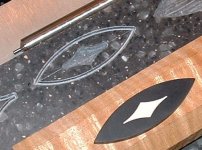
Just wanted to thank you again. The info You gave me seemed to be right on the money. The inlay in this picture dropped right in after making this plate, I did'nt even have to sand the points in or anything.:) The points look larger in the picture, because it's about 3 times actual size, but they are alot thinner looking in person, probably the thinest so far for Me without cutting the pocket sharp. I got the pocket setup with the correct size cleanup stylus, to fit the points of this diamond perfectly, and the cleanup bit's width cuts the perfect width to accept the thin male points, with the stylus fitting the corners tight and no play from side to side. I'm sure you can apprietiate the dificulty in that, it kind of falls into the 1to1 limitations You mentioned, and getting the size inlay you want at the same time. It worked out great on this one, I could'nt be more thrilled with the outcome. There is no glue or dye used here, just a test piece, press fit, and as you can see the fit is'nt too bad at all, very close fitting.:)

By the way, have you ever cut a plate like this one to do inlay inside of inlay before going into the cue? Not sure If I have seen one before, but for Me it works well, and simplifies things quite a bit, so that I don't develop centering issues while I have the cue indexed, and making My cuts into It, or getting one template centered where the first one was when using 2 seperate templates on the flat material before going into the cues with It. I just do It one time to make the template, and from there on no hassles with that stuff. I have many ideas of how to utilize this method and do some nice borders with it. I'm sure It's been done before, and I just have'nt seen it, but It works for me.

Thanks Again, still Keeping you guys in our prayers.:)

Greg C
 

Attachments

  • tplate9.JPG
    tplate9.JPG
    86.9 KB · Views: 186
Yes I have made patterns with an inlay inside another inlay. I used to offer some patterns cut like that. But they didn't sell very well as they were twice the price. Your inlays look real good. That method makes life a lot easier on you. If you want to make a point pattern or such that you want to put various shapes into. Make your point parts pattern and put one 1/32" or .035" dot just above where the end of the part you want to inlay will start. Then you just drill the small dot into your part before cutting it out. Remember don't drill all the way through or it will fill up with glue. What this does is gives you a perfect center to come back to after the point is in the cue. Then you won't have problems getting the new part right in the middle.
 
cueman said:
Yes I have made patterns with an inlay inside another inlay. I used to offer some patterns cut like that. But they didn't sell very well as they were twice the price. Your inlays look real good. That method makes life a lot easier on you. If you want to make a point pattern or such that you want to put various shapes into. Make your point parts pattern and put one 1/32" or .035" dot just above where the end of the part you want to inlay will start. Then you just drill the small dot into your part before cutting it out. Remember don't drill all the way through or it will fill up with glue. What this does is gives you a perfect center to come back to after the point is in the cue. Then you won't have problems getting the new part right in the middle.


The standard plate I got from You is very nice, so that's a shame they did'nt sell, because your correct it does make life alot easier, and worth the extra money IMO. Brass is'nt cheap either. I just got mine in. I bought 6 feet of it to start with, and went with the 2" wide, because it was only a total of $4 extra over the price of 1-1/2. I hoping maybe I can slip 2 rows of inlays in each plate, and get more bang for My buck. I've had the flu this last week, and everytime I try to work on inlays, the dust & hanging My head low looking at the work makes me worse, so I have'nt tried the brass yet. I don't want to make any mistakes on It, so I'm waiting till I kick this cold, but Looking forward to working with it.

I used a chipbreaker to cut the female on the plate, but for the inlays I'm using the bits I got from you, as they run alot truer. They are very tuff mills for the size, and seem to last alot longer then some others I have tried. Which reminds me I still need to get with you to order a bunch of the stuff I usually prefer to getting through you, but the holidays has me in a pinch, so after I recover from that I'll be in touch.

Thanks for the tips on centering, I'll give it a try next time It comes up. You've been a huge help to me. Before I was doing it all with nothing but a wooden female profile:rolleyes: :p I was able to do it, but this will make things alot easier.:) Now I have many shapes to get milled into permanent plates.

Anyway, For a bussiness man Your a true gentlemen, and very unselfish. I can't express enough how much I apprietiate it.

Thanks Again, Greg C
 
Back
Top