

Rehi guys,
On the beginning of my post i just wanna say that i would never try to mess me with anyone- here are just too many so experienced well known instructors i respect SO MUCH- but also really would enjoy to receive response and critic on my posting.
Til now noone *found the gral* to teach billiards and especially the mechanics etc. - but in my humble opinion there are some that are extremly close to it.
The Reason about this posting is that some guys pmed and emailed me with a question. They asked me what i meant with the *anatomical length of your stroke*- ok i ll try to show and explain here what i mean. And ofc i am really lookin forward for comments from the amazingly experienced guys like RandyG, Scott, STeve, Dr.Dave, Dr9Ball etc. etc. pp ^^
Ok here a little picture of a *stroke-arm* i found in an old paper for a student from the early 90 s.
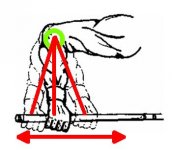
The distance from ellbow joint to the *begin of your grip*. The *begin of the grip* i would describe where cue *touches* your cue. So i mean the upper point of the cue in your hand. This length of course is individual for everyone. So if you know this length it s just about physics (and a bit mechanics ) - depending on this length you can move your forearm (downwards the ellbow-joint) without moving your upper-arm/or even ellbow!
If i write here about the anatomical length i need to talk even so about the anatomical end of your stoke- if you know about your anatomical length you should know also *your* anatomical end of the stroke.
Imagine you are *down* to make your stroke. In this case you ll probably have this mostly discussed *right angle* while your tip is about 1-2 inches from the cueball. Usualy i teach my student this: the anatomical length will show you and force you how far your bridge is placed from the cueball. In my case it s about the distance from one diamond to the next diamond (exactly 29.5 cm). So if i start my stroke from there (with the distance cueball <-------> Bridge-Hand i am able to stoke through the cueball without moving my ellbow/upperarm and even so i am able to accelerate fast enough to do EVERY shot successfully just using my (attention-here it comes again :grin-square PENDULUM-STOKE.
The anatomical length with his starting position and the (anatomical) end of the stroke is naturally given- individual to everyone depending on how tall or small he is. And here you all can think about if you re watchin other guys playin- you will see (if you re really thinkin about it!) if guy for example is too far away from the cueball
(distance cueball <----->bridgehand)
he will have a problem- he can t finish his stroke (usualy) successful. He will not be able to accelerate trough the cueball because the stroke itself *ended before his anatomical end*-
With the correct distance of your bridge you re sure to be able to go parallel *through* the cueball- and only then you re able to have control over it.
At least one thing from my side- many are discussing about Pendulum or Piston Stroke- All i can say from my experience. Pool and Snooker Players have a bit different stance and stroke. The concept instructors of DBU (gemany, also associated to wpa) are teaching is very close to what the BCA and even so the SPF is teaching. The concept of the stroke the DBU were taught to the *certifying instructors* say this (just about physics!!)
the highest point of acceleration of your stroke is a bit behind the centre of the cueball after you hit it. If you compare this to the concept of snooker there is just one thing that is different. Because the stance is a bit different, the highest acceleration with a stroke of a snooker-player is at the point you hit the cueball. Both can be taught in my opinion. This difference is given because you re just using another stance (so balance/weight is a bit different).
Ok, i hope my low english was good enough and that didn t make too many grammar mistakes
if i made some mistakes caused by a conversion-problem-sry for that and i would enjoy correcting me. I would love to receive a response by guys like -Dr.Dave for example because his knowledge about the theoretical things and physics are so amazing.....-then i would be sure that i didn t post bullsh..t ^^
lg
Ingo
On the beginning of my post i just wanna say that i would never try to mess me with anyone- here are just too many so experienced well known instructors i respect SO MUCH- but also really would enjoy to receive response and critic on my posting.
Til now noone *found the gral* to teach billiards and especially the mechanics etc. - but in my humble opinion there are some that are extremly close to it.
The Reason about this posting is that some guys pmed and emailed me with a question. They asked me what i meant with the *anatomical length of your stroke*- ok i ll try to show and explain here what i mean. And ofc i am really lookin forward for comments from the amazingly experienced guys like RandyG, Scott, STeve, Dr.Dave, Dr9Ball etc. etc. pp ^^
Ok here a little picture of a *stroke-arm* i found in an old paper for a student from the early 90 s.
The distance from ellbow joint to the *begin of your grip*. The *begin of the grip* i would describe where cue *touches* your cue. So i mean the upper point of the cue in your hand. This length of course is individual for everyone. So if you know this length it s just about physics (and a bit mechanics
) - depending on this length you can move your forearm (downwards the ellbow-joint) without moving your upper-arm/or even ellbow!If i write here about the anatomical length i need to talk even so about the anatomical end of your stoke- if you know about your anatomical length you should know also *your* anatomical end of the stroke.
Imagine you are *down* to make your stroke. In this case you ll probably have this mostly discussed *right angle* while your tip is about 1-2 inches from the cueball. Usualy i teach my student this: the anatomical length will show you and force you how far your bridge is placed from the cueball. In my case it s about the distance from one diamond to the next diamond (exactly 29.5 cm). So if i start my stroke from there (with the distance cueball <-------> Bridge-Hand i am able to stoke through the cueball without moving my ellbow/upperarm and even so i am able to accelerate fast enough to do EVERY shot successfully just using my (attention-here it comes again :grin-square
PENDULUM-STOKE. The anatomical length with his starting position and the (anatomical) end of the stroke is naturally given- individual to everyone depending on how tall or small he is. And here you all can think about if you re watchin other guys playin- you will see (if you re really thinkin about it!) if guy for example is too far away from the cueball
(distance cueball <----->bridgehand)
he will have a problem- he can t finish his stroke (usualy) successful. He will not be able to accelerate trough the cueball because the stroke itself *ended before his anatomical end*-
With the correct distance of your bridge you re sure to be able to go parallel *through* the cueball- and only then you re able to have control over it.
At least one thing from my side- many are discussing about Pendulum or Piston Stroke- All i can say from my experience. Pool and Snooker Players have a bit different stance and stroke. The concept instructors of DBU (gemany, also associated to wpa) are teaching is very close to what the BCA and even so the SPF is teaching. The concept of the stroke the DBU were taught to the *certifying instructors* say this (just about physics!!)
the highest point of acceleration of your stroke is a bit behind the centre of the cueball after you hit it. If you compare this to the concept of snooker there is just one thing that is different. Because the stance is a bit different, the highest acceleration with a stroke of a snooker-player is at the point you hit the cueball. Both can be taught in my opinion. This difference is given because you re just using another stance (so balance/weight is a bit different).
Ok, i hope my low english was good enough and that didn t make too many grammar mistakes
if i made some mistakes caused by a conversion-problem-sry for that and i would enjoy correcting me. I would love to receive a response by guys like -Dr.Dave for example because his knowledge about the theoretical things and physics are so amazing.....-then i would be sure that i didn t post bullsh..t ^^
lg
Ingo