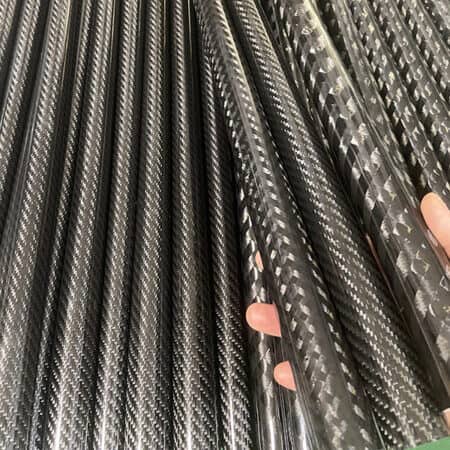
Source for cf shaft blanks

Am I correct in assuming the ones on the left are natural with just polished surface and the ones on the right are the same but have the coating on them?
In this pic, the ones on the left do look like they have a finish, ones on the right look raw. Looked around on the site didn't see anything about the finish, maybe I'm just not looking good enough.


cfShafts.gif
 
I sanded a wedge out of a 'normal' non-woven CF shaft and shot some pics with my microscope.

2026-02-25-184501167.jpg

This image shows the outer four layers. The outer two layers (above the darker parabola) can be seen as fibers oriented the length of the shaft. The dark parabola is a layer of fibers wrapped around the shaft, this can be best seen in the bottom right of the parabola, tho photo size limits resolution.

2026-02-25-184521077.jpg

This photo shows the inner two layers. The innermost layer, with the hole can easily be seen as fibers wrapped around the shaft, while the next layer is fibers running the length.

This shaft appears to be made from 11 layers, alternating between circumferential and axial, with one additional axial layer. Because of how CF works, the circumferential layers are used to keep the shaft from simply splitting lengthwise. The circular patterns I mentioned in my previous post are most likely due to the lay-up of the circumferential layers.

 
I sanded a wedge out of a 'normal' non-woven CF shaft and shot some pics with my microscope.

View attachment 886008
This image shows the outer four layers. The outer two layers (above the darker parabola) can be seen as fibers oriented the length of the shaft. The dark parabola is a layer of fibers wrapped around the shaft, this can be best seen in the bottom right of the parabola, tho photo size limits resolution.

View attachment 886012
This photo shows the inner two layers. The innermost layer, with the hole can easily be seen as fibers wrapped around the shaft, while the next layer is fibers running the length.

This shaft appears to be made from 11 layers, alternating between circumferential and axial, with one additional axial layer. Because of how CF works, the circumferential layers are used to keep the shaft from simply splitting lengthwise. The circular patterns I mentioned in my previous post are most likely due to the lay-up of the circumferential layers.
Is the upper part of that pic the shaft surface as it was delivered or has everything in the pic been rough sanded. If not, have you taking pictures of the surface before any rough sanding?
Edit: read it more carefully, looks like everything in the pic has been sanded. Guess I was curious what a well polished surface looked like at that magnification.
 
Last edited:
Is the upper part of that pic the shaft surface as it was delivered or has everything in the pic been rough sanded. If not, have you taking pictures of the surface before any rough sanding?
Edit: read it more carefully, looks like everything in the pic has been sanded. Guess I was curious what a well polished surface looked like at that magnification.

The darker triangle in the upper right is not sanded.
 
Back
Top