Hello, Im sure this question has been asked before. I cant seem to find the exact answer so I figured I'd throw it out here. I have finally decided to pull the trigger and I ordered a cue lathe. I know I have a lot to learn and I have pulled a lot of info from this forum alone. I have done a lot of research on this forum and it is full of knowledge. Thanks to all the folks on here that don't mind sharing information and teaching the new guys! So here is my question. Is there a problem with building cues from red or white oak? I have a ton of red and white oak from a farm house renovation i did on a family farm house. The house was built in 1931. So the wood is really old. I have several people in my family that play pool and thought this could be a great gift idea later down the road ( once I learn what Im doing )since the house has been in our family for a while and has a sentimental value. Not to mention I would have a ton of wood to practice on. I assume there is a down side to using oak seeing I never see anyone use it? Any information would be greatly appreciated!

You are using an out of date browser. It may not display this or other websites correctly.
You should upgrade or use an alternative browser.
You should upgrade or use an alternative browser.
Wood question for the pros
- Thread starter Remory
- Start date
DeeDeeCues
Well-known member
I've seen a few very old cues made from white oak. There should be no problem, per se. Oak is a very strong and stable wood. Both species are not horribly far off of hard maple in density.
The problem with oak is that it will look like you went to a house and cut balusters out of a staircase and made cues from them. Oak is not an attractive wood and has wide-open pores. Finishing to anything near what a cuemaker should be aiming for will not be easy. Oak also tends to shatter out when working.
I have used cherry and walnut in cues, so you don't have to buy a $200 piece of burl to start. There are 'exotic' species that are affordable and interesting. Things like purpleheart, sapele, canarywood, etc. work well and look the part.
The problem with oak is that it will look like you went to a house and cut balusters out of a staircase and made cues from them. Oak is not an attractive wood and has wide-open pores. Finishing to anything near what a cuemaker should be aiming for will not be easy. Oak also tends to shatter out when working.
I have used cherry and walnut in cues, so you don't have to buy a $200 piece of burl to start. There are 'exotic' species that are affordable and interesting. Things like purpleheart, sapele, canarywood, etc. work well and look the part.
Thanks so much for the info! I agree it will not make a beautiful cue but at least it sounds like I can use a bunch to practice and learn on! Make a few for my kids to use when on my table so they stay away from mine lol. The ones you listed, can you use these and get by with not coring? I will not have gun drills for a while. Just trying to start off a little simple for now. Thanks!I've seen a few very old cues made from white oak. There should be no problem, per se. Oak is a very strong and stable wood. Both species are not horribly far off of hard maple in density.
The problem with oak is that it will look like you went to a house and cut balusters out of a staircase and made cues from them. Oak is not an attractive wood and has wide-open pores. Finishing to anything near what a cuemaker should be aiming for will not be easy. Oak also tends to shatter out when working.
I have used cherry and walnut in cues, so you don't have to buy a $200 piece of burl to start. There are 'exotic' species that are affordable and interesting. Things like purpleheart, sapele, canarywood, etc. work well and look the part.

Oak is as stated about the same hardness as sugar maple, however the coarse grain does not look good in a cue if you ask me. I have seen oak used several times and I can't think of a single instance oak has lifted the appereance of the cue, the same way say a BEM/ebony, curly maple/PH or any classic combo's seem to complement each other.
Subjective opinion of course, but if you have a lot of oak laying around I would use it for other projects than cues imo..
Subjective opinion of course, but if you have a lot of oak laying around I would use it for other projects than cues imo..

Hard Knock Cues
Well-known member
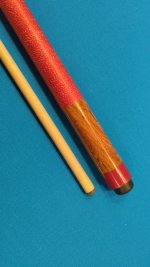
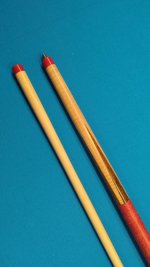
I think the piece of oak matters too as far as how attractive. This is a cue I finished up not too long ago that I used an old old root burl I found in the woods around my house. I talked about it in the Wood porn Monday thread. It is a little more porous and I even should have done another coat or two a finish, but my first experiment with using it.
Enjoy using it to learn. Definitely try to use parts that have tighter grain to avoid splintering and finish problems. Good luck.
Enjoy using it to learn. Definitely try to use parts that have tighter grain to avoid splintering and finish problems. Good luck.