Creating Pool Room Unknowns

BeastBilliards

New member
I am closing in my two car garage for a 9 ft pool table. I wanted to see if anyone else had done this and had any pitfalls or suggestions they have may have to help me make it the best pool room possible. Things that most people do not think about like double electrical outlets, flooring types, wiring concerns etc.
Thank you in advance.
 
I am closing in my two car garage for a 9 ft pool table. I wanted to see if anyone else had done this and had any pitfalls or suggestions they have may have to help me make it the best pool room possible. Things that most people do not think about like double electrical outlets, flooring types, wiring concerns etc.
Thank you in advance.
Depending on where you live, flooring choice, wall insulation, airflow, natch light, direction you place the table,
all are considerations unless you want to play on a diff table every time the weather turns.
If in a humid part of the country, dehumidifiers are an absolute necessity, irregardless of the HVAC you have. With the new LED lighting, wiring is a non issue. Avoid thick carpet. Holds heat and moisture. Put a Tyvek sheet under Modular flooring. 👍🏻
Good luck and what's your address again??😉
 
Number one thing you have to do is seal off the edges and floor around the roll -up garage doors. You need to get garage door floor and wall seals off Amazon. They go on the outside wall up against the flashing on the side and top. The floor ones are extra squishy and the door settles down on them eliminating any airflow under the door.

All of these are critical to creating a maintaining an environment that won't mess up your rails and cloth.

I use a 7ft valley with Ridgeback Pro rails because I'm in Texas and even with all theae seals and a ductless AC/heat unit it's still not an environment a solid wood table would do well in
 
IMG_5412.jpeg
Garage floors are pitched so vehicle fluids run towards the door. IIRC my town’s spec is 1” every 4’.
My floor must’ve been done by the previous home owner because it’s less than the code. But it is noticeable over 9’.
That’s why I put the table across the 2 car garage.
Blown in insulation in the outer walls. Insulation panels on the doors. Weather strips on the outside.
Floor length curtains not only hide the doors but add a good layer of dead air.
The curtain rods hang on S hooks on the door rails & lift off easily if we need to open the doors.

The flooring is “puzzle piece” gym mat which I like a lot. The concrete was painted with sealer before the floor tiles went down.
After 3 years I plan to take it up and power wash it. Vacuum works but we track in dirt from the side entrance.

Mini split AC/heat rounds it out. Add a dehumidifier for the 70% humidity summers and a humidifier for when it’s cold out. The heat just sucks the humidity away.
IMG_5489.jpeg
 
View attachment 897358Garage floors are pitched so vehicle fluids run towards the door. IIRC my town’s spec is 1” every 4’.
My floor must’ve been done by the previous home owner because it’s less than the code. But it is noticeable over 9’.
That’s why I put the table across the 2 car garage.
Blown in insulation in the outer walls. Insulation panels on the doors. Weather strips on the outside.
Floor length curtains not only hide the doors but add a good layer of dead air.
The curtain rods hang on S hooks on the door rails & lift off easily if we need to open the doors.

The flooring is “puzzle piece” gym mat which I like a lot. The concrete was painted with sealer before the floor tiles went down.
After 3 years I plan to take it up and power wash it. Vacuum works but we track in dirt from the side entrance.

Mini split AC/heat rounds it out. Add a dehumidifier for the 70% humidity summers and a humidifier for when it’s cold out. The heat just sucks the humidity away. View attachment 897360
Address??😉 🙏🏻
 
Unless you remove the garage door and build a wall in it's place, there is no good solution for heating a garage that is cost effective. But then you can't use the door to back in your car and unload groceries. Plus you can buy a faux-leather cover for the table and place 3/4" sanded plywood over the table and use the space for parties/events (which is what I do).

I have a dehumidifier that keeps the humidity around 50%, and it re-stabilizes after a door-opening in about 30 minutes. The garage and the table aren't heated, but since the garage is insulated it doesn't drop below 32F in the middle of the winter. I just wear a hat and a sweatshirt during those months, and live with the change in table conditions. I can't justify losing the garage door and paying $40 to $100 to heat the table and/or the garage.

If you do remove the door, and both your slab and walls and ceiling are insulated, I'd suggest a split unit running off of propane. Just know that garages are notoriously difficult to heat in usual circumstances, and that's why I don't even bother.

1776261138183.png


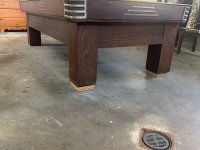
For the slope, we just added blocks to one end of the table.
 

Attachments

  • IMG_2026-04-16-114042.jpeg
    IMG_2026-04-16-114042.jpeg
    260.2 KB · Views: 5
Last edited:
Just understand most garages slope 11/2" for every 20 ft. So, you'll have one end higher than the other. The type of table may be impacted by this. For example GC1s and earlier Brunswick models along with 3C tables did not have legs that had adjustable footings.
 
I did a whole write up on this:

 
Garage Door
1. Replace the rubber strip on the bottom of your door.
2. Add outside weatherstripping around the door.
3. Add inside weatherstripping glued to the top of the door and bottom of the door.
4. Tighten your door to the wall (loosen a few bolts and push it as close as possible.
5. Add that extra rubber strip on the ground.
6. Remove your overhead garage door opener and install a jack drive model.
7. Insulate the garage door itself with a corning product. I sealed all of the gaps in my door and filled in the holes with insulation. I used paint sticks to hold the corning product in on the sides.
8. Curtains help to hide the door and to create another insulation barrier. My curtains run on a track like on a hospital. They can be circled around the couch that folds into a bed. That also allows me to pull them around and open the door without having to remove them. (Each panel was about $10 at IKEA).
9. Use spray foam and rope caulk to fill in any gaps around the bottom sides of your door.

Foor
1. I epoxied mine. Paint or those foam squares are also cool.

Table:
I used a round wood riser to offset the lower side of the table.

Room:
1. Minisplit A/C. I run that thing all summer for about $.25 a day. I added an aftermarket smart thermostat/remote that will automatically run the thing to dry out the room. Plus, I can control it via my phone or my voice (via Alexa).

Lights:
1. I love my stadium lights.

My garage pics

 
Just understand most garages slope 11/2" for every 20 ft. So, you'll have one end higher than the other. The type of table may be impacted by this. For example GC1s and earlier Brunswick models along with 3C tables did not have legs that had adjustable footings.
Shims??
 
Garage Door
1. Replace the rubber strip on the bottom of your door.
2. Add outside weatherstripping around the door.
3. Add inside weatherstripping glued to the top of the door and bottom of the door.
4. Tighten your door to the wall (loosen a few bolts and push it as close as possible.
5. Add that extra rubber strip on the ground.
6. Remove your overhead garage door opener and install a jack drive model.
7. Insulate the garage door itself with a corning product. I sealed all of the gaps in my door and filled in the holes with insulation. I used paint sticks to hold the corning product in on the sides.
8. Curtains help to hide the door and to create another insulation barrier. My curtains run on a track like on a hospital. They can be circled around the couch that folds into a bed. That also allows me to pull them around and open the door without having to remove them. (Each panel was about $10 at IKEA).
9. Use spray foam and rope caulk to fill in any gaps around the bottom sides of your door.

Foor
1. I epoxied mine. Paint or those foam squares are also cool.

Table:
I used a round wood riser to offset the lower side of the table.

Room:
1. Minisplit A/C. I run that thing all summer for about $.25 a day. I added an aftermarket smart thermostat/remote that will automatically run the thing to dry out the room. Plus, I can control it via my phone or my voice (via Alexa).

Lights:
1. I love my stadium lights.

My garage pics
I'll pay for that address!!😉
 
Back
Top