
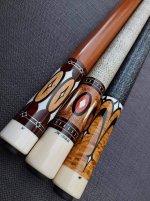
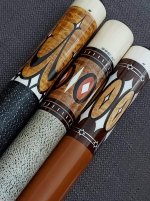
3 big Joss West Cues
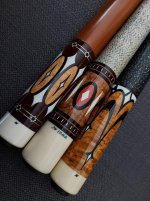
The 1st cue from the left was made for Bob Price for the 1st ICS show in Ruidos in NM in 2002 and is absolutely gorgeous, unique and highly collectible.
I am happy and proud that this cue has ended up in my collection!
This is another classic Bill Stoud creation. Custom made for a collector and hand delivered by Bill at the first International Cue Collector Show in Riudoso, New Mexico in 2002. Remarkably, it has been locked away all these years and is still unplayed and unchalked.
It's a six-point snakewood and maple cue with ivory inlays and silver ringwork. According to the original accompanying letter from Bill, it was his "first true 4th axis cue with parallel wall points made."
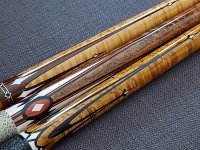
This is a rare one. Just think ... Bill Stroud's first 4th axis cue made in this kind of design. It was the beginning of one of his greatest influences on the future of cue building. And, it is simply a gorgeous cue. It has six gracefully curved snakewood points with a single black veneer in a curly birdseye maple forearm.
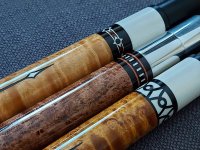
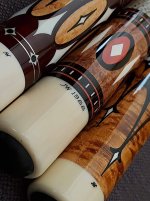
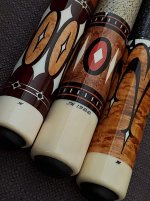
He built a snakewood butt sleeve with six birdseye maple oval windows veneered in black, with two large ivory spearheads between each oval.
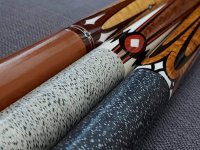
The ringwork in all locations (ABCDE) is an original Josswest design - a snakewood band bordered with silver, inlaid with six ivory Tiffany diamonds inset with an ebony dot. The rings at the joint on the shaft ring collars is set in black phenolic.
The design of this butt sleeve is sheer beauty. It all comes together beautifully. It is filled with work, yet doesn't look overly busy.
As always, Bill's work is cleverly designed and expertly executed. His work was always clean and tight. Because of his disciplined construction techniques and his tight tolerances, his cues always played "jam up."
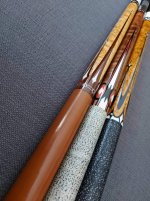
He finishes this beauty off with a smooth caramel brown calfskin leather wrap. It is the perfect final touch in bringing this whole masterpiece together.
The butt cap is solid ivory and it is reinforced with black linen phenolic, helping to seal the end of the cue. His logo at the time is engraved in this cap.
It is built with his favorite joint from this time period - a "thin-walled ivory joint collar reinforced with black linen phenolic." He had been making his ivory joints this way since about 1995. It has a stainless steel radial pin, and as Bill said, with a "3/8X7.6 thread.
This is a Josswest classic. It comes with two 13mm shafts with ivory ferrules and probably LePro tips. It weighs 19.8 ounces.
This cue in the middle is very unusual and rare find.
The last cue Bill made in Austin before he moved to New Mexico. One of the first two 4 axis cues he made. The swooping ebony points that go around the cue are one continuous piece of ebony. You wouldn't see this very often and it is highly complex to be done and takes lots of efforts.
Ivory joint, butt cap and ferrules.
Amazing and unique cue.
Very unusual, complex joint collars.
A stunner, one of a kind cue.
Never chalked!
The 3rd cue from the left:
I am very happy I was able to add this cue to my collection. Not only that this cue is rare find but it is a cue in timeless design that has lots of impact on all future and current designs.
This is "golden oldie" - a vintage creation from Bill Stroud. Built in 1988, I found this cue in a private collection. It is still unplayed and in "new' condition. It is about as mint as a cue of this age can be - still unplayed and even unchalked.
Having been a player, and then a collector, for many years before I got into the cue business, I always followed and admired the work of Bill Stroud. He was perhaps the greatest innovator in the industry, and his magnificent designs seemed to be endless.
It's a design that can be considered a "native American", but not necessarily so. If you're looking for a Native-American design, that's the way you'll see it. If not, you might not make that connection. Either way, it's a gorgeous, bold design that jumps out at you across the room.
It is a stained maple cue. In the nose are long pure ivory points with pink ivorywood ovals tied together with inlays of ebony. The butt sleeve is also maple, circled with ebony ovals that are inlaid with ivorywood ovals, and finally ivory diamonds inlaid in the middle of those. Then, all of that is framed between two complex ring sets. It's a terrific design.
This pattern around the base of the points is really clever. It almost looks like it was built in one piece and then stretched over the cue and popped into place. The inlay work is so good that it's difficult to see that it's a series of highly coordinated inlays.
This cue is a rare find. Stroud's cues have greatly increased in value, and will probably continue to do so. They are about as good an investment as you can find in the cue world.
Enjoy the pics!
The 1st cue from the left was made for Bob Price for the 1st ICS show in Ruidos in NM in 2002 and is absolutely gorgeous, unique and highly collectible.
I am happy and proud that this cue has ended up in my collection!
This is another classic Bill Stoud creation. Custom made for a collector and hand delivered by Bill at the first International Cue Collector Show in Riudoso, New Mexico in 2002. Remarkably, it has been locked away all these years and is still unplayed and unchalked.
It's a six-point snakewood and maple cue with ivory inlays and silver ringwork. According to the original accompanying letter from Bill, it was his "first true 4th axis cue with parallel wall points made."
This is a rare one. Just think ... Bill Stroud's first 4th axis cue made in this kind of design. It was the beginning of one of his greatest influences on the future of cue building. And, it is simply a gorgeous cue. It has six gracefully curved snakewood points with a single black veneer in a curly birdseye maple forearm.
He built a snakewood butt sleeve with six birdseye maple oval windows veneered in black, with two large ivory spearheads between each oval.
The ringwork in all locations (ABCDE) is an original Josswest design - a snakewood band bordered with silver, inlaid with six ivory Tiffany diamonds inset with an ebony dot. The rings at the joint on the shaft ring collars is set in black phenolic.
The design of this butt sleeve is sheer beauty. It all comes together beautifully. It is filled with work, yet doesn't look overly busy.
As always, Bill's work is cleverly designed and expertly executed. His work was always clean and tight. Because of his disciplined construction techniques and his tight tolerances, his cues always played "jam up."
He finishes this beauty off with a smooth caramel brown calfskin leather wrap. It is the perfect final touch in bringing this whole masterpiece together.
The butt cap is solid ivory and it is reinforced with black linen phenolic, helping to seal the end of the cue. His logo at the time is engraved in this cap.
It is built with his favorite joint from this time period - a "thin-walled ivory joint collar reinforced with black linen phenolic." He had been making his ivory joints this way since about 1995. It has a stainless steel radial pin, and as Bill said, with a "3/8X7.6 thread.
This is a Josswest classic. It comes with two 13mm shafts with ivory ferrules and probably LePro tips. It weighs 19.8 ounces.
This cue in the middle is very unusual and rare find.
The last cue Bill made in Austin before he moved to New Mexico. One of the first two 4 axis cues he made. The swooping ebony points that go around the cue are one continuous piece of ebony. You wouldn't see this very often and it is highly complex to be done and takes lots of efforts.
Ivory joint, butt cap and ferrules.
Amazing and unique cue.
Very unusual, complex joint collars.
A stunner, one of a kind cue.
Never chalked!
The 3rd cue from the left:
I am very happy I was able to add this cue to my collection. Not only that this cue is rare find but it is a cue in timeless design that has lots of impact on all future and current designs.
This is "golden oldie" - a vintage creation from Bill Stroud. Built in 1988, I found this cue in a private collection. It is still unplayed and in "new' condition. It is about as mint as a cue of this age can be - still unplayed and even unchalked.
Having been a player, and then a collector, for many years before I got into the cue business, I always followed and admired the work of Bill Stroud. He was perhaps the greatest innovator in the industry, and his magnificent designs seemed to be endless.
It's a design that can be considered a "native American", but not necessarily so. If you're looking for a Native-American design, that's the way you'll see it. If not, you might not make that connection. Either way, it's a gorgeous, bold design that jumps out at you across the room.
It is a stained maple cue. In the nose are long pure ivory points with pink ivorywood ovals tied together with inlays of ebony. The butt sleeve is also maple, circled with ebony ovals that are inlaid with ivorywood ovals, and finally ivory diamonds inlaid in the middle of those. Then, all of that is framed between two complex ring sets. It's a terrific design.
This pattern around the base of the points is really clever. It almost looks like it was built in one piece and then stretched over the cue and popped into place. The inlay work is so good that it's difficult to see that it's a series of highly coordinated inlays.
This cue is a rare find. Stroud's cues have greatly increased in value, and will probably continue to do so. They are about as good an investment as you can find in the cue world.
Enjoy the pics!
Attachments
-
 received_550090440134547.jpeg223.6 KB · Views: 183
 -
 received_542181237633774.jpeg241.1 KB · Views: 181
 -
 received_1425709654578491.jpeg302.5 KB · Views: 179
 -
 received_1094860604777483.jpeg170.2 KB · Views: 180
 -
 received_371752438232090.jpeg249.8 KB · Views: 188
 -
 received_420214983374946.jpeg180 KB · Views: 163
 -
 received_1388414804977528.jpeg206 KB · Views: 153
 -
 received_1402920726856976.jpeg265.8 KB · Views: 167
 -
 received_778701053488494.jpeg240.3 KB · Views: 160
 -
 received_560762872398199.jpeg148.3 KB · Views: 200


