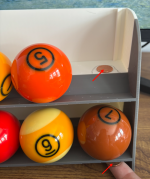
Local room owner asked me to make a one pocket ball holder that the fans can see what the score is on a feature table. We worked together through many iterations to come up with this design. The wooden shelf and black square panel were existing to the room, and the owner wanted the ball holders integrated into them.
It took a LOT of iterations of different concepts and print trials. One of the bigger challenges was to make it in two pieces so it fits on the printer, but with the seam smooth enough that the balls roll well on it.
From the front view, its sloped 2 deg so the balls all roll to the left.
From the side view, it's sloped 4 deg, so the balls roll towards the front. This allows stacking a second row on top once a player has 8, for handicapped games.
The joining method of the two halves had to be really strong, and not interfere with the balls rolling.
The print took a LONG time. 30 hrs for one player's score. Adding the numbers accounted for probably half of that time. I really wanted the numbers, the owner was ok without them. This material was wood based so they match the shelves better. It's the first time I used this material, and it actually smelled like sawdust while printing. There is also a texture applied so the quality looks better.
I tried to print it with the numbers pointing up, which would have reduced the print time a ton. But I couldn't get the lap joint to be perfect that way, even with support. This way is the strongest orientation anyway, so I went with it.
There is a lap joint to keep alignment and strength. I was going to glue in addition to screw, but decided on screw only.
Heat-set inserts for the screws.
It took a LOT of iterations of different concepts and print trials. One of the bigger challenges was to make it in two pieces so it fits on the printer, but with the seam smooth enough that the balls roll well on it.
From the front view, its sloped 2 deg so the balls all roll to the left.
From the side view, it's sloped 4 deg, so the balls roll towards the front. This allows stacking a second row on top once a player has 8, for handicapped games.
The joining method of the two halves had to be really strong, and not interfere with the balls rolling.
The print took a LONG time. 30 hrs for one player's score. Adding the numbers accounted for probably half of that time. I really wanted the numbers, the owner was ok without them. This material was wood based so they match the shelves better. It's the first time I used this material, and it actually smelled like sawdust while printing. There is also a texture applied so the quality looks better.
I tried to print it with the numbers pointing up, which would have reduced the print time a ton. But I couldn't get the lap joint to be perfect that way, even with support. This way is the strongest orientation anyway, so I went with it.
There is a lap joint to keep alignment and strength. I was going to glue in addition to screw, but decided on screw only.
Heat-set inserts for the screws.
Last edited: