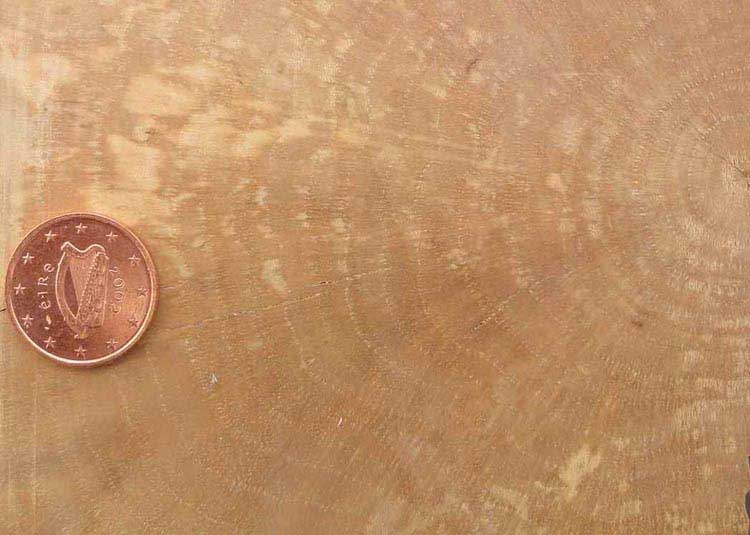
ash wood maple wood

Paul:

I would say hickory would be an excellent choice for the forearm (and buttplate) of a cue. Pretty much anywhere in the butt, with the proviso that the cuemaker balance the cue correctly, because remember -- hickory is VERY heavy (heavier than purpleheart, even though purpleheart scores very slightly higher on the Janka test). You might think about coring the cue with maple, and use hickory as a "shell" or jacket, because I think a solid piece would be just too heavy (and if used only in the forearm, would throw the balance point of the cue w-a-y far forward than expected).

Interesting side story about hickory:

We had two instances with storms ripping down trees in the last couple of years -- first, an F-1 tornado (rare in these parts), and then superstorm Sandy. During both, we had a couple hickory trees pulled down, and Lisa and I were out there for days cutting 'em up and splitting firewood. With the electricity out, hickory taught me how to quickly field-sharpen my chainsaws using a Granberg jig. In all my years of woodsmanship (including being an apprentice for my Dad, who was an arborsman / tree surgeon on the side), I never had to do that before. I couldn't believe how resistant to cutting this wood is.

EDIT: Also, I was cutting one particular tree that was laying over a flowing stream (approximately 2 feet deep), and the pieces were going right to the bottom -- hickory sinks!

And then, splitting hickory is an experience. In an electric or engine splitter, at first, it looks like the blade isn't even penetrating the end of the log, and you hear the hydraulic pump start to strain. But then as the pressure ramps up, it lets go with a loud BANG. I mean, the log explodes! We learned quickly to not stand to the sides of the splitter, lest you get whacked with these really heavy (and sharp!) pieces that would definitely send you to the hospital. We couldn't believe how heavy this wood is, too. I was always brought up to believe that Oak was the hardest of the commonly-available hardwoods. That belief was shattered when I encountered hickory for the first time.

I can see why hickory is no longer used for baseball bats, because it's just too damn heavy. And, why we no longer have baseball players the caliber of Babe Ruth or Mickey Mantle -- swinging hickory like that tends to make you into a different player. ;)

-Sean

Your information about the density of hickory is wrong. Hickory dry weight published numbers are 48-52 pounds per cubic foot. Purpleheart is heavier, usually mid to high 50's. Hard maple isn't really all that far behind hickory at 44 pounds per cubic foot.

Many woods used in cues are heavier than hickory. Most rosewoods are, the already mentioned purpleheart, bocote, bloodwood to name a few. A solid hickory forearm would not throw the balance way forward.

Your piece of hickory you cut sank because it was green.
 
PT109, that is really good information and if i am correct Ronnie O'Sullivan who has won more snooker then Kenyon else and holds several titles uses an ash Snooker cue. I am going to have an ash shaft made for my cue and try it out.

Played with an cue that had two ash shafts, one conical (European), one problem tapered. Both didn't deflect much and had fibre ferrules. The pro tapered shaft felt funnier than hell in the hands due to the prominent grain.

BTW Stephen Hendry's cue when he won the vast majority of tournaments was maple.
 
Interesting observations.

FWIW many dense hardwoods sink when green, including red oak. However, neither hickory nor oak will sink in water once dried. Shagbark hickory has a SG of around .80 at 12% MCdb compared to hard maple or BEM at around .72 (SG of water is 1.0 by definition), so there is only a 10% difference in density between the two woods. Adding a stainless steel joint would have a much bigger effect on cue balance IMO.

Here's some pretty special fiddleback pignut hickory I saved from my firewood pile many moons ago. In over 25 years of cutting firewood (maybe 150 full cord of hardwood) I've never seen hickory with this much figure, so I just had to save it for something.

It's been air-drying for several years now, and will likely end up as cue forearms and butt sleeves once I get set up for cue making. I'd be real interested in your opinion about how it plays once I get one togethter.

Thanks for this! I did notice that after seasoning in the firewood pile for one full season, the hickory did lighten up quite a bit (although most of it got burned that season, since it was one of the coldest winters in recent memory). So it definitely looks like a case of hickory having a lot of water content when green.

That hickory my wife and I cut was indeed shagbark hickory by the way. The bark was curling away from the trunk in huge shards. (The bark especially smelled wonderful when burned. ;) I hear/read that there's a version of hickory syrup made from shagbark hickory? Will have to try to find it.) Also, the pieces had a sharp red/white contrast between the heartwood and sapwood.

Thanks for those pics of your fiddleback pignut hickory, btw. Indeed, the figuring in those pieces is wonderful -- I like the contrast between the heartwood and sapwood and the rolling/curling effect over both! Those will make some wonderful looking forearms and buttsleeves for sure -- would love to be a fly on the wall when you finally cut into those pieces with your lathe, and watch what gets revealed. Yep, I am interested!

Thanks again,
-Sean
 
I lost a hickory tree recently too.

It was fun getting it all cut up and split, but it sure does smell good in the wood burner.:thumbup:

Oh, absolutely! The trees my wife and I cut up turned out to be shagbark hickory, and the bark especially must've had a very high sugar content, because it was a real treat throwing shards of the bark [that fell off during cutting] into the fire. Man! The aroma filled the whole house.

When storms rip through here, all manner of trees unfortunately get ripped down. Some do not smell so good in the fire (e.g. sumac [although fun to burn because of the loud popping and snapping]); others are a treat to remember. That hickory was indeed one of the high points (as was birch, which we have a lot of around here as well).

-Sean
 
great information Sean,

Some of the information I gathered cam right from the http://www.slugger.com/bats/ website about there bats and looking at each bat they make ash/maple and there woods.

WOOD BASEBALL BATS
ASH
A lighter, more flexible timber than maple bats, ash bats give a wider range of large barrel models and a larger, more forgiving sweet spot that results in less breakage. Ash is the timber of choice for many MLB sluggers.

WOOD BASEBALL BATS
MAPLE
Maple's dense, hard timber makes it a powerful bat less prone to flaking and one, many players say, that improves their performance in the batter's box. Slugger's maple bats are built for power and performance, and many of the MLB's biggest hitters prefer them.

MLB PRIME
We rebuilt our bats from the ground up with old-school methods and cutting-edge technology. We start with the best-quality veneer wood on the market and use Amish square-cut craftsmanship, a 360-degree compression process superior to bone rubbing, and an advanced finishing system that guarantees 9H hardness – the highest rating available on the 21-level universal hardness scale. MLB Prime is the only bat available to the public that is the exact same bat used by the pros.

Which is what you get in both ash and maple. http://www.slugger.com/bats/technology/default.aspx

No problem -- glad to share.

A lot of that info you copy/pasted from the website is marketing. Notice how both descriptions "walk both sides of the fence" and avoid undue competitive comparisons with each other (i.e. no final result as to "who's best").

Ash's problem in wooden bats is that flaking they mentioned. If the bat is from quarter-sawn (or equivalent) wood, the bonding between the layers is not so good, and it tends to let go -- releasing flakes of wood, leaving a flat section on the bat where the flake came off. Maple doesn't do that (not nearly as much, anyway) and when it breaks, it breaks cleanly. The problem with maple, though, is how they cut bats these days -- with a thicker "club" and thinner handle than the old days. So when maple fractures cleanly -- usually at the handle -- you get a whole section of the bat flying at other players or even into the crowd, with an extremely sharp spear-shaped section where it broke. Think of an axe-head that has flown off of its handle mid-swing -- yowza!

-Sean
 
Your information about the density of hickory is wrong. Hickory dry weight published numbers are 48-52 pounds per cubic foot. Purpleheart is heavier, usually mid to high 50's. Hard maple isn't really all that far behind hickory at 44 pounds per cubic foot.

Many woods used in cues are heavier than hickory. Most rosewoods are, the already mentioned purpleheart, bocote, bloodwood to name a few. A solid hickory forearm would not throw the balance way forward.

Your piece of hickory you cut sank because it was green.

I'm not a cuemaker, so I admit my knowledge of the intricate properties of wood (especially when worked, as you do on a daily basis) is not as strong. As mentioned in a previous post, I did notice that when dried/seasoned, the pieces of hickory were noticeably lighter, which obviously speaks to the water content. However, the Janka test speaks to seasoned hickory's toughness, and it's easily on par with (exceeding, in some cases) the toughness of the rosewoods you mentioned -- including rosewood itself.

Good to hear that hickory won't throw the balance as much as I thought it would. It would be interesting to see a cue made from it, especially if it has nice figuring as the post from Sloppy Pockets above shows.

Thanks for setting me straight on the density of hickory compared to other woods used in cues.
-Sean
 
So what do you think about Hornbeam being used in Russian billiard cues and by AZB's own, DBK?

In between Ash and Hickory on the janka scale.

I've seen Hornbeam, and it's a pretty wood -- love the figuring, especially if cut cross-grain. Cues made from it are especially interesting when used with a contrasting darker wood.

hornbeam_end.jpg

-Sean
 
Last edited:
Oh, absolutely! The trees my wife and I cut up turned out to be shagbark hickory, and the bark especially must've had a very high sugar content, because it was a real treat throwing shards of the bark [that fell off during cutting] into the fire. Man! The aroma filled the whole house.

When storms rip through here, all manner of trees unfortunately get ripped down. Some do not smell so good in the fire (e.g. sumac [although fun to burn because of the loud popping and snapping]); others are a treat to remember. That hickory was indeed one of the high points (as was birch, which we have a lot of around here as well).

-Sean

Shagbark is awesome stuff! Yeah, it dulls a chain fast, especially in high wind areas where sand and dirt get blown into that shaggy bark and acts like a course abrasive on the cutter edges. Same problem with black locust bark. I've seen huge sparks jumping out of locust I was bucking up, then suddenly it's off to grab a file.

Here's a link to a tutorial for making hickory bark syrup.

http://davescupboard.blogspot.com/2011/01/making-shagbark-hickory-syrup.html

The sap doesn't flow up and down each day the way maple sap does in the spring, but you can flavor sugar syrup with it and it is supposed to be delightfully good. On a lot of the pignut and bitternut I've cut and split I'd see beads of sap form on the ends of the sapwood. I've gotten more than one strange look from somebody who caught me licking the split ends to get the hickory sap sugar, but it was worth it because it's so freaking tasty. Lol

Another interesting high-density eastern hardwood is black (sweet) birch. It smells just like wintergreen when you cut it, and it's right up there with hickory in density. Burns like gasoline in a wood stove, too, even when it is wet. I posted a burn I did in my old Vermont Castings on a stove forum a few years back. I started the fire from scratch with black birch that had been cut and stacked just two days before. I got the stove up to over 700ºF from a cold start in about 45 minutes, with not a trace of smoke coming out the top of the chimney.

Black birch sapwood is creamy white and very straight grained. I'm gonna try to get some logs long enough for shafts and see how that goes. Who knows? Maybe the new Holy Grail woods for cue making are sitting right there in our firewood piles.:cool:
 
Black birch sapwood is creamy white and very straight grained. I'm gonna try to get some logs long enough for shafts and see how that goes. Who knows? Maybe the new Holy Grail woods for cue making are sitting right there in our firewood piles.:cool:

Wow!!!....that explains a lot to me.
Bill Werbenuik was number 8 in the World Snooker ranking in the early 80s....
...he had the most powerful draw stroke of all the snooker pros.

He used a birch shaft.
I've always thought birch to be light and weak.
Thanx for this info, sir.

Should be well worth making some shafts.
 
Back
Top