Cue dimensions?

Thread pitch and tolerance can be found on-line.

For a 3/8-10 (which is unusual outside cue making), you may have to use a 3/8-16 and 'fudge' the rest. But, if you are making everything, you can make it any way you want- say an Acme thread for example if you wanted, because you are also making the mating thread...:wink:
 
I was gong to make everything but now am not. I think im just going to use one of my mcdermott shafts I have for it. I been trying to find the specs on the thread size but having no luck.
 
You may want to mke a quick seperate post, with reference to this one, regarding McDermott thread dimensions.

If I remember correctly, it is either 5/16-18 or 5/16-14.

You could also measure the thread diameter and put a thread gage on it...

You will also need to get the pilot dimeter correct- measure the OD of the shaft pilot and add 0.003" or so for a slip fit.
 
Actually its the 3/8-10 thread with the mcdermott shaft and no pilot on it. I start a new thread here and ask if anyone knows.
 
Shows how much I know about McDermott cues...:rolleyes:

That general description of "3/8-10" can include radial root threads as well as standard threads and Acme.

best bet to get specifics from someone who is familiar with that exact thread...:wink:
 
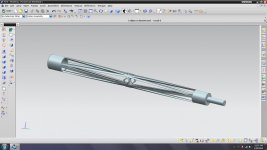
Just posted a new thread asking the specs. Here is what I have so far for the forearm. Its not final, but open to suggestions.
 

Attachments

  • forarm.jpg
    forarm.jpg
    92.3 KB · Views: 178
I like the idea of 'skeletonizing' the forearm. Good idea, and form folows function...
 
I like the idea of 'skeletonizing' the forearm. Good idea, and form folows function...

Thanks for the praise. Now im trying figure out the handle. I want to put leather over it but I still need to make it light. so im thinking of milling slots the length of it to make it lighter.
 
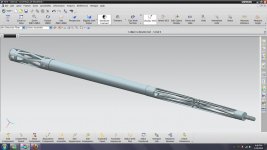
Carbon tube would be nice but I have no carbon experience. Heres an updated pic of the cue.
 

Attachments

  • cue.jpg
    cue.jpg
    94 KB · Views: 187
Carbon bonds well to Aluminum; particularly if you keep it clean and dry.

A lot of bonded bike frames are having problems because of oxide forming at the glue line, and then the frame 'fails' due to atmospheric contamination (IE salt, water mud etc.).

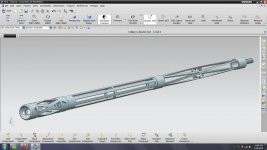
Magnesium is far more active, and therefore more likely to oxidize. Based on your drawing, I think you may have to reduce a lot of weight from your handle area- which you may have done internally (butting, as discussed) that is not visible in your pictures.

What is your center of gravity and overall weight of the but at this time?

What might be a good idea (and you have to research this) is to cut threads on your components, have then all hard anodized and then assemble them (with a good aircraft epoxy such as MasterBond EP-15). It is an oven cure epoxy but since everything is metal, it shouldn't matter.
 
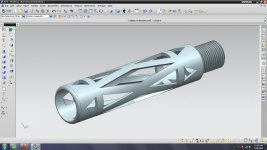
Heres some pics of showing the whole cue. Its all threaded with a 7/8-14 thread. All of it is hollowed out. Not sure on the center of gravity. Dont know how to check that on here. Open to suggestions on modifications.
 

Attachments

  • Sleeve.jpg
    Sleeve.jpg
    93 KB · Views: 120
  • Handle.jpg
    Handle.jpg
    94.6 KB · Views: 136
  • forarm.jpg
    forarm.jpg
    95.1 KB · Views: 130
  • Cue.jpg
    Cue.jpg
    94.2 KB · Views: 126
Looks cool!

Is there any way to get CoG through the Analysis pull down?

I don't use that (or any other 3-d program for that matter) but the full time draftsman use Inventor here and you specify the materials and it gives you all that information if you ask for it...
 
ill check into it. I think that I have removed alot of weight by boring it out. Still have to notch the butt sleeve to accept a mcdermott push in bumper. But have to find some dimensions for that. Thanks for your input. Do you think the forarm will be weak witht the thin ribs? I think by puting the leather wrap on you wont even be able to tell that it was milled underneth. I might even widen all the butt sleeve cuts to make it lighter.
 
The ribs do look a bit spindly on the forearm; and that area should be stiff and strong.

You can always drill holes (straight or angled for an 'oval' hole) to create 'trim rings' at various positions as well...
 
You might save some weight if you could mill the whole thing out of one piece.
The length might be troublesome though, depending on your equipment.
 
Yeah if it was one piece I could mill the joint areas too. But the equipment at the school wouldnt be capable of boring it out. The forarm was a consern that im going to have to look at again. Instead of making the ribs wider, I could also make the bore smaller that way each rib is thicker.
 
I just did a weight analysis and total weight is .54 lbs. So its probably close to 9-10oz. With 6061 aluminum
 
Back
Top