Dime shape/Nickel Shape tips....

GordonRamsay

Snooker > Pool
Silver Member
as funny and ridiculous as this sounds.. what exactly does Dime/nickel shape refer to??? and what is the difference/benefits?

 
GordonRamsay said:
as funny and ridiculous as this sounds.. what exactly does Dime/nickel shape refer to??? and what is the difference/benefits?
First!

-td

[do a search, please - lots of info on this]

http://forums.azbilliards.com/search.php?searchid=2134707

EXACT SEARCH TERMS IN TITLE: "DIME NICKEL" -> one thread is 5 years old...

Search.JPG
 
Last edited:
As a British ex-pat who also converted from Snooker to Pool I feel your pain. Yes, there is a search function here but it is often useless. (It won't let you search for any word less than 4 characters like "Cue") It never ceases to amaze me how such a sport with such simple parameters can have such different terminology on either side of the Atlantic.

This term refers to measuring the circular profile of the tip of a cue by the radius of either a nickel or dime coin. (Remember the dime is the smaller, so has a narrower radius. The idea is to hold the coin up to the tip to determine which it is. I'd recommend you start with a nickel (the wider profile) if you have a shaft 12.75mm or larger. If you have something 12.5mm or smaller try the dime radius.

You may also find that, if you use a lot of Side/English, a nickel radius gradually gets worn into a dime radius over time.
 
GordonRamsay said:
as funny and ridiculous as this sounds.. what exactly does Dime/nickel shape refer to??? and what is the difference/benefits?

The most common curvature (radius) for the shape of a tip is about the same as the curvature of the edge of a dime, nickel or quarter. That's because a radius of that size with a width of 3/8" to 1/2" (the width of normal pool cues) corresponds to an arc of about 60 degrees, which is the minimum arc you need in order to be able to put maximum spin on the CB without hitting right on the edge of the tip.

There are no real benefits between the two (dime shape vs. nickel shape) - they're too close to each other for that to matter much. It's a matter of habit and personal preference.

pj
chgo
 
AuntyDan said:
You may also find that, if you use a lot of Side/English, a nickel radius gradually gets worn into a dime radius over time.

I've always experienced it the other way round.
 
with a higher radius you get more action and as said before when you use side english less chance of miscues.
 
The dime and nickle radius measurments will not work for every tip. The smaller the diameter of the tip the smaller the radius needs to be. The reason is on a 14mm out on the edge of a nickle radius it is curving down about right. But on a 12mm tip a nickle radius has almost no roundness on the outside edge of the tip and will give very little English on the cue ball. On a 12mm tip I think a dime is still not enough radius. So I don't use preset tip shapers when installing tips for that reason.
 
i dunno i was told that efren shoots with a flat tip and so do a few people that i know and i can still put a lot of english on it i think it might be a lil more on the personal prefrence side
 
on a 12mm tip a nickle radius has almost no roundness on the outside edge of the tip and will give very little English on the cue ball.
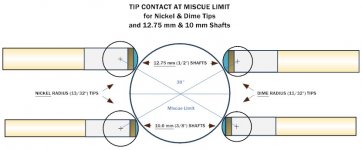
This just isn't true. Here's a graphic that shows a nickel shape can produce maximum sidespin with a tip as little as 10mm wide.

Tips Shafts & Miscue Limits.jpg

pj
chgo
 
Last edited:
Patrick Johnson said:
...Here's a graphic that shows a nickel shape can produce maximum sidespin with a tip as little as 10m wide...
Great diagram!

The 10mm shafts look a little iffy when you consider that the cueball will rotate something like an additional 7-9 degrees on a brisk hit at 1/2R. This is figured for a cueball speed of 8 mph and plausible contact times of 1.5 or 2 millisecs, respectively. It doesn't appear as if there would be much tip left on the ball, if any, near the end of impact.

It looks though that you're interpreting 1/2R as the final offset limit (approx.) As such, contact would have to be initiated at about 2/5R for the 8 mph shot. As your diagram illustrates, thicker shafts can do a little better in that respect, although, admittedly, you're playing with fire.

Jim
 
Jal said:
Great diagram!

The 10mm shafts look a little iffy when you consider that the cueball will rotate something like an additional 7-9 degrees on a brisk hit at 1/2R. This is figured for a cueball speed of 8 mph and plausible contact times of 1.5 or 2 millisecs, respectively. It doesn't appear as if there would be much tip left on the ball, if any, near the end of impact.

My 10mm tip works fine at that offset, maybe because compression of the tip "rounds off" the edge on impact.

pj
chgo
 
Back
Top