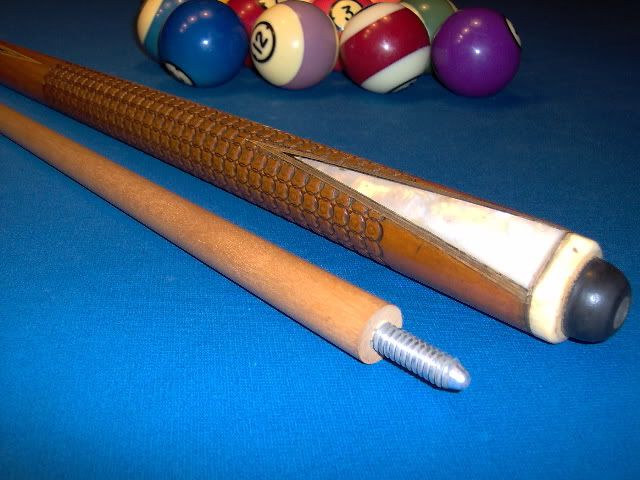
Early Palmer wedge.. interesting

justabrake said:
Hey Joe, what was the reason for the wedge bottoms ?

Steven

The wedge bottom is a take off on the older cues that Brunswick and a few other companies used to make. I have heard a few different reasons, some technical some not, for the wedge. If you ask me though, I think the most popular reason for the pearl wedge was to be able to use it as a name plate. IMHO.

JV
 
Just to add my tuppence.....On early billiard cues and snooker cues from France and England, the wedge is just a carry over from the days when Maces were used. Someone flipped a Mace over to the other end (handle end) and used that for certain shots. Then a chap (who's name escapes me right now) put a piece of leather on it. Cues developed from there but the wedge was left on most cues just in case a shot required it. I have a very old marquetry cue with this same feature.

Modern day cues (by Modern, I mean 1900 onwards) kept this feature for nothing more than asethetics and as Joe says...somewhere to put the company logo. So nearly all modern snooker cues have this wedge.

Si

PS: Joe, I LOVE the Palmer, that is a classic cue with great history. Never felt a Bushka leather wrap.
 
Last edited:
I would also like to add that I believe the wedge was done to remove some weight from the rear of the cue and perhaps to balance the cue out somewhat...just a thought.
 
the flat wedge was cut out so players could lay the cue flat on the table. it was used for shots you could not reach. mostly for billiards and snooker. (bigger, longer tables).

was not for cosmetic use, even though you could dress them up like this.......

(my 26.5 bbc)


262.jpg
 
Chris

With the cosmetics, it wasn't then but it certainly is now. I know all the great UK cue makers personally and every one of them makes a chamfer....not one of them can give another explanation other than a hang over from the olden days...ie, its just what people expect....thats John Parris, Craftsman Cues, Glover Cues etc.

Si
 
i suppose like bogey said.. if you push down the wedge flat it will raise the tip up about center ball..
chris
 
Chris, It's the other way around. I read somewhere that in old days, ladies would turn the cue around, place the flat end on the table and shoot with the butt-end of the cue instead of reaching or bending over the table.
 
What about the blank?

Look familiar? I would have said Spain, UNTIL I was shown the exact same blank and was told, verified, who made it...

JV
 
classiccues said:
Look familiar? I would have said Spain, UNTIL I was shown the exact same blank and was told, verified, who made it...

JV

Here's a page I have worked on to help ID Palmer forearms:

http://www.palmercollector.com/forearms.html

I will be curious to hear this because it is a mystery to me if it's not made by Palmer or a conversion from an older cue. I have a Model 5 from the same time period with the same blank.

Palmer did buy blanks from Spain but not a lot. They had a hard time getting consistent delivery. The Spain forearms are generally very clean, although they were prone to veneer separation over time where the veneers are mitered together at the points because of the nature of the full splice construction.

I took apart a Viking from 1966 and also found the exact same blank. Under the wrap was a "V" splice to the handle, very similar to the splice Joel Hercek uses. The veneers ended under the wrap in a big blunt stack. I sent a pic to Joel and he said Burton did not use this similar splice until much later, and he mitered the veneers so they ended more neatly.

I sent a picture to Peter Balner and he recognized the blank as one that Palmer built in their own shop. They were building full splice blanks similar to the Spain blanks, similar colors, etc. and joined the forearm to the handle with a V splice.

I sent the picture to Viking and they refused to discuss the builder. As ridiculous as this may seem, I concluded that Viking in the early days were using Palmers as a base for some of their cues.

Chris
 
TATE said:
Here's a page I have worked on to help ID Palmer forearms:

http://www.palmercollector.com/forearms.html

I will be curious to hear this because it is a mystery to me if it's not made by Palmer or a conversion from an older cue. I have a Model 5 from the same time period with the same blank.

Palmer did buy blanks from Spain but not a lot. They had a hard time getting consistent delivery. The Spain forearms are generally very clean, although they were prone to veneer separation over time where the veneers are mitered together at the points because of the nature of the full splice construction.

I took apart a Viking from 1966 and also found the exact same blank. Under the wrap was a "V" splice to the handle, very similar to the splice Joel Hercek uses. The veneers ended under the wrap in a big blunt stack. I sent a pic to Joel and he said Burton did not use this similar splice until much later, and he mitered the veneers so they ended more neatly.

I sent a picture to Peter Balner and he recognized the blank as one that Palmer built in their own shop. They were building full splice blanks similar to the Spain blanks, similar colors, etc. and joined the forearm to the handle with a V splice.

I sent the picture to Viking and they refused to discuss the builder. As ridiculous as this may seem, I concluded that Viking in the early days were using Palmers as a base for some of their cues.

Chris


That's pretty neat. I always wondered who made the points for this cue..... How beautiful some of the old vikings really were.
 

Attachments

  • IMAG0835.JPG
    IMAG0835.JPG
    56.5 KB · Views: 232
  • IMAG0836.JPG
    IMAG0836.JPG
    89.9 KB · Views: 297
Mystick Cue Fan said:
That's pretty neat. I always wondered who made the points for this cue..... How beautiful some of the old vikings really were.

I've always liked that particular design of Viking. Viking probably made that one, but there is a lot of crossover. It's like connecting the dots.

The other company that was making a lot of stuff was Mali - they made their own points but I don't know if they sold parts to other companies. I know Viking sold parts later on. Richard Helmstetter was also working for Gordon Hart early on, so he might have been involved in the construction of these early cues. Since Helmstetter and Spain were friends, there is a lot of copying going on back and forth. It is very difficult to tell a Helmsetter forearm from a Spain except for an expert like Joel.

The picture below is the Viking Peter ID'd as a Palmer made cue from the era. It is very distinctive - hard to mistake for something else, considering the look and the "V" spliced handle - very unusual. Maybe they were customizing Palmers at first and selling them, who knows?

Bear in mind this Viking I have is also a 1965/1966 vintage - so that's right at the beginning for them. It is similar to some other models but it hasn't been cut for a ring. Under the warp were hand written notes of a re-wrap done in 1968.

Check out this picture. Joel Hercek was amazed that they used this "V" splice back in the 1960's.


Viking_002.jpg
 
Back
Top