Preshot routine - part II on youtube

randyg said:
Hi Andrew

There are three very distinct eye movements in pool. BEFORE-DURING-AFTER. In school our Instructors focus on what's right for the student.

99% of our students choose #1. Helps focus and aids their stroke naturally.
0% of our students choose#2. Puts too much strain on their eyes and stroke.
1% of our students choose #3. Puts an premium on the longer "pause".

You make mention of the great Allison Fisher. When Allison was in our school she talked with the class about her #3 eye pattern and her longer (than normal) "pause" and how they are related. I did not see any of the other students rush off to copy her. Nor did I see any Instructors try to change her. What is right for one may not fit another.

You guys go fight for the right of the meaning of the term, "pause". We will continue to put out great students who's ability to understand their options of SPF and P.E.P (Personal Eye Movements) make them better players with every stroke.

OPEN MINDS-OPEN DOORS......SPF=randyg

Where are these #1, #2 & #3's?
Thanks,
JoeyA
 
mikepage said:
I suggested four reasons on the video.

1. A pause requires two transitions to/from simple motions instead of one.

2. indeterminate length of time requires another decision on the part of the shooter--exactly when to pull the trigger

3. Going from the paused position to a forward motion compells some players to start with an ever-so-short back segment aka a hitch in the stroke.

4. a pause can mask a problematically quick backstroke

Again, I understand some players need some time in the vicinity of the back of the backstroke to change focus or whatever. I'm saying you can get that without the pause. Essentially you need to "turn the corner" ON your rythmic backstroke motion. You actually spend a fair amount of time in the vicinity of the all-the-way-back position.

If this is not enough time for you, try a slower basckstroke motion. This will give you more time.

I know there are many very successful players that have incorporated real pauses. I'm not suggesting anybody change what works. But what I'm suggesting is, I believe, the best way to teach a good stroke.

----------------------------
It also seems at least for me that the Pause at the end of the backstroke requires the muscles to hold the cue in the air for that length of time and that it is possible that as the muscles hold the cue instead of allowing the cue to find it's center of gravity a person may be inclined to hold the cue upward and thereby possibly pull the cue off line.

The slow backstroke is critical whether you pause or not. I have tried the pause and the no pause and it seems that the no pause but SLOW, BACKSTROKE AND SMOOTH FORWARD STROKE is the key to accuracy (along with the other myriad of things to do. :) )

Each person should practice with and without the pause to see what works best for them, IMO.

JoeyA
 
unknownpro said:
I should've said anytime the shot is not dead straight. If there's a cut involved and you are looking at the contact point you cannot be looking where your tip must go to make the ball. No english - too thick, outside english - way too thick, inside english - too thin. The only way to make the balls with inside or outside when focusing on the contact point is to let the cueball curve. When you are tight and focused and stroke all the way through then you miss because you didn't curve the cueball. Or because you didn't focus on real spot your tip must be going toward, which is the nearest edge of the ghost ball for the english you are using.

unknownpro

Is there a difference between the "nearest edge of the ghost ball for the english you are using" and the contact point on the object ball?
Thanks,
JoeyA
 
JoeyA said:
Is there a difference between the "nearest edge of the ghost ball for the english you are using" and the contact point on the object ball?
Thanks,
JoeyA


YES...randyg
 
JoeyA said:
----------------------------
It also seems at least for me that the Pause at the end of the backstroke requires the muscles to hold the cue in the air for that length of time and that it is possible that as the muscles hold the cue instead of allowing the cue to find it's center of gravity a person may be inclined to hold the cue upward and thereby possibly pull the cue off line.

The slow backstroke is critical whether you pause or not. I have tried the pause and the no pause and it seems that the no pause but SLOW, BACKSTROKE AND SMOOTH FORWARD STROKE is the key to accuracy (along with the other myriad of things to do. :) )

Each person should practice with and without the pause to see what works best for them, IMO.

JoeyA


JoeyA: The Pause is not a time issue, it's a transfer of motion and direction...randyg
 
Originally Posted by JoeyA
Is there a difference between the "nearest edge of the ghost ball for the english you are using" and the contact point on the object ball?
Thanks,
JoeyA

randyg said:
YES...randyg

Well Randy.......

What is it?
JoeyA
 
Not that i know anything hehe..and by the way Mike i enjoyed ur video. It was done very well. I am student of Scott Lee and I have to admit I am partial to the Set PAUSE Finish method. I can tell you from the prespective of a player as to why the pause benifits me. Alot of people have talked about doing several things in one fluid motion..aiming, stroking back and foward...wow...maybe their brain is better at processing that than mine. hehehe

The ability to have the pause at the end of my backstroke allows my mind to switch gears so to speak...and complete the finial part of my stroke which is the excelleration foward and the finish or what we shooters call the follow thru. I used to use the full motion of a backswing right into the foward stroke prior to working with Scott. What i have found is that by having the pause i am a more controlled player and my stroke is more refined. Now this is just relative to me as a player but i commend you for doing the video, and the way you responded to Randy and Scott. It was very classy and professioal. And I commend Randy and Scott. They never ripped Mike video to shreds but made comments on how well it was but interjected where their methods were diffrent. A smart man is always listening and learning an ignorant man feels he knows it all already ..great thread guys
 
JoeyA said:
Originally Posted by JoeyA
Is there a difference between the "nearest edge of the ghost ball for the english you are using" and the contact point on the object ball?
Thanks,
JoeyA


Well Randy.......

What is it?
JoeyA


1 1/8th inches
 
JoeyA said:
Originally Posted by JoeyA
Is there a difference between the "nearest edge of the ghost ball for the english you are using" and the contact point on the object ball?
Thanks,
JoeyA


Well Randy.......

What is it?
JoeyA

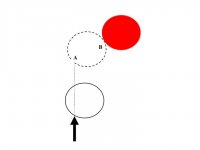
I think this is what he means Joey. The original poster will hopefully correct me if I'm wrong.

For this cut to the right with outside english, the stick is pointing toward "A." If your eyes are drawn toward "B," then maybe the stick will be drawn toward "B" as well --resulting in this case in too full a hit.

Of course considering squirt and swerve, the stick won't really be pointing to the "equivalent" spot on the OB, but this gives the general idea.
 

Attachments

  • Slide1.jpg
    Slide1.jpg
    13.8 KB · Views: 140
mikepage said:
I think this is what he means Joey. The original poster will hopefully correct me if I'm wrong.

For this cut to the right with outside english, the stick is pointing toward "A." If your eyes are drawn toward "B," then maybe the stick will be drawn toward "B" as well --resulting in this case in too full a hit.

Of course considering squirt and swerve, the stick won't really be pointing to the "equivalent" spot on the OB, but this gives the general idea.

I think this makes sense as to what "unknowpro" was referring to, in that if you are under pressure in a match and if you apply inside or outside English or even no English if you are concentrating too hard on the contact point on the object ball, you will steer the cue ball into the object ball and will be unable to pot the object ball. I think this makes perfect sense but am always interested in any additional details. I still don't know why Randy says it is 1 1/8" but am keeping an open mind. Hope unknownpro confirms or corrects your interpretation.
Thanks!
JoeyA
 
My $.02:

I believe the greatest benefit of this discussion is for teaching. The SPF method is great for this. It breaks the stroke down and makes distinct parts that students can concentrate on. I was a decent shooter before taking Randy's class. Employing the SPF improved my game tremendously. But, here's what I've noticed after some time post-class. The set and pause times have decreased to almost nothing. During mastery of SPF, there is a lot of concentration on stopping the cue before executing the next phase of the stroke. As the phases of the stroke become automatic, there is less concentrating on the parts of the stroke and the pausing diminishes. During his class, Randy makes a very pronounced pause (to help demonstrate it, obviously). I've also watched Randy playing a match. Randy, are you aware just how little pause you use in your game stroke (when you're thinking of other things)? I think, like me, it's now all so automatic.

Having been taught the SPF approach, it made perfect sense that the tricep had to stop pulling before the bicep could pull in the opposite direction. Having read this discussion, it makes even more sense that the bicep is also what slows and stops the backstroke. The backstroke doesn't stop solely because the tricep stopped contracting just as as a car doesn't stop when you put in the clutch (objects in motion...). To me, I believe that is why the pause diminishes over time. If the bicep is used to slow and stop the backstroke and then there is a pause, the bicep is working, not working, then working again. The pause goes away because the bicep naturally wants to start working slowly as it slows the backstroke, contract more as it stops the backstroke, then continue contracting as the tricep releases it's pull and the stroke goes forward.

The SPF is an awesome way to teach students a good stroke. And, keeping a pause can be a good thing for some. In the end, it boils down to being able to repeat the same stroke at contact with the CB with consistency. As noted, Efren Reyes has a horrible looking stroke. But, he repeats it very consistently. Everyone misses shots. As good as Efren is, I don't think it's because of his stroke. There's all those other reasons (nerves, thinking about leave, etc.) that are for other discussions....

For what it's worth,
Chris D. in Austin

 
Sharky_TX said:
My $.02:

I believe the greatest benefit of this discussion is for teaching. The SPF method is great for this. It breaks the stroke down and makes distinct parts that students can concentrate on. I was a decent shooter before taking Randy's class. Employing the SPF improved my game tremendously. But, here's what I've noticed after some time post-class. The set and pause times have decreased to almost nothing. During mastery of SPF, there is a lot of concentration on stopping the cue before executing the next phase of the stroke. As the phases of the stroke become automatic, there is less concentrating on the parts of the stroke and the pausing diminishes. During his class, Randy makes a very pronounced pause (to help demonstrate it, obviously). I've also watched Randy playing a match. Randy, are you aware just how little pause you use in your game stroke (when you're thinking of other things)? I think, like me, it's now all so automatic.

Having been taught the SPF approach, it made perfect sense that the tricep had to stop pulling before the bicep could pull in the opposite direction. Having read this discussion, it makes even more sense that the bicep is also what slows and stops the backstroke. The backstroke doesn't stop solely because the tricep stopped contracting just as as a car doesn't stop when you put in the clutch (objects in motion...). To me, I believe that is why the pause diminishes over time. If the bicep is used to slow and stop the backstroke and then there is a pause, the bicep is working, not working, then working again. The pause goes away because the bicep naturally wants to start working slowly as it slows the backstroke, contract more as it stops the backstroke, then continue contracting as the tricep releases it's pull and the stroke goes forward.

The SPF is an awesome way to teach students a good stroke. And, keeping a pause can be a good thing for some. In the end, it boils down to being able to repeat the same stroke at contact with the CB with consistency. As noted, Efren Reyes has a horrible looking stroke. But, he repeats it very consistently. Everyone misses shots. As good as Efren is, I don't think it's because of his stroke. There's all those other reasons (nerves, thinking about leave, etc.) that are for other discussions....

For what it's worth,
Chris D. in Austin

The Pause is not a time duration, it's a timing in the two movements.
I never think of my stroke movements, they happen from years of perfect practice. That allows me to focus on the real job....SPF=randyg

PS: Great job!
 
mikepage said:
I think this is what he means Joey. The original poster will hopefully correct me if I'm wrong.

For this cut to the right with outside english, the stick is pointing toward "A." If your eyes are drawn toward "B," then maybe the stick will be drawn toward "B" as well --resulting in this case in too full a hit.

Of course considering squirt and swerve, the stick won't really be pointing to the "equivalent" spot on the OB, but this gives the general idea.
In your example if you are using left middle (not high or low) then my aim point A would be all the way on the left side of the ghost ball. That's what I meant by the nearest edge. The nearest point from the tip on the edge of the cueball is the aim point on the ghost ball.

unknownpro
 
unknownpro said:
In your example if you are using left middle (not high or low) then my aim point A would be all the way on the left side of the ghost ball. That's what I meant by the nearest edge. The nearest point from the tip on the edge of the cueball is the aim point on the ghost ball.

unknownpro

With your tip halfway to the edge of the cueball, then neglecting swerve your aim to the edge of the ghost ball is correct when the object ball is the cue's pivot point away from the cueball.

As the cueball gets closer than the pp away from the object ball, you need to catch more of the ghost ball, and when the cueball is farther away than the pivot point, you need to aim outside the ghost ball. However the increased presense of swerve migh make your aim point decent for a bit.
 
mikepage said:
With your tip halfway to the edge of the cueball, then neglecting swerve your aim to the edge of the ghost ball is correct when the object ball is the cue's pivot point away from the cueball.

As the cueball gets closer than the pp away from the object ball, you need to catch more of the ghost ball, and when the cueball is farther away than the pivot point, you need to aim outside the ghost ball. However the increased presense of swerve migh make your aim point decent for a bit.
On close shots you can use more english, allowing the cueball to deflect more quickly to 1/2 ball width, or adjust your english high or low to get a similar result. I assume it is impossible to deflect the cueball more than 1/2 ball width with a good stroke, so I would never aim outside the edge of the ghostball with the inside of my ferrule.

unknownpro
 
Back
Top