router collets

Bearings

kunin35 said:
WHo's a good supplier of replacement bearings for the PC trimmers?
Thanks:thumbup:

Just wanted to menton that I always warm up my spindle on low rpm's to let the bearings adapt to the heat and get a good working temperature before I even do anything with it.It's maybe obvious but it's easy to forget and then reduce the life on the spindle bearings.

Just a comment which I have posted earlier but I hope it's worthwile to repeat.

Kent
 
TIR Update

Well, I have been playing with my setup and done some tests to compare
the stock Chinese ER25 collets supplied with the CNC and the Ultra
precision collets.

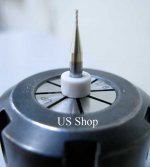
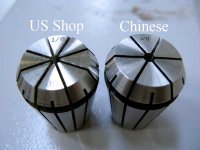
Here is a pic of the Stock Chinese 1/8 and the UP collet from US Shoptools.

Note that the UP collet is not branded...
 

Attachments

  • collets.jpg
    collets.jpg
    34.5 KB · Views: 185
1/4" Er 25

This is the UP collet from US-Shopt.
Note it's branded which is not the case for the 1/8"...
 

Attachments

  • collet2.jpg
    collet2.jpg
    21.8 KB · Views: 174
Stock 1/8" shank mill

Setup with ER25 nut and end mill in the US ShopT collet.
 

Attachments

  • Endm_US.jpg
    Endm_US.jpg
    29.6 KB · Views: 185
Starting with the spindles inside.

No TIR measurable with the indicator used (Res 0.0005").
I expect TIR to be <0.0001"
 

Attachments

  • Spindle.jpg
    Spindle.jpg
    49.8 KB · Views: 192
Spindle TIR Closeup

Close up of Spindle TIR.
 

Attachments

  • SpindleTIR.jpg
    SpindleTIR.jpg
    33.7 KB · Views: 195
TIR on endmils

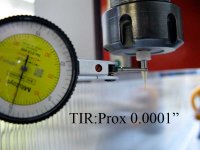
This is the setup I used for the TIR measurements on the Endmil.
As far down as I could come.

The results was as follows:

1: US Shoptools 1/8" adaptor : TIR=0.001 (A LOT)

2: Stock Chinese 1/8" adaptor: TIR<0.00025"

3: US Shoptools 1/8" adaptor - second test: TIR<0.00025"

4: Stock Chinese 1/8" adaptor - second test: TIR<0.00025"

The first test is expected to be a anomaly and is most likely caused by me
making a mistake.
The surprise was however that the Chinese was as good as it was. I have
never bothered to use this or measure this until now, but it did feel very good.
It was not as loose when placed in the nut as the "UP-USShopt" equivalent
and to be frank, the UP was not branded at all with SYIC as the other so I'm
not sure how good this Ultra Precision - UP collet is...?
 

Attachments

  • TIR_Chinese.jpg
    TIR_Chinese.jpg
    35.2 KB · Views: 182
A test with a larger shank, in this case KJ's saw blade setup

I did a test with the 1/4" UP collet and KJ's shank to see how the collet branded
SYIC was performing. KJs shanks is not as even in it's surface as the end mill,
but a test showed that the TIR was in this case very good even far from the
collets "collar".
KJ has in other words produced these with great tolerances and is for sure
a good product - you know you're things KJ :thumbup2:
 

Attachments

  • KJShank2.jpg
    KJShank2.jpg
    37 KB · Views: 179
Conclusion

Well, what is the lesson learned ?

I was surprised to see that the stock Chinese collet did pretty good - at least
comparable to the US Shoptools Ultra Precision collet.

Speaking about the UP 1/8" collet, this was not branded with SYIC as the other
collets was when I received these, so I'm not sure how Ultra this is....
So I'm not sure if this is a "normal" collet or a real UP collet but it did perform
pretty good at the end. It did however feel more "loose" when used together
with the stock ER25 nut, compared to the Chinese which felt more "stuck" in
the nut.

I looked in to the back side of the two 1/8 collets and the US Shopt version
had a smaller height on it's insides "collar" gripping area. The Chinese version
seemed to be a little more "rounded" in it's gripping surface which made the
end mill feel more "secure in there"...

So what have I learned....?
I'm not sure but I would for sure not cheap out on the collets and since most
of my end mills has 1/8" shank - I'm going to buy the poshest-nicest-precision made Swiss/Italian or what ever 1/8" collet I can get... I just need
that single one and it's for sure not going to be the reason for messing up
my spindles quality and my work.

Kent
 
Pancerny said:
Should the spindle be checked when it's running or just spinnning it by hand??

Thanks,
Mike
For a milling machine, if the spindle is running less than 200 rpm, it is fine to check run out with it running.
But a router or any spindle exceeding 1000 rpm is only going to damage the workings of the dial test indicator.
The coaxial indicators for mills recommend no more than 500 rpm.
So in short , it is best to rotate the spindle by hand.
When checking the runout on reamers, I turn the spindle backwards, so the reamer flute is effectively lifting the stylis from the pivotpoint side of the stylis, not the open side.This has always produced more consistant results.
Similar when rotating the spindle , I always move the workpiece away from the indicator. So in the picture showing the dti on the KJ mandrel, I would be turning the spindle counter clockwise(backwards) for the same reason.
DTI 's last alot longer this was as well.
Neil
Neil
 
conetip said:
So in the picture showing the dti on the KJ mandrel, I would be turning the spindle counter clockwise(backwards) for the same reason.
DTI 's last alot longer this was as well.
Neil
Neil

Neil,

I'm on the same "wagon", I rotate only by hand and as you I rotate from the tip. This was done on all measurements.

Also, don't forget to move a little /rotate a little on the spindle, then
take you're hands from the spindle and continue to rotate and then
do a read out.
Don't keep you're hand up there all the time since you in this case could
inflict on the reading (depending on the machines rigidity) :)

Kent
 
Back
Top