Nobody'd admit to it. How many red lines can you sell anyway?i bet every one of the top players just use the red line when they shoot.

You are using an out of date browser. It may not display this or other websites correctly.
You should upgrade or use an alternative browser.
You should upgrade or use an alternative browser.
Seeing the contact point on the object ball.
- Thread starter jimstone
- Start date
I see things pretty much as diagrammed except in 3D. The shooting part is down the stick centered but that's separate and too much text anyway. I use aerial marks (like DD's peace sign and other gestures) which allow me to do the visualization for many shots from behind the cue ball. For instance you can nail the tangent line using the edge of your hand right in front of your face. you can move it around to check all kinds of stuff no foul.
In short, I've done a lot to calibrate my PSR to the geometry. Generally I consider the stick itself a component of the shot and getting "chambered and locked in" is very high priority.
thanks for the repliesGhost ball trick: It's the exact size as the object ball and always frozen to it. You can train your eyes by freezing the CB to another ball and walking around it till you memorize the look or you can no longer miss.
Also this might work:
A right triangle half the height of the object ball.View attachment 900128
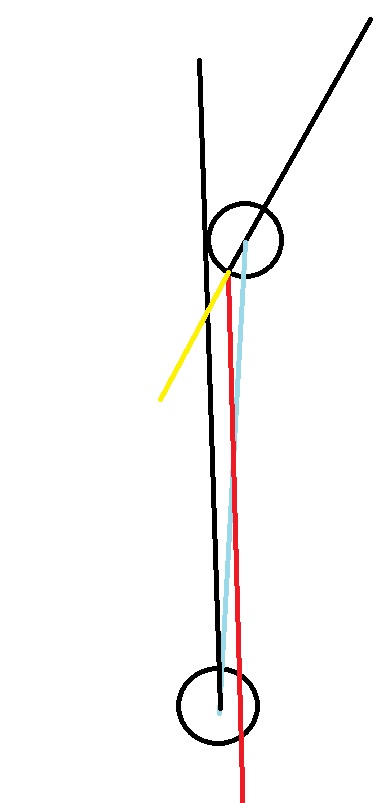
Here's an interesting artifact of Jimmy Reid's Equal Angle Opposites:
View attachment 900129
The Yellow line shows the intended object ball line.
The Red line is contact line. You can use your stick on close shots to get the hang of it.
The Black line is the shot line running parallel to the Red contact line.
Notice, the Black shot line intersects the Yellow shot line at the base of the mythical Ghost Ball.
The blue line is just the line of centers.
The half ball hit is incidental. Could be any pool shot angle; different angles and parallelogram but the connection points would be the same.
Seen the training ball; I'd like to hear Rempe's _sincere_ take on aiming.rempe and reid both played about the same speed. id say rempe was more consistent. jimmy never talked about any of the stuff he professed later on in life. at least as far as ive seen or heard.

Paul Bell
Well-known member
Hello, for those of you who use contact point aiming systems, where you first find the contact point on the object ball
by drawing a line from the pocket through the object ball, here is my question.
Let's say you have a long shot , and the object ball is a solid color. You step away from the object ball, after finding the contact point, and head
back to the cue ball which is say - 4 diamonds away. How do you keep track of that contact point on the object ball with your eyes? Thank you.
OP has been lurking for five days but may return . . . . . . . . .OP is long gone!
The answer to OP's question of how you can keep track of an object-ball contact point that is many feet away? Use an object ball with 110 multi-colored, multi-shaped spots. Assign a contact point to one of the spots and it will be visible several diamonds away.
Using this ball, it is also not necessary to move or adjust the ball after its been hit and stops to mark where a new contact point is. Line up the new contact point and there will be another colored spot there that can be easily seen the length of the table.
Last edited:

boogieman
It don't mean a thing if it ain't got that ping.
It's almost as if they were over complicating things to sell a product... strange.Hmmm, you may have a point. I did not copy the CutShots method correctly. It finds that to make the shot, the cue ball overlaps OB the same amount as the distance between OB-contact point and OB edge. That distance on OB and CB makes two contact points for the initial aiming line. The player, then, moves that line parallel toward cue-ball center to aim at OB.
Other things look similar in Patrick's figure with what is the OB center, the cue-ball center, and that aiming can be determined by double-the distance or double-the-overlap methods. No parallel shift described, however. As to how the middle of the CB is determined --- it appears to be the closest distance between cue ball and object ball. I do not see a step involving a parallel shift to the cue-ball center.
For what its worth, here's CutShots method:
View attachment 900054

Paul Bell
Well-known member
They are trying to be accurate with the extra step. Maybe by adding that extra step, in practice its a wash and there is no improvement. I suspect under some cut angles and shot distances, the extra step is necessary to pot balls.It's almost as if they were over complicating things to sell a product
what do you do when the balls dont have those shapes on them?They are trying to be accurate with the extra step. Maybe by adding that extra step, in practice its a wash and there is no improvement. I suspect under some cut angles and shot distances, the extra step is necessary to pot balls.
my closing on this.
if you cannot see the spot you want to hit on the object ball when down on the shot
and
the place where you want on the cue ball to hit that spot,
you really are still in the banger stage. sorry but its true. and you need to work on what to see rather than some discipline to get your results.
and just play more and it will come naturally.
if you cannot see the spot you want to hit on the object ball when down on the shot
and
the place where you want on the cue ball to hit that spot,
you really are still in the banger stage. sorry but its true. and you need to work on what to see rather than some discipline to get your results.
and just play more and it will come naturally.
Started considering points maybe 30 years ago. There's always a reference on the balls to set the visualization. Those speckles are distracting and ultimately, unnecessary. Blackball sets might better for CPG training.what do you do when the balls dont have those shapes on them?
@bbb
Really. You've seen the MSPaint circles. Pick a pocket line and go back to the cue ball.
Ok it does crack me up when pool noobs spend 2 minutes agonizing over the pocket line before walking back to the cue ball and then have no idea what they are shooting at and shoot anyway.
That's why the triangles and parallelograms. For the noobs, stick with the stick line. Pay attention to it before you shoot; compare, rinse, repeat...
Really. You've seen the MSPaint circles. Pick a pocket line and go back to the cue ball.
Ok it does crack me up when pool noobs spend 2 minutes agonizing over the pocket line before walking back to the cue ball and then have no idea what they are shooting at and shoot anyway.
That's why the triangles and parallelograms. For the noobs, stick with the stick line. Pay attention to it before you shoot; compare, rinse, repeat...
I just saw my paint drawing - this one,
in this thread https://forums.azbilliards.com/threads/taking-the-pocket-out-of-aiming.586265/
attributed to Jimmy Reid. It's my depiction of his method. Somebody at least gimme credit for drawing it. Geez.
Nice work with the contact lattice Patrick Johnson.
in this thread https://forums.azbilliards.com/threads/taking-the-pocket-out-of-aiming.586265/
attributed to Jimmy Reid. It's my depiction of his method. Somebody at least gimme credit for drawing it. Geez.
Nice work with the contact lattice Patrick Johnson.
I wonder if many people are not versed in dimensional drawings, and so do not already "naturally" translate/connect 2D views to the real-world 3D setting. And, even when someone has that ability, no one ever mentions that the perspective change due to distance may or may not even occur to them--although, enough experience should burn that in, with the thought that the person's brain is actually learning without them being conscious of it!@bbb
Really. You've seen the MSPaint circles. Pick a pocket line and go back to the cue ball.
Ok it does crack me up when pool noobs spend 2 minutes agonizing over the pocket line before walking back to the cue ball and then have no idea what they are shooting at and shoot anyway.
That's why the triangles and parallelograms. For the noobs, stick with the stick line. Pay attention to it before you shoot; compare, rinse, repeat...
There is also the oddity, in that we often have posts with top views, such as in this thread, and there are many with the equal-sized, juxtaposed balls that overlap (I will look for an example later), but I really never see them together. [I actually made some graphics with both together, back in the early 2000s, but I don't even know if I have the originals on a hard drive somewhere--and that's assuming they survived the house-dousing the fire department gifted me with last week....]
Drawing anything in paint is going to be a drawing challenge. You can simulate space of course:I wonder if many people are not versed in dimensional drawings, and so do not already "naturally" translate/connect 2D views to the real-world 3D setting. And, even when someone has that ability, no one ever mentions that the perspective change due to distance may or may not even occur to them--although, enough experience should burn that in, with the thought that the person's brain is actually learning without them being conscious of it!
There is also the oddity, in that we often have posts with top views, such as in this thread, and there are many with the equal-sized, juxtaposed balls that overlap (I will look for an example later), but I really never see them together. [I actually made some graphics with both together, back in the early 2000s, but I don't even know if I have the originals on a hard drive somewhere--and that's assuming they survived the house-dousing the fire department gifted me with last week....]
but a CAD would be required to do it right.
Here's another Equal Angle Opposites drawing:
Depth perception should be developed in any pool player who is able. Injuries, errant genetics etc...
Still pool is doable in 2D especially working with CPG.
Last edited:
My issue/point was that you can show people a top-down (or behind-the-balls) diagram, but they may not immediately grasp the connection when trying to apply it back to spheres on a table.Drawing anything in paint is going to be a drawing challenge. You can simulate space of course:
View attachment 900542
but a CAD would be required to do it right.
Here's another Equal Angle Opposites drawing:
Depth perception should be developed in any pool player who is able. Injuries, errant genetics etc...
Still pool is doable in 2D especially working with CPG.
I don't recall when I learned about mechanical views, but I know it was before I too drafting around '88--probably because I did have an interest in drawing as a pre-teen. In reading this thread, it made me question whether many "n00bs" might NOT have a similar experience, and so it takes them longer to reach their "Eureka!" moment.
About the graphic, I understand is a sort of 2-in-1, 3D (or is that isometric?) to a 2D representation. Also, when you posted it earlier, I found the most interesting part to be that the spheres are 'geometrically similar'--so that the left end of the blue line is essentially duplicated on the target ball contact point. The double-distance/overlap aiming is not new to me, but I just never thought about the g-similarity of both balls as they face the shooter.
FWIW there's a missing diagram in my previous post which I re added. In the aiming forum, AI has apparently taken my drawing and attributed the diagram to Jimmy Reid. Pisser but pretty sad too:My issue/point was that you can show people a top-down (or behind-the-balls) diagram, but they may not immediately grasp the connection when trying to apply it back to spheres on a table.
I don't recall when I learned about mechanical views, but I know it was before I too drafting around '88--probably because I did have an interest in drawing as a pre-teen. In reading this thread, it made me question whether many "n00bs" might NOT have a similar experience, and so it takes them longer to reach their "Eureka!" moment.
About the graphic, I understand is a sort of 2-in-1, 3D (or is that isometric?) to a 2D representation. Also, when you posted it earlier, I found the most interesting part to be that the spheres are 'geometrically similar'--so that the left end of the blue line is essentially duplicated on the target ball contact point. The double-distance/overlap aiming is not new to me, but I just never thought about the g-similarity of both balls as they face the shooter.
I just saw my paint drawing - this one,
View attachment 900539
in this thread https://forums.azbilliards.com/threads/taking-the-pocket-out-of-aiming.586265/
attributed to Jimmy Reid. It's my depiction of his method. Somebody at least gimme credit for drawing it. Geez.
Nice work with the contact lattice Patrick Johnson.
2D, 3D - given a child could understand the contact drawings if taught them in conjunction with real pool, I haven't skill rated any. They are depictions of pool nonetheless. Viewer responsibility to add the pool.
Anyway, post some of your drawings.
This is the core of what I mean. Before actually thinking about it, I would have overestimated the number of (average) people that would immediately grasp the relationship between top-view drawings and side-view. Still, maybe it's a generation thing.FWIW there's a missing diagram in my previous post which I re added. In the aiming forum, AI has apparently taken my drawing and attributed the diagram to Jimmy Reid. Pisser but pretty sad too:
2D, 3D - given a child could understand the contact drawings if taught them in conjunction with real pool, I haven't skill rated any. They are depictions of pool nonetheless. Viewer responsibility to add the pool.
Anyway, post some of your drawings.
Also, please don't take anything I've said as a knock on your skill with MS-Paint--or w/e graphic package you choose. I think they get the point across, and my comment about what I found "interesting" was the part I had not noticed before. It was a positive thing.

Anyway, I did some months back find a few graphics from my old Tripod side. So there's this, courtesy of the Wayback Machine:
NOTE2: This is meant to combine the top and 'behind' views.
NOTE3: Made in a very old version of Adobe Illustrator.
Very nice. That's a lot clearer than just the overlap.

The 1/2 ball cut really is 30 degrees (ignoring throw).NOTE: The angles are approximations. I think Bob Jewett actually called me out on this in the 2000s--for example, I think the 1/2-ball is actually more like 32-degrees, but I was using the 15-degree steps.
I like the dual-view idea.

pj
chgo
Last edited:

Hello, for those of you who use contact point aiming systems, where you first find the contact point on the object ball
by drawing a line from the pocket through the object ball, here is my question.
Let's say you have a long shot , and the object ball is a solid color. You step away from the object ball, after finding the contact point, and head
back to the cue ball which is say - 4 diamonds away. How do you keep track of that contact point on the object ball with your eyes? Thank you.
I've never used contact point aiming systems but keeping track of the contact point can be done by not taking your eyes off of it while walking back to the CB, getting down and shooting. Although I've done it that way I am able to recognize the contact point after looking away from it when I go back and get down on the shot. It seems to be some sort of mental/visual persistence that developed after months of shooting 8 hrs a day when I was first learning. I do stare at the contact point when standing on the cut line some times but don't pay any attention to any markings on the OB, and I often don't go to the cut line - I just walk over to the CB, get down on the shot and look at the OB, see the contact point and cut it in. It is kinda automatic. I've been able to teach it to a couple students, telling them they just need to learn to visualize it.