
Seeing the contact point on the object ball.

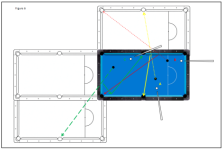
I've spent years trying to improve my bank shots with what I always called "off-table visualization" or "Siamese tables". Others call it a "mirror" technique. Over time, I've found I can hit most shots (particularly the harder ones) more often than those who are otherwise my peers. I truly believe this is because it makes you invite the right brain to the party. For most players, it's a left-brain activity of finding an apex to a triangle and aiming for a tiny spot on the rail. With my approach, I visualize an imaginary pocket, as accurately as possible. Not a point in space, but a pocket. It's a large target. Granted, it's just an initial aiming point and you still have to compensate for all the variables, but it becomes very intuitive.
An experienced player has literally seen a pool table from every angle imaginable. Those billions of data points make your mind intimately familiar with the proper dimensions. The key is tapping into that subconscious knowledge, consciously locating where the pocket should be and making adjustments, and then back to the right brain to "see" it. Similar to relaxing your eyes to see a 3-D image, I'm sometimes shooting with a blank, glaze-eyed stare off in the corner somewhere, which is a bit unnerving to some opponents. With full-brain engaged, I use it all to make the shot. The real trick is learning how to exercise and improve those memory muscles for better recall at any table.
 

Attachments

  • 1779736855536.png
    1779736855536.png
    586.4 KB · Views: 15
And I think at least thousands of balls are needed for understanding or getting a feel for bank shots, but it also helps to know what the balls are doing and what changes the lines -- cloth, rails, speed, spin, cut angle, .... For some people, it helps to experiment with banks on the practice table, so you can try something again immediately and maybe come to a conclusion. Some systems at least get you started and have something to compare the on-table results against.
Yep - HAMB is just the (less desirable) alternative.

pj
chgo
 
Not sure how to answer that, but if I were just a math/science nerd I might have looked for a system. I am also a musician, which relies heavily on intuition and feeling.

When I started playing pool during college it was with the intention of taking a break, getting my mind off all the math/science (calculus class at 0730? gimme a break). What I meant by math background was geometry, understanding what was happening with the angles. AFAIK, I don't have a system for aiming bank shots or kick shots; I just experimented with it until I could do it by feel/intuition. If I had a system, I might be able to teach it but I wouldn't know where to start with teaching my method to someone else.
Thanks for the reply
HAMB= Hit A Million Balls
Edit
I see pj already answered you
 
I've spent years trying to improve my bank shots with what I always called "off-table visualization" or "Siamese tables". Others call it a "mirror" technique. Over time, I've found I can hit most shots (particularly the harder ones) more often than those who are otherwise my peers. I truly believe this is because it makes you invite the right brain to the party. For most players, it's a left-brain activity of finding an apex to a triangle and aiming for a tiny spot on the rail. With my approach, I visualize an imaginary pocket, as accurately as possible. Not a point in space, but a pocket. It's a large target. Granted, it's just an initial aiming point and you still have to compensate for all the variables, but it becomes very intuitive.
An experienced player has literally seen a pool table from every angle imaginable. Those billions of data points make your mind intimately familiar with the proper dimensions. The key is tapping into that subconscious knowledge, consciously locating where the pocket should be and making adjustments, and then back to the right brain to "see" it. Similar to relaxing your eyes to see a 3-D image, I'm sometimes shooting with a blank, glaze-eyed stare off in the corner somewhere, which is a bit unnerving to some opponents. With full-brain engaged, I use it all to make the shot. The real trick is learning how to exercise and improve those memory muscles for better recall at any table.
Thats a system 😉
 
HAMB with or without knowledge. Without knowledge, it may be HAMBx2 or 3. With knowledge, HAMB will put you in a pretty good spot. I really don’t think there is a substitute for HAMB and that takes time.


Sent from my iPhone using Tapatalk
 
“Hit A Million Balls” (practice without systems). Takes longer and you learn less, but lots of players do it.

pj
chgo

When I was learning it was pre VHS in a rural setting, way before youtube. The only book I found was Mosconi's at the local library. I got a handle on the knowledge side pretty quickly though, running every third or fourth rack of 8 ball on a GC1. Most everybody that knew me refused to play me so I shot 1 handed but didn't last long because I kept winning. If I would have been smarter I would have started shooting left handed instead. The guys that could win against me wouldn't give me any pointers.
 
  • Like
Reactions: bbb
What is that? Google says it stands for Hokey Ass Message Board, which I don't think you meant.
Have at my brilliance. Hardly any make balls. Google is right.

Any particular genre of music? Just a general good musician? Even that requires some attention to some kind of structure. The average musician won't have to agonize over it. Pros however, need to be more configured to the gig. This can range from what key, to note for note in style or nuthin'. They have prestigious institutions to address the details of professional music.

On the other hand, playing pool on the feel of a meeyun baws, is still hit or miss. Player is like, "This works 80% of the time so I'm not gonna worry about it." They never bother with the remaining 20%.

CG is one precaution worth the bother.
 
Have at my brilliance. Hardly any make balls. Google is right.

Any particular genre of music? Just a general good musician? Even that requires some attention to some kind of structure. The average musician won't have to agonize over it. Pros however, need to be more configured to the gig. This can range from what key, to note for note in style or nuthin'. They have prestigious institutions to address the details of professional music.

On the other hand, playing pool on the feel of a meeyun baws, is still hit or miss. Player is like, "This works 80% of the time so I'm not gonna worry about it." They never bother with the remaining 20%.

CG is one precaution worth the bother.
I am not a pro but I can sound as good as them. I may get something going on youtube some day but too busy for that right now. I do have a gigging jazz friend who went to Berklee and now teaches theory in college, if I really needed to ask something. I have played live in bands that were well received but wasn't about to try to make a living at it. My venn diagram overlapped with the pro music scene in LostAngeles.

For guitar: Experimental, hard rock, prog rock, modal folk acoustic instrumental, can do convincing blues, mess around with jazz once in a while. For drums, any style that does not require a disco beat or 4 on the floor. I had to deal with structure to learn guitar but once it becomes muscle memory the structure fades into the background and I can shut my eyes and play freely. Structure supports, but does not make the song/music. I learned to play drums out of frustration of dealing with drummers who overplayed.

Drums are different. If I am playing along with bands on youtube on songs, it is strictly by feel (no key/harmony required). After a few times through, I have a workable performance that sounds like it fits and adds to the song. I do not count any of it. Maintaining a clear mind makes it much easier to play effortlessly. I did not take the conventional approach to learning drums, no practicing rudiments, no metronome or instruction other than a couple books. I remembered playing the bongos in the 3rd grade and found that I could only do it by feel. So I figured that if I could feel the music, I could play it. If I can see a makeable shot, I can make it.

For me, the overlap between music and pool is that when I get into the flow state/zone, it all becomes fluid and easy. Not much thinking required and strong success. I do watch a lot of professional matches, looking for things to incorporate into my game. It's good practice for recognizing patterns.
 
Maybe this one - banks/kicks aren't often perfect mirror images, but it's a close starting place.
View attachment 906393

pj
chgo
I use equal in outs on skinny banks. On broken in cloth, the bends are negligible. One adjustment that helps me is offsetting the aim/rebound line from center OB to the outside edge. This sets the swath to clear the outside tit. Even long straight backs take well to this offset. Adjust for oomph of course.
 
I am not a pro but I can sound as good as them. I may get something going on youtube some day but too busy for that right now. I do have a gigging jazz friend who went to Berklee and now teaches theory in college, if I really needed to ask something. I have played live in bands that were well received but wasn't about to try to make a living at it. My venn diagram overlapped with the pro music scene in LostAngeles.

For guitar: Experimental, hard rock, prog rock, modal folk acoustic instrumental, can do convincing blues, mess around with jazz once in a while. For drums, any style that does not require a disco beat or 4 on the floor. I had to deal with structure to learn guitar but once it becomes muscle memory the structure fades into the background and I can shut my eyes and play freely. Structure supports, but does not make the song/music. I learned to play drums out of frustration of dealing with drummers who overplayed.

Drums are different. If I am playing along with bands on youtube on songs, it is strictly by feel (no key/harmony required). After a few times through, I have a workable performance that sounds like it fits and adds to the song. I do not count any of it. Maintaining a clear mind makes it much easier to play effortlessly. I did not take the conventional approach to learning drums, no practicing rudiments, no metronome or instruction other than a couple books. I remembered playing the bongos in the 3rd grade and found that I could only do it by feel. So I figured that if I could feel the music, I could play it. If I can see a makeable shot, I can make it.

For me, the overlap between music and pool is that when I get into the flow state/zone, it all becomes fluid and easy. Not much thinking required and strong success. I do watch a lot of professional matches, looking for things to incorporate into my game. It's good practice for recognizing patterns.
Cool. You know the drill so I don't need to supply any more detail. Remind us if you get something on the web. (y)

But, imagine having to do any gig with heckling or an a hole producer - survival would require a more stable approach than artistic magic right? That's all.
 
Back
Top