Spin-to-Speed or Revolutions-per-Foot?

Patrick Johnson

Fargo 1000 on VP4
Silver Member
In pool we use the term "spin-to-speed ratio" to describe the "amount" of spin on the CB, comparing revolutions to distance traveled over a fixed time. But the simpler way to express that would be "revolutions per foot traveled", ignoring the time interval.

For a given amount of tip offset, revolutions per foot (RPF) are the same at all speeds - for example, if 1/4 maximum tip offset produces 10 revolutions per foot (10 RPF) at lag speed, it also produces 10 RPF at break speed and every other speed.

In other words there's a given amount of RPF for each amount of tip offset - for instance 3/16" offset (1/3 of maximum) might = 10 RPF, 3/8" offset (2/3 of maximum) might = 20 RPF, and 9/16" offset (maximum) might = 30 RPF.

My question:
Has anybody measured (or estimated) the RPF for each fraction of maximum tip offset? Does RPF increase linearly with the % of maximum tip offset - twice as much RPF for twice as much offset, etc. - as suggested above?*

I'm not sure how this might be useful info, just wondering and babbling as usual...

Thanks in advance,

pj
chgo

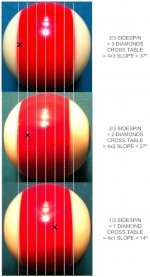
*For reference, here's an old post of mine suggesting that the amount of spin effect increases linearly with tip offset:
 
Last edited:
This info would have no practical use in a game because there are too many variables to maintain consistency.
It would quantify one of the variables so it might be better understood/used.

Maybe I've already quantified it in the most useful way (in the old post I linked above): "X percentage tip offset creates Y cross-table kick angle". But I'm always looking for improvement...

pj
chgo
 
Has anybody measured (or estimated) the RPF for each fraction of maximum tip offset? Does RPF increase linearly with the % of maximum tip offset - twice as much RPF for twice as much offset, etc. - as suggested above?

RPF definitely increases linearly with tip offset. The math and physics is here:


where SRF is the spin-rate factor (spin-to-speed ratio), omega is the angular speed in radians/sec, v is the ball speed, R is the ball radius, and b is the tip offset from center.

Speed is related to distance (d) and time (t):
v = d / t​
So:
SRF = (omega * t) * R / d​
The first term is related to revolutions (rev) according to:

(omega * t) = rev * (2 * pi) [there are 2*pi radians per revolution]​
So:
SRF = (2 * pi * rev) * R / d​
So revolutions per foot (RPF) is:
RPF = rev / d = SRF / (2 * pi * R)​
with d and R measured in feet.

The ball radius (in feet) is:
R = (2.25" / 2) * (1ft / 12") = 1.125/12 feet​

For an assumed maximum spin at the standard miscue limit of 0.5*R,

SPF = (5/2) * (b/R) = (2.5) * (0.5) = 1.25​
which gives:
RPF = 1.25 / (2 * pi * 1.125/12) = 2.1 rev/ft
If you roll a ball (SRF = 1) and see how many revolutions it makes in one foot, you would observe:

RPF = 1 / (2 * pi * R) = 1.7 rev/ft​
 
Last edited:
Babbling AND referencing one's own post from 14yrs ago. Somebody needs help. ;) Just more mindless minutia that means NADA to REAL WORLD pool. Reminds me of a lot of golfers: paralysis by analysis. If i thought about this shit i wouldn't make a ball.
 
Babbling AND referencing one's own post from 14yrs ago. Somebody needs help. ;) Just more mindless minutia that means NADA to REAL WORLD pool. Reminds me of a lot of golfers: paralysis by analysis. If i thought about this shit i wouldn't make a ball.

Agreed. The math and physics are of no interest to most pool players.

But sometimes the math and physics helps us figure out things that are useful to pool players. Examples include:

90 degree rule tangent line
30 degree rule natural angle
3-times-the-angle system for good action draw
40% Rule for judging gearing outside spin
ideal tip contact point to get maximum sidespin reaction with a drag shot
ideal tip offset to get maximum SIT
ball gap size where cut and throw cancel over a wide range of angles
optimal tip height on a lag shot

Etc!

See also: helpful pool physics understanding
 
Last edited:
RPF definitely increases linearly with tip offset. The math and physics is here:


where SRF is the spin-rate factor (spin-to-speed ratio), omega is the angular speed in radians/sec, v is the ball speed, R is the ball radius, and b is the tip offset from center.

Speed is related to distance (d) and time (t):
v = d / t​
So:
SRF = (omega * t) * R / d​
The first term is related to revolutions (rev) according to:

(omega * t) = rev * (2 * pi) [there are 2*pi radians per revolution]​
So:
SRF = (2 * pi * rev) * R / d​
So revolutions per foot (RPF) is:
RPF = rev / d = SRF / (2 * pi * R)​
with d and R measured in feet.

The ball radius (in feet) is:
R = (2.25" / 2) * (1ft / 12") = 1.125/12 feet​

For an assumed maximum spin at the standard miscue limit of 0.5*R,

SPF = (5/2) * (b/R) = (2.5) * (0.5) = 1.25​
which gives:
RPF = 1.25 / (2 * pi * 1.125/12) = 2.1 rev/ft
If you roll a ball (SRF = 1) and see how many revolutions it makes in one foot, you would observe:

RPF = 1 / (2 * pi * R) = 1.7 rev/ft​
Appreciated as always, Dave.

So RPF = % of maximum tip offset X 2.1, right?

So my previous post about thirds of maximum tip offset (linked above) shows 0.7 RPF, 1.4 RPF and 2.1 RPF for 1/3, 2/3 and maximum tip offset, right? I thought (for no particular reason) the maximum would be higher.

Might be handy to know someday...?

pj
chgo
 
RPF definitely increases linearly with tip offset. The math and physics is here:


where SRF is the spin-rate factor (spin-to-speed ratio), omega is the angular speed in radians/sec, v is the ball speed, R is the ball radius, and b is the tip offset from center.

Speed is related to distance (d) and time (t):
v = d / t​
So:
SRF = (omega * t) * R / d​
The first term is related to revolutions (rev) according to:

(omega * t) = rev * (2 * pi) [there are 2*pi radians per revolution]​
So:
SRF = (2 * pi * rev) * R / d​
So revolutions per foot (RPF) is:
RPF = rev / d = SRF / (2 * pi * R)​
with d and R measured in feet.

The ball radius (in feet) is:
R = (2.25" / 2) * (1ft / 12") = 1.125/12 feet​

For an assumed maximum spin at the standard miscue limit of 0.5*R,

SPF = (5/2) * (b/R) = (2.5) * (0.5) = 1.25​
which gives:
RPF = 1.25 / (2 * pi * 1.125/12) = 2.1 rev/ft
If you roll a ball (SRF = 1) and see how many revolutions it makes in one foot, you would observe:

RPF = 1 / (2 * pi * R) = 1.7 rev/ft​
Of course the math and physics can be applied, but how useful is this in a real world situation? Simply, it's not. Between the acceleration of your arm, tip offset variances, tip/chalk friction coefficient, and all the human error, you can only approximate but never accurately define these conditions.

Then you add in stress to a given situation and any reasonable consistency goes out the window for your average player.

P.S. - Thank you for all your contributions to the game, it's great that someone works hard to inform everyone of all these nuances. Your 8b and 9b breaking videos from a few years back had excellent information.
 
Appreciated as always, Dave.

So RPF = % of maximum tip offset X 2.1, right?

So my previous post about thirds of maximum tip offset (linked above) shows 0.7 RPF, 1.4 RPF and 2.1 RPF for 1/3, 2/3 and maximum tip offset, right? I thought (for no particular reason) the maximum would be higher.

Looks good to me.
 
Of course the math and physics can be applied, but how useful is this in a real world situation?

See my non-math-physics posts above with the links. This physics-based stuff is incredibly useful in real-world situations.

To make it easy, here are some of the examples listed above:
90 degree rule tangent line
30 degree rule natural angle
3-times-the-angle system for good action draw
40% Rule for judging gearing outside spin
ideal tip contact point to get maximum sidespin reaction with a drag shot
ideal tip offset to get maximum SIT
ball gap size where cut and throw cancel over a wide range of angles
optimal tip height on a lag shot

P.S. - Thank you for all your contributions to the game, it's great that someone works hard to inform everyone of all these nuances. Your 8b and 9b breaking videos from a few years back had excellent information.

You're welcome. I aim to swerve. 🤓
 
RPF definitely increases linearly with tip offset. The math and physics is here:


where SRF is the spin-rate factor (spin-to-speed ratio), omega is the angular speed in radians/sec, v is the ball speed, R is the ball radius, and b is the tip offset from center.

Speed is related to distance (d) and time (t):
v = d / t​
So:
SRF = (omega * t) * R / d​
The first term is related to revolutions (rev) according to:

(omega * t) = rev * (2 * pi) [there are 2*pi radians per revolution]​
So:
SRF = (2 * pi * rev) * R / d​
So revolutions per foot (RPF) is:
RPF = rev / d = SRF / (2 * pi * R)​
with d and R measured in feet.

The ball radius (in feet) is:
R = (2.25" / 2) * (1ft / 12") = 1.125/12 feet​

For an assumed maximum spin at the standard miscue limit of 0.5*R,

SPF = (5/2) * (b/R) = (2.5) * (0.5) = 1.25​
which gives:
RPF = 1.25 / (2 * pi * 1.125/12) = 2.1 rev/ft
If you roll a ball (SRF = 1) and see how many revolutions it makes in one foot, you would observe:

RPF = 1 / (2 * pi * R) = 1.7 rev/ft​
Will the real sphereologist please stand up?
 
In pool we use the term "spin-to-speed ratio" to describe the "amount" of spin on the CB, comparing revolutions to distance traveled over a fixed time. But the simpler way to express that would be "revolutions per foot traveled", ignoring the time interval.

For a given amount of tip offset, revolutions per foot (RPF) are the same at all speeds - for example, if 1/4 maximum tip offset produces 10 revolutions per foot (10 RPF) at lag speed, it also produces 10 RPF at break speed and every other speed.

In other words there's a given amount of RPF for each amount of tip offset - for instance 3/16" offset (1/3 of maximum) might = 10 RPF, 3/8" offset (2/3 of maximum) might = 20 RPF, and 9/16" offset (maximum) might = 30 RPF.

My question:
Has anybody measured (or estimated) the RPF for each fraction of maximum tip offset? Does RPF increase linearly with the % of maximum tip offset - twice as much RPF for twice as much offset, etc. - as suggested above?*

I'm not sure how this might be useful info, just wondering and babbling as usual...

Thanks in advance,

pj
chgo

*For reference, here's an old post of mine suggesting that the amount of spin effect increases linearly with tip offset:
Reading this actually makes me not want to play pool.
 
Back
Top