Hello all,
Firstly, I am not a cue builder / repairman, but I'm starting to learn about it and have bought Hightower's book and starting to collect some squares to put aside for later use. I'm nowhere near ready to work on this project, but I'd love to hear some thoughts.
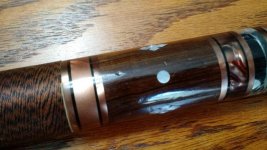
This old Viking was my dad's cue. He passed away a little over a year ago, and would have been 78 yesterday. He and I had a tumultuous relationship, but pool was a way that we could connect.
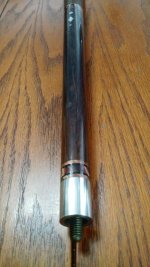
Unfortunately, this old dog of a stick (I'm guessing 70s) has seen better days and only has sentimental value. He didn't build cues, but was a skilled craftsman and painter, so I feel it would be more honorable for me to make something of it and hope it can at least be worth playing with.
I do have several things I'd love to hear some ideas on:
1. Can you identify the wood? I'm guessing some variety of rosewood.
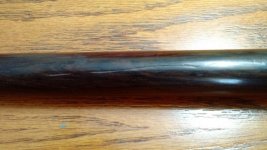
2. The forearm has several small dings and one long scratch that's definitely deeper than what finish it has left. I don't think there's room to turn it down at all, and sanding won't cut it. Could the dings/scratch be pulled out somehow or am I looking at trying to do my best cosmetically by filling them?
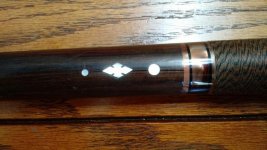
3. Most concerning on the forearm is a split right in the middle of an inlay group. What can be done short of turning it into a pointed cue?
4. The forearm itself is pretty short (~9.5 in). Doesn't leave me a lot to work with. The SS joint collar has some visible threads exposed and looks to be threaded onto the forearm tenon. Would it be possible to break down the glue on the collar and thick ring, remove the pin, and leave myself with a tenon to work with for constructing a new joint? I'm imagining a lot of structural concerns around the joint. Of course I could cut it off and start from there, but I'm not sure I'd like the look of such a short forearm. Another idea I had was to either turn down my buttcap and use that wood somehow in the forearm, but I don't know how deep the pockets for the inlays are.
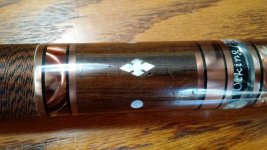
5. The buttcap has a lot more dings and some checks and a hole near one of the notched diamond inlays. Same question about repairing that.
Otherwise, what would you do if you were forced to convert this cue? Not ideal stock, but who doesn't love a challenge!
Firstly, I am not a cue builder / repairman, but I'm starting to learn about it and have bought Hightower's book and starting to collect some squares to put aside for later use. I'm nowhere near ready to work on this project, but I'd love to hear some thoughts.
This old Viking was my dad's cue. He passed away a little over a year ago, and would have been 78 yesterday. He and I had a tumultuous relationship, but pool was a way that we could connect.
Unfortunately, this old dog of a stick (I'm guessing 70s) has seen better days and only has sentimental value. He didn't build cues, but was a skilled craftsman and painter, so I feel it would be more honorable for me to make something of it and hope it can at least be worth playing with.
I do have several things I'd love to hear some ideas on:
1. Can you identify the wood? I'm guessing some variety of rosewood.
2. The forearm has several small dings and one long scratch that's definitely deeper than what finish it has left. I don't think there's room to turn it down at all, and sanding won't cut it. Could the dings/scratch be pulled out somehow or am I looking at trying to do my best cosmetically by filling them?
3. Most concerning on the forearm is a split right in the middle of an inlay group. What can be done short of turning it into a pointed cue?
4. The forearm itself is pretty short (~9.5 in). Doesn't leave me a lot to work with. The SS joint collar has some visible threads exposed and looks to be threaded onto the forearm tenon. Would it be possible to break down the glue on the collar and thick ring, remove the pin, and leave myself with a tenon to work with for constructing a new joint? I'm imagining a lot of structural concerns around the joint. Of course I could cut it off and start from there, but I'm not sure I'd like the look of such a short forearm. Another idea I had was to either turn down my buttcap and use that wood somehow in the forearm, but I don't know how deep the pockets for the inlays are.
5. The buttcap has a lot more dings and some checks and a hole near one of the notched diamond inlays. Same question about repairing that.
Otherwise, what would you do if you were forced to convert this cue? Not ideal stock, but who doesn't love a challenge!