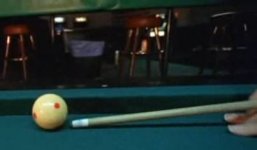
Do you jack up to get more draw?

Does "jacking up" create more draw on a medium-distance, straight-in shot?

  • yes

    Votes: 14 7.0%
  • no

    Votes: 186 93.0%

  • Total voters
    200
Tip Offset?

In the other thread about draw it was stated that the max draw occurs with an 80% tip offset (with 100% being a miscue).
My theory is that by jacking up people are more comfortable or concentrate more on where they are striking the ball and getting closer to that 80%.
What we would need to see is someone who can draw the ball well with a jacked up cue and poorly with a level cue to determine where they are hitting the ball in each instance. My bet is that they do not hit the ball where they think they are with a level cue.


Andy
 
Do you jack up to get more draw?
2 other things that I failed to previously note:
1) The term "jacking up" actually connotes something different than intended (i.e., substantial angle vs. slight elevation). It is possible, and often required (see #2), to elevate the WITHOUT being jacked up.
2) Due to the physical constraints, there are only a few shots on the table where a level cue is even possible.

-td
 
I find that most people have a slightly elevated cue despite their belief they are level.
By "level cue," I think most people mean "as level as possible" or "near level" or "no added elevation." Are you saying "most people" add unnecessary cue elevation without being aware of it? I have certainly seen this with novice players, especially with draw shots.

One point to ponder: although your calculations indicate some loss of velocity due to the cue ball contacting the table when skipping, isn't it possible to have a net increase in spin/speed ratio if you can contact the object ball before the cue ball's second table contact (when the cue ball is on a downward trajectory). Thus, where spin reduction due to tip offset is negligible, there can be (substantial?) gains in relative spin loss since there is no loss due to drag.
You make a good point. The amount of spin is affected by each bounce, so depending on whether or not the CB takes its last bounce just before the OB does make a difference (see the example numbers at the bottom of page 6 in TP B.10 if you are interested); but even with this effect taken into consideration, a near-level cue (with no CB hopping) still comes out on top (based on the physics).

Here is an experiment that everyone can try to verify if they actually shoot level AND if level is actually better for them:

1) put the cue ball 2 diamond from the pocket.
2) put the cue ball by the side pocket (around 3 diamonds away).
3) both balls are close to the side rail that facilitates draw for your shooting hand (right/left)
4) shoot a number of level power draw shots (say 5 or 10). Go for a record distance, like 15 diamonds of straight draw. Keep track of your results.
5) put a few dimes on the table in line with the shot (2 or 3 or 10) - but put the first one about 9-12 inches away from the cue ball.
6) shoot the same shot again - still going for a draw record.
7a) you should hit the first dime EVERY TIME if you shoot level. [you might launch the cue ball over the rail, so don't shoot towards a window]
7b) if you don't hit the dime - you actually have some angle on your cue.
8a) if you do hit the first dime, elevate ever-so-slightly so you avoid hitting any of the dimes. The key is getting the lowest elevation that allows you to "skip" the dimes.
9) note your results.
[you may surprise yourself and skip all the dimes - every time]
That's a good experiment. I hope people try it out. I will. FYI, I have a super-slow-motion clip of coin skipping here:


The effect can be even more surprising with a follow shot, where the cue can be more level.

For me, I net between an extra diamond or 2 [sometimes a bit more] with the slight elevation. Again, we're not talking light draw shots, but super whammy shots.
I think it is important to use a marked ball (e.g., a Jim Rempe ball or a striped ball), and to tilt the ball with cue elevation so the chalk mark will indicate the actual tip offset for each shot. It is also important to look at the chalk mark after each shot to see exactly where you hit the ball. Some people might be getting a slightly different tip offset when they elevate slightly (without knowing it). Also, some people might be generating more cue speed when they elevate, but it is difficult to tell without a radar gun or high-speed camera.

Thank you for your ideas and experiment,
Dave
 
In the other thread about draw it was stated that the max draw occurs with an 80% tip offset (with 100% being a miscue).
My theory is that by jacking up people are more comfortable or concentrate more on where they are striking the ball and getting closer to that 80%.
What we would need to see is someone who can draw the ball well with a jacked up cue and poorly with a level cue to determine where they are hitting the ball in each instance. My bet is that they do not hit the ball where they think they are with a level cue.
You make some excellent points!

Thanks,
Dave
 
By "level cue," I think most people mean "as level as possible" or "near level" or "no added elevation." Are you saying "most people" add unnecessary cue elevation without being aware of it? I have certainly seen this with novice players, especially with draw shots.

Thank you for your ideas and experiment,
Dave
Added elevation may actually be the KEY to super-extreme draw. By added, maybe 3-5 degrees. This appears to be the difference between getting normal draw vs extreme draw.

To illustrate my point, the draw guru uses ADDED elevation (a few inches higher than the rail) when executing his super-extreme draw shots. Although he is the exception and not the rule, perhaps the extra angle is the missing link the "collective" has written off?

-td

Me shooting Cory's super draw shot:
me.jpg

From Mike's Youtube "how to":
image001.jpg

image002.jpg

image003.jpg

image004.jpg
 
2 other things that I failed to previously note:
1) The term "jacking up" actually connotes something different than intended (i.e., substantial angle vs. slight elevation). It is possible, and often required (see #2), to elevate the WITHOUT being jacked up.
2) Due to the physical constraints, there are only a few shots on the table where a level cue is even possible.
Good points. A purely "level" (perfectly horizontal) cue is not possible with most pool shots. A level cue is even tougher with a draw shot, because the tip is lower than with a follow or center-ball shot.

However, the point is whether or not a player is adding extra elevation (beyond what is required), and whether or not the extra elevation helps or hurts, and why.

Thanks,
Dave
 
Thank you for posting those great photos. I think there might be several plausible reasons why elevating might help some people achieve better power draw. Some explanations have been suggested already. Also, some people might be able to generate more power with a slightly more upright stance and slight cue elevation. Also, the elevation might help some people create a safer amount of clearance for the grip hand over a rail or the table (especially with people that drop their elbow significantly with a power draw ... like Mike Massey). There could also be other reasons for other people.

The physics analysis and results are useful (and sometimes enlightening), but they don't always tell the whole story. That's why I like posting stuff here. The more perspectives, the better.

Regards,
Dave

Added elevation may actually be the KEY to super-extreme draw. By added, maybe 3-5 degrees. This appears to be the difference between getting normal draw vs extreme draw.

To illustrate my point, the draw guru uses ADDED elevation (a few inches higher than the rail) when executing his super-extreme draw shots. Although he is the exception and not the rule, perhaps the extra angle is the missing link the "collective" has written off?

-td

Me shooting Cory's super draw shot:
View attachment 96691

From Mike's Youtube "how to":
View attachment 96687

View attachment 96688

View attachment 96689

View attachment 96690
 
a near-level cue (with no CB hopping) still comes out on top (based on the physics).
Dave
What about a cue ball that does not skip at all, but hits the object ball "on the fly?" ;)

Seriously, a substantially level cue (with a few degrees of elevation may actually result in a "floating" cue ball that is not in full contact with the cloth, thus reducing the rate of spin loss. That is, the ball may be slightly hovering above the cloth apparently in contact with it, but only slightly so - and imperceptible to the eye. Thus, there would be less reduction in rotation since the entire mass of the cue ball would not be pressing on the cloth the entire time, but it would appear to be. Just another thougth to ponder.

With this in mind, perhaps there are still a few variables that can affect the maximum draw result that haven't been taken into account.

I'm sure you understand that my comments are only intended to facilitate a broader discussion on this topic. And, as always, your efforts in this field are greatly appreciated!

-td
 
Last edited:
With this in mind, perhaps there are still a few variables that can affect the maximum draw result that haven't been taken into account.
I just had another thought:

Watch a bunch of super draw videos (Mike, Cory, Efren, ChrisCapp, etc) and you will notice a very peculiar thing - they all use a very similar angle for super-draw: which equals the natural angle the stick would have at about 2 diamonds out from the end rail. That is, if you put the cue ball about 2 diamonds out from the end rail the stick will have a particular angle. This (or close to it) is the preferred angle for mega-draw shots, even when the cue ball is more than 2 diamonds from the rail.

Maybe this is the starting point for further analysis: comparing actual angles used by the super draw gurus and then determining why their experience dictates that angle. Perhaps there is a direct correlation between that angle and the desired results.

Just another thought.

-td
 
What about a cue ball that does not skip at all, but hits the object ball "on the fly?" ;)
Actually, this is possible after the first hop resulting from the tip driving the CB ball down initially; but, again, the amount of spin lost on the bounce outweighs the amount that would be lost with less elevation (and multiple "delicate" bounces or just sliding).

It could be possible to have no bounce at all with a typical "near-level" cue elevation and a really "squirty" (large CB deflection) cue, but this is just being silly. ;)

Seriously, a substantially level cue (with a few degrees of elevation may actually result in a "floating" cue ball that is not in full contact with the cloth, thus reducing the rate of spin loss. That is, the ball may be slightly hovering above the cloth apparently in contact with it, but only slightly so - and imperceptible to the eye. Thus, there would be less reduction in rotation since the entire mass of the cue ball would not be pressing on the cloth the entire time, but it would appear to be. Just another thougth to ponder.
FYI, my analysis does cover all cases from pure sliding to delicate skipping, to hard bouncing. The conclusion is still: for maximum straight-back draw, the less elevation ... the better, assuming the cue speed and tip offset are the same in all comparisons.

With this in mind, perhaps there are still a few variables that can affect the maximum draw result that haven't been taken into account.
There are certainly some physical effects I haven't taken into account (e.g., how the ball-cloth friction coefficient might change with speed and angle of impact, how aerodynamic drag and "ground effects" might affect shots at very high speeds, etc.), but I doubt these effects would change the main conclusions (although I could be wrong). Also, as I have written, a physics analysis doesn't always tell the "whole story" ... things like stroke biomechanics, human perception, and individual preference/comfort might be important factors.

I'm sure you understand that my comments are only intended to facilitate a broader discussion on this topic. And, as always, your efforts in this field are greatly appreciated!
Understood. I appreciate your comments and ideas. You have certainly helped me (and I bet others) think about things more.

Thanks,
Dave

 
Can you or others offer some suggestions as to why this might have helped you? Also, do you still prefer jacking up a little? Do you do this on just draw shots?

Thanks,
Dave
I think I've answered this about 5 or 6 dozen times. Unfortunately, readers get confused by the term "slight elevation," and then mock the rest of the post by only considering "extreme jackup." And so it goes, and so it will go.

I think your study is 100% correct if we only consider the mechanical engineering concepts of the collision.

However, the study of "draw" isn't strictly confined by the forces and force diagram at collision. The entire stroke has to be looked at. And the reality is, the butt being elevated slightly is more natural than trying to keep it level. It's ergonomics and biomechanics. You can use statics (and dynamics) at the collision to explain the physics of draw. But you must be willing to allow others to use ergonomics and biomechanics to explain why better players can draw better with (seemingly) less effort.

Yes, we know that "good draw" only requires X speed and Y offset. But if that's the end of the statement, the you're far behind the proverbial 8-ball. You must ask "what is the easiest, most repeatable way to get to X speed and Y offset." For the unbelievably high majority, there's going to be some elevation. It's no coincidence that the best power drawers in the world have quite a bit of elevation (Nevel, Massey, Louie Roberts, to name a few). It's also no coincidence the immediate results people get when they're told to slightly elevate.

It's not hopping or lessening of friction or anything like that like I used to theorize. It's simply that a person can swing the stick in a more natural fashion to get the cuestick to a desired speed and offset. "Trying" to keep it level goes against the body's mechanics.

Fred
 
Last edited:
Good points. A purely "level" (perfectly horizontal) cue is not possible with most pool shots. A level cue is even tougher with a draw shot, because the tip is lower than with a follow or center-ball shot.

However, the point is whether or not a player is adding extra elevation (beyond what is required), and whether or not the extra elevation helps or hurts, and why.

Thanks,
Dave
Well, Dave I think your posts are confusing then. I'd like for you to exclaim without a shadow of a doubt that elevation is better than level. Which is what I and many people have been saying all along. This whole "adding more than what is necessary" is a bit of a false point. The "elevation" that all of us are and have been talking about is exactly the elevation to bring that cue to an angle that allows the players to stroke the cue effectively, efficiently, and comfortably.

Everyone who keeps saying "as level as possible" apparently has their own definition. Wouldn't it be best to admit to "slight elevation" and be done with it???

Fred
 
Well, Dave I think your posts are confusing then. I'd like for you to exclaim without a shadow of a doubt that elevation is better than level. Which is what I and many people have been saying all along. This whole "adding more than what is necessary" is a bit of a false point.

How so? Dave's point is that adding elevation doesn't by itself add effectiveness. You don't seem to dispute that.

The "elevation" that all of us are and have been talking about is exactly the elevation to bring that cue to an angle that allows the players to stroke the cue effectively, efficiently, and comfortably.

Yes, and Dave acknowledges that may be an explanation for the success that many feel they have by adding elevation on draw shots.

Everyone who keeps saying "as level as possible" apparently has their own definition.

I don't think so, but so what? It seems that, no matter what slight elevation is natural for you, adding elevation doesn't help the ball/table mechanics of draw.

OK, that doesn't take into account "biomechanics", but so what? It's still good and useful information - now we know that any benefit probably comes entirely from biomechanics.

Wouldn't it be best to admit to "slight elevation" and be done with it???

Has anybody denied it?

pj
chgo
 
How so? Dave's point is that adding elevation doesn't by itself add effectiveness. You don't seem to dispute that.

Which point do you want me to address? Every half vague one?

One would "add whatever he needs to be more consistent, reliable, and repeatable." Obviously, "adding more than what is necessary" is a false argument.

Fred
 
Could you describe "up and down cue action" some more? Is the elbow moving up and down much? I know people can generate more power by involving the shoulder, but not everybody can control this well.

Thanks,
Dave

yes u drop the elbow through the shot its what ronnie o sullivan was taught to do, once you learn to control this its a massive difference in cue power, you have a high elbow, with the cue on a up slope and drive the elbow down through the shot, hope you understand this and it helps
 
you don't want to "jack up" but you do want to be cueing down on the ball a little, otherwise your not pinching the ball at all if you're too level. i find that you can get a lot of cheese on the ball with a slip stroke too. for most players who can't draw the ball well, they usually shoot way too hard and don't accellerate smoothly enough, you have to remember that the harder you shoot the tougher it is for the spin to get the cueball going backwards. i find that if i want extreme draw, i usually use a slip-stroke and i can get that "double backspin" (where the cueball draws back slowly - because it has so much spin it's not catching on the cloth - and then hits another gear once the spin really catches) going pretty good.
 
yes u drop the elbow through the shot its what ronnie o sullivan was taught to do, once you learn to control this its a massive difference in cue power, you have a high elbow, with the cue on a up slope and drive the elbow down through the shot, hope you understand this and it helps

yeah ronnie!!! i think there's a video of him teaching two kids where he claims that "shooting from the elbow" is the most accurate way to cue. pretty good advice from arguably the greatest cueist of our time. (please nobody argue that it's stephen hendry - I don't think he's a better cueist than ronnie, but he has more bottle and NOBODY digs deeper than hendry!)
 
Back
Top