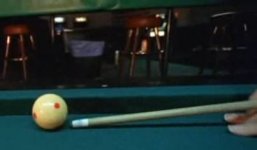
What about a cue ball that does not skip at all, but hits the object ball "on the fly?"

Actually, this is possible after the first hop resulting from the tip driving the CB ball down initially; but, again, the amount of spin lost on the bounce outweighs the amount that would be lost with less elevation (and multiple "delicate" bounces or just sliding).
It could be possible to have no bounce at all with a typical "near-level" cue elevation and a really "squirty" (large CB deflection) cue, but this is just being silly.
Seriously, a substantially level cue (with a few degrees of elevation may actually result in a "floating" cue ball that is not in full contact with the cloth, thus reducing the rate of spin loss. That is, the ball may be slightly hovering above the cloth apparently in contact with it, but only slightly so - and imperceptible to the eye. Thus, there would be less reduction in rotation since the entire mass of the cue ball would not be pressing on the cloth the entire time, but it would appear to be. Just another thougth to ponder.
FYI, my analysis does cover all cases from pure sliding to delicate skipping, to hard bouncing. The conclusion is still: for maximum straight-back draw, the less elevation ... the better, assuming the cue speed and tip offset are the same in all comparisons.
With this in mind, perhaps there are still a few variables that can affect the maximum draw result that haven't been taken into account.
There are certainly some physical effects I haven't taken into account (e.g., how the ball-cloth friction coefficient might change with speed and angle of impact, how aerodynamic drag and "ground effects" might affect shots at very high speeds, etc.), but I doubt these effects would change the main conclusions (although I could be wrong). Also, as I have written, a physics analysis doesn't always tell the "whole story" ... things like stroke biomechanics, human perception, and individual preference/comfort might be important factors.
I'm sure you understand that my comments are only intended to facilitate a broader discussion on this topic. And, as always, your efforts in this field are greatly appreciated!
Understood. I appreciate your comments and ideas. You have certainly helped me (and I bet others) think about things more.
Thanks,
Dave