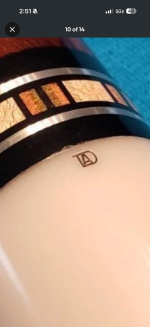
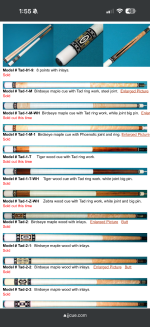
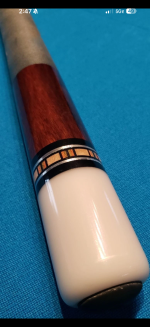
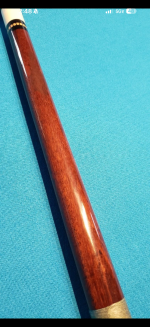
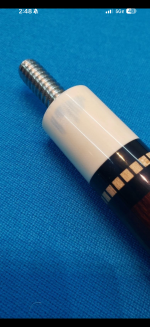
TAD-1 Tigerwood Big Pin is Rare (picture)

Lépine

Active member
I always wanted to try a big pin TAD, I bought one off ebay to satisfy my curiosity. I don't see many merry widow with the big pin. Out of the annual 100 average number of cues made, do you think maybe 2 or 3 were big pin or more would have been made including any model (merry widow through 8 points)
 

Attachments

  • IMG_3722.png
    IMG_3722.png
    419 KB · Views: 12
  • IMG_3729.png
    IMG_3729.png
    543 KB · Views: 8
  • IMG_3718.png
    IMG_3718.png
    817.6 KB · Views: 8
  • IMG_3719.png
    IMG_3719.png
    1.3 MB · Views: 8
  • IMG_3720.png
    IMG_3720.png
    1.1 MB · Views: 7
Last edited:
I always wanted to try a big pin TAD, I bought one off ebay to satisfy my curiosity. I don't see many merry widow with the big pin. Out of the annual 100 average number of cues made, do you think maybe 2 or 3 were big pin or more would have been made including any model (merry widow through 8 points)
Probably more than 2 or 3 out of 100 average, but definitely not as plentiful as 14 thread pin with steel joint.
 
It's always difficult to determine if the Big Pin TADs were not popular or if Tad just didn't want to make many of them. Am I also correct in assuming that all of the white joints were in fact made of Juma? I don't believe I have seen evidence that any joint was ever made from ivory.
 
Probably more than 2 or 3 out of 100 average, but definitely not as plentiful as 14 thread pin with steel joint.
After further checking, I see I was incorrect and you were absolutely correct. Not rare at all, but harder to come by. For my playing preferences, I noted that Tigerwood is very lively and maybe preferable to the more universal birds eye maple. As a side note: I was having a conversation asking if Tad made BRW Tads. I assumed that there were none since I have not been able to find one that is clearly BRW and not maybe Tigerwood or Cocobolo. From the person who would know, he confirmed that yes there were a small number that were made, but the reason BRW TADs are not more common is that Tad Kohara did not like the wood. It pinged too much, I found that ironic. Seemed to me that everything about the way TAD cues are made, the goal is to get a nice clear ping. Tad instead preferred BEM and thought that was the best wood overall. Fred pointed out that in terms of performance and feel, he felt that Tigerwood does some things better than rosewoods. I decided to have new shafts made for my Tigerwood merry widow since it seems to play really well and is the nicest feeling TAD I have experinced. It is also the only big pin I have experienced so not sure if it is the big pin or the wood that is contributing the most to the feel. Off the cue goes, DHL must love me.
 
Last edited:
  • Like
Reactions: bbb
After further checking, I see I was incorrect and you were absolutely correct. Not rare at all, but harder to come by. For my playing preferences, I noted that Tigerwood is very lively and maybe preferable to the more universal birds eye maple. As a side note: I was having a conversation asking if Tad made BRW Tads. I assumed that there were none since I have not been able to find one that is clearly BRW and not maybe Tigerwood or Cocobolo. From the person who would know, he confirmed that yes there were a small number that were made, but the reason BRW TADs are not more common is that Tad Kohara did not like the wood. It pinged too much, I found that ironic. Seemed to me that everything about the way TAD cues are made, the goal is to get a nice clear ping. Tad instead preferred BEM and thought that was the best wood overall. Fred pointed out that in terms of performance and feel, he felt that Tigerwood does some things better than rosewoods. I decided to have new shafts made for my Tigerwood merry widow since it seems to play really well and is the nicest feeling TAD I have experinced. It is also the only big pin I have experienced so not sure if it is the big pin or the wood that is contributing the most to the feel. Off the cue goes, DHL must love me.
I know a couple of cuemakers who don’t like BRW primarily due to the fact it’s hard to find stuff with good color and figure. They think people are more infatuated with the name than anything.
 
I know a couple of cuemakers who don’t like BRW primarily due to the fact it’s hard to find stuff with good color and figure. They think people are more infatuated with the name than anything.
Wouldn't the ideal BRW be as straight grained as possible wihout figure in the wood?
 
In any case, from what I was told by TAD Custom Cues is that BRW did not perform to Tad's expectations so Goncalo Alves is the only similar wood Tad used for any notable quantities and it was offered as a player's cue model. Since custom TAD is almost a nonexistent occurrence it is less likely to see it as a wood in his high end cues
 
Last edited:
  • Like
Reactions: bbb
I used Gemini:

Finding a Tad Custom Cue with a Tigerwood forearm (often listed as Goncalo Alves) is quite rare, primarily because it deviates from the "classic" Tad aesthetic that collectors typically hunt for.


While Birdseye Maple and Ebony are the hallmarks of Tad Kohara’s most famous designs, Tigerwood was occasionally used, particularly in the TAD1 series (Standard/Straight cues).


Rarity & Availability


• Production Context: Tigerwood was generally used for Tad’s "plain Jane" or straight-grained series rather than his high-end, heavily inlaid point cues. Because collectors often prioritize the iconic 4-point or 8-point inlaid designs, fewer Tigerwood models were preserved in "mint" collections.


• The TAD1 Model: On historical price lists and dealer catalogs (like JJ Cue), the TAD1 is one of the few models specifically noted as being available in Zebrawood, Birdseye Maple, or Tigerwood.


• Market Frequency: If you browse major custom cue registries or secondary markets (AZBilliards, Biggelbachs, or Cornerstone), you will likely see 20–30 Birdseye Maple Tads for every one Tigerwood forearm you encounter.


Why It’s Unique


1. The "Tad Hit": Tad cues are legendary for their stiff, crisp "ping" or hit. Since Tigerwood is a dense, oily wood, it provides a slightly different feedback than the traditional maple, which some players find desirable for its natural weight and balance.


2. Visual Distinction: Most Tads look "traditional." A Tigerwood forearm gives the cue a much more exotic, striped appearance that stands out in a rack of otherwise conservative-looking vintage cues.


3. Investment Value: While "points and inlays" usually drive the highest prices for Tads (often $3,000–$10,000+), a rare wood like Tigerwood can bolster the value of a straight TAD1 model, making it more than just an "entry-level" custom.
IMG_3921.jpeg

IMG_3922.jpeg

Short answer: Tigerwood is uncommon as a primary forearm wood on TAD custom cues; it ranks as uncommon-to-rare compared with TAD’s most-used forearm woods (birdseye maple, rosewood, ebony), and is noticeably less common than the classic maple-based forearms TAD is best known for.

---

Forearm-wood rarity comparison (TAD cues)

Wood Typical use by TAD Rarity (TAD context) Why it ranks that way

Birdseye maple Frequent; classic TAD forearm Common Traditional TAD styling; many catalog examples show maple forearms.

Maple (plain) Frequent Common Standard base wood for many TAD models.

Rosewood Regularly used for butts/points Uncommon Used for contrast and points; less as full forearm.

Ebony Used for points/inlays Uncommon Dense, used sparingly for accents.

Tigerwood Occasionally used by cue builders generally Uncommon → Rare Not commonly listed in TAD galleries; appears rarely if at all.

Exotic hardwoods (cocobolo, koa, bubinga) Sporadic/custom orders Rare Exotic, expensive, and used only on special commissions.

Purpleheart / Padauk / Zebrawood Occasional accents Rare Decorative veneers or points rather than full forearms.


Sources: Custom Bi... +4

---

How I reached this ranking

• TAD’s production is small and collectible, and many of the cues shown in dealer galleries emphasize maple forearms and maple with points/veneers rather than full exotic forearms; that pattern makes classic maples the most common TAD forearm choice J&J Cues and....
• Dealer and catalog listings for TAD cues repeatedly show birdseye maple and maple-based forearms with inlays and veneers as the dominant style in available inventory biggelbac... +1.
• Marketplace listings and specialty cue dealers show TAD cues as collectible and often list maple/ebony/rosewood combinations; exotic full-forearm woods are far less frequently offered, which implies tigerwood would be relatively rare among TAD forearms Custom Bi... +1.


---

Practical implications for buyers and builders

• If you want a TAD cue with a tigerwood forearm, expect a custom-order or a rare used example. TAD’s standard offerings and most dealer-stock cues favor maple forearms, so tigerwood will likely require a special commission or a lucky find on the secondary market thailandb... +1.
• Cost and availability trade-offs: tigerwood is an exotic hardwood—higher material cost and limited supply make it a less common choice for full forearms; builders often reserve it for accents or one-off commissions, increasing rarity and price eBay.


---

Key considerations before pursuing a tigerwood TAD forearm

• Confirm authenticity and source (exotic woods can vary in grade).
• Expect longer lead times and higher price for a true custom commission.
• Ask the seller/builder for photos and provenance—TAD cues are collectible and finishes/wood choices affect value Custom Bi... +1.


If you want, I can search current listings for TAD cues that specifically mention tigerwood and pull recent examples from dealers and marketplaces to show how often it appears.

 
Last edited:
  • Like
Reactions: bbb
It is beginning to look like this combination is extremely rare. Tigerwood TADs are unicorn level in rarity and Big Pin feature is by itself scarce. This cue plays and feels the best. Better than a Keshenbrock, better than Burton Spain George Balabushka, better than McDaniel, better than high end no serial number TAD, better than rosewood Tascarella.
 
  • Like
Reactions: bbb
Back
Top