Automatic Shot Clock

Just buy a game clock. They are made for the purpose. They are flexible. They don't require a special cue ball. They have been in use for time control for almost 150 years. And they have a lot of nice features the electronic cue ball does not have.
Bob, I would but I haven’t found any that fits the bill. It has to be easily visible from 12-14 away for a 9’ table player and chess clocks and the like don’t fit the bill. Gosh, I would have thought APA and BCA would have adopted this by now which would have sparked demand to build a shot clock for pool players. Lazy or slow players are really intolerable annoyances, IMO.
 
Bob, I would but I haven’t found any that fits the bill. It has to be easily visible from 12-14 away for a 9’ table player and chess clocks and the like don’t fit the bill. Gosh, I would have thought APA and BCA would have adopted this by now which would have sparked demand to build a shot clock for pool players. Lazy or slow players are really intolerable annoyances, IMO.
It is not a per-shot clock. It is a total time used clock. There is no need to see it continuously. If you start with 40 minutes as your time for the race to 7, the exact time is of no concern until you get really low, and then you know you need to step lively. And if you need three minutes to figure out a shot, and you have the time to spend on that single shot, you can.
 
It is not a per-shot clock. It is a total time used clock. There is no need to see it continuously. If you start with 40 minutes as your time for the race to 7, the exact time is of no concern until you get really low, and then you know you need to step lively. And if you need three minutes to figure out a shot, and you have the time to spend on that single shot, you can.
Yes but the concern is limiting players time per shot, not per match. A lot of people don’t want to sit watching nothing for three minutes. I think this is the point.

Three cushion matches have for example 40 seconds per shot (or something like that) with a few extensions allowed. This is more of the idea.

Correct me if I am wrong.
 
Yes but the concern is limiting players time per shot, not per match. A lot of people don’t want to sit watching nothing for three minutes. I think this is the point.

Three cushion matches have for example 40 seconds per shot (or something like that) with a few extensions allowed. This is more of the idea.

Correct me if I am wrong.
The major 3-cushion matches have per-shot clocks with time keepers on each table. In carom leagues, they use chess clocks.

I think you are wrong about the goal. If a player has a very complicated shot, the audience can understand that the problem requires time. And the player will have to play the rest of the shots more speedily. For the schedule, it is total time you are concerned about. If both players take 28 seconds per shot, every shot -- like Albin, Fedor, others... -- it is a slow grind. If they have, on average, 20 seconds per shot, they will play a better pace. There are some carom players who start their final strokes when the beeps start at 35 seconds -- every damn shot.
 
Bob, I would but I haven’t found any that fits the bill. It has to be easily visible from 12-14 away for a 9’ table player and chess clocks and the like don’t fit the bill. Gosh, I would have thought APA and BCA would have adopted this by now which would have sparked demand to build a shot clock for pool players. Lazy or slow players are really intolerable annoyances, IMO.

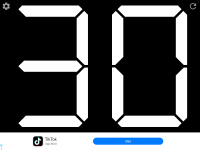
Take a look at this app. It’s called Pool Shot Clock.

If you got it on a tablet I think it would fit the bill.

You can program the length of the shot, length of the extension, the beeps, etc.

To be fully like a tournament you’d need a person to operate it. But you could have the opponent reset the clock for the player if people aren’t being jerks.

783a63ac5130648df5adefd394ef8923.jpg
 
Yes but the concern is limiting players time per shot, not per match. A lot of people don’t want to sit watching nothing for three minutes. I think this is the point.

Three cushion matches have for example 40 seconds per shot (or something like that) with a few extensions allowed. This is more of the idea.

Correct me if I am wrong.

I think time between shots is a useful metric for types of practice. For example, how often do I ever exceed 30 seconds between shots without a clock (my natural speed of play) and is it something I need to be conscious about during a time match?

This isn’t a reason someone would buy the digiball, but if you have the code already to compute this metric it’s a neat benefit on top of everything else. And perhaps this was already part of the app when I tested the digiball, in which case good job.
 
Yes the shot clock is already part of the app (at least it is now) so you can also use your phone or a tablet. This shot clock prototype is an extra large display novelty.

I am trying to get a bead on if I should lay out a PCB and make it an available product in low quantities. It seems that the average response was positive.
 
I don't think an object ball spinning in place poses any real problem, it doesn't prevent the shooter from his shot preparation.
We are pool players; someone in the group would bitch about the probability of a meteor hitting the building and messing up their shot. Of course, Garzcar might bitch that the probability of a meteor hitting other posters is too low! :)
 
I think time between shots is a useful metric for types of practice. For example, how often do I ever exceed 30 seconds between shots without a clock (my natural speed of play) and is it something I need to be conscious about during a time match?

This isn’t a reason someone would buy the digiball, but if you have the code already to compute this metric it’s a neat benefit on top of everything else. And perhaps this was already part of the app when I tested the digiball, in which case good job.
I think Digiball and a shot clock would be great for practice just to get you in a natural rhythm of using less than 30 seconds per shot if you don't want nuisance at the table.
 
Take a look at this app. It’s called Pool Shot Clock.

If you got it on a tablet I think it would fit the bill.

You can program the length of the shot, length of the extension, the beeps, etc.

To be fully like a tournament you’d need a person to operate it. But you could have the opponent reset the clock for the player if people aren’t being jerks.

783a63ac5130648df5adefd394ef8923.jpg
Thanks…..we’ve tried this but it really is like keeping score in APA which means it really doesn’t fit the bill.
And it isn’t easily visible which is really a prerequisite for any shot clock. Some day there will be shot clocks.
 
It is not a per-shot clock. It is a total time used clock. There is no need to see it continuously. If you start with 40 minutes as your time for the race to 7, the exact time is of no concern until you get really low, and then you know you need to step lively. And if you need three minutes to figure out a shot, and you have the time to spend on that single shot, you can.
So it’s not a shot clock but a match clock like in chess. It doesn’t do much to improve slow play in pool.
A shot clock has to be visible to the competitors; a total time clock does nothing to improve pace of play.
 
Thanks…..we’ve tried this but it really is like keeping score in APA which means it really doesn’t fit the bill.
And it isn’t easily visible which is really a prerequisite for any shot clock. Some day there will be shot clocks.

I haven’t tried it with a tablet, but I would have thought it would be visible?
 
I haven’t tried it with a tablet, but I would have thought it would be visible?
It likely would be how fast and easy is it to see? If you were at the foot rail on a 9’ pool table foot looking
back toward where your opponent is sitting behind the head rail and the clock counting down to 30 secs,
do you think it’s easy to see how much time is left while it is counting down looking at a tablet that distant?

I’d plug it in the wall outlet near the side pocket of the pool table and set the countdown time to 30 seconds.
The incoming player to shoot next after you miss activates the clock when he gets to the table. Slow play is
usually after the player start’s his inning rather than when he/she walks over to the pool table. If a player starts
to abide that too, call them out publicly for unsportsmanlike conduct for deliberate slow play to undermine the
30 secs. requirement or whatever time is agreed upon. Best way to treat a jerk is to always treat him decisively.

I’d like to see the numbers 8-10” in size on a shot clock so the players and any spectators can easily see the
countdown. I’d pay a couple of hundred dollars for a digital time clock like I’ve mentioned. Wouldn’t you want
one if you had a pool table at home? I’d set the countdown to 15 secs. If you’re on your game, that seems ample.
The app you identified could work on a tablet but visibility is the sole criterion, IMO. A clock sure would be nice.

 
So it’s not a shot clock but a match clock like in chess. It doesn’t do much to improve slow play in pool.
A shot clock has to be visible to the competitors; a total time clock does nothing to improve pace of play.
Their clock is visible to them every time they go to sit down and turn it off. My experience in using game clocks is that it does speed up play. When the chance to lose the match if they run out of time is looming over them, the slugs put on running shoes.

Another advantage of a chess/game clock for pool is that it encourages the guy who just missed to go back immediately to his seat.
 
Durability, brightness, contrast, viewing angle, long distance readability and nostalgia are all advantages of using a large 7seg display over a backlit screen. However they have to be custom made, so cost around the same price as a small cheap tablet or flatscreen TV.

I could make two units that pair together, so you can still use them like a traditional game timer / score board if you don’t have a DigiBall. If you do have a DigiBall, the extra feature could be an automatic shot clock and break speed indicator, or whatever else you want.

Since they have to be wireless anyway I can make them emit their own signal that a central computer can read, so it can keep track of scores, average time, etc.
 
Personally, the chess clock approach works when you are seated at a table playing chess and you can reach it in less than a second to start your opponent’s clock. It doesn’t matter if you are playing rapid transit or tournament chess.

You can make your move and start your opponent’s clock in under a second. Anyone ever play rapid transit chess? Just move your arm a few inches to start your opponent’s clock. It’s pretty easy to do. So a player shouldn’t have to rush back to his seat anyway since as long as he completes his shot within the time limit, he fulfilled the requirement.

A time clock near the pool table, like on the wall on a hook, that’s activated by the incoming player is what’s needed. The outgoing player doesn’t get to activate it. I’ve been experimenting with Shot Clock and the time countdown can be any number you set it at and you can have a warning X seconds before it reaches zero.

The numbers are large enough to easily read if it is positioned in the vicinity of the pool table.the incoming player just taps it and it resets to 30 seconds or whatever you want. If I could hang it on an eye hook in a open face case, I think it would work. Thanks Gideon F. I looked at several apps and I liked Shot Clock the best……big numbers that fill up the tablet screen that can be seen far off.
 

Attachments

  • IMG_2295.png
    IMG_2295.png
    58.1 KB · Views: 14
Last edited:
... A time clock near the pool table, like on the wall on a hook, that’s activated by the incoming player is what’s needed. The outgoing player doesn’t get to activate it. ...
The clock does not change until it is legal for the incoming player to take a shot. The clock is best switched by the outgoing player and I think it is a very good thing that the outgoing player is forced to return to his seat promptly.
 
I think we are splitting hairs over something that isn’t being used.

Your 30 seconds should start when the incoming player is at the table,
It should conclude once he strikes the cue ball. Any time involved
walking to the table to start your inning or returning to your seat after
missing a shot or playing a safety should not matter in any countdown.

Just like in MLB, the batter and the pitcher have allotted times to be ready
and perform. But both must have the opportunity to get set and ready before
the clock starts for either player. A pool clock should function the same way.

You have X seconds to stroke the cue ball, i.e., get it rolling. It’s that simple.
Any rules stipulating something should merely be written and acknowledged.
But 30 seconds, or whatever time allowed, comes across as “See Spot Run.”
 
I would rather see a product that uses a cheap commodity video device like a go-pro to monitor when balls stop moving. Use it with software that runs on a laptop or rasperry pi. Not sure if that would work with spinning balls though.
 
Back
Top