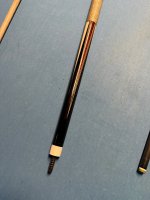
That cue is gorgeousThis is what a cue should look like.
No bling.
Full-splice Titlist.
View attachment 899698View attachment 899699View attachment 899700View attachment 899701

You are using an out of date browser. It may not display this or other websites correctly.
You should upgrade or use an alternative browser.
You should upgrade or use an alternative browser.
4-6 point cues with colored veneers and linen wraps are my favorite
- Thread starter Lowell
- Start date

My cue is at the top.thats the way ive had most of my cues made except with a black and a white hoppe(rambo) ring instead of the longer butt cap sleeve.
I had it made to resemble the bottom cue. It is a Titlist conversion made by George Balabushka.
that was also rambos style he was first with it. he also did the small two rings. like on a hoppe cue.
i have a couple like yours as well. one is a balabuska ebony with leather wrap
when house cues were on the wall titliest i used to buy them from the house for 5 to 8 bucks depending.. and give them to gene balner to make ones just exactly like yours.
20 to 25 bucks back then. 7 or 10 for a 2nd shaft. palmer then started making them himself and called it the number 4 in one of his early catalogs.
i have a couple like yours as well. one is a balabuska ebony with leather wrap
when house cues were on the wall titliest i used to buy them from the house for 5 to 8 bucks depending.. and give them to gene balner to make ones just exactly like yours.
20 to 25 bucks back then. 7 or 10 for a 2nd shaft. palmer then started making them himself and called it the number 4 in one of his early catalogs.
Last edited:
My cue is at the top.
I had it made to resemble the bottom cue. It is a Titlist conversion made by George Balabushka.
View attachment 900299
This + slightly bolder color would be perfect for me

How in the F are we on a billiards forum and none of you have ANY IDEA how sharp points are made? Im dumbfounded by the stupidity on here. Just WOW.
I've been drinking all night and this is the most ignorantly amazing thing I've ever seen. There's actually guys on here that have been posting for years that are absolutely clueless.
I've been drinking all night and this is the most ignorantly amazing thing I've ever seen. There's actually guys on here that have been posting for years that are absolutely clueless.
All of my guys can stand full scrutiny of a loupe, I've seen examples of very well known makers use marker. Should be run out of the businessBilly Stroud showed me how he would finish the rounded point with a razor knife to create a sharp point. Pretty easy actually. Then put in the inlayed point. You could not tell when it was done that it was not a splice unless you look closely.
The way to tell is at the pointed end in the point. On a splice each venner is a little different as it comes to a point due to the taper.
On an inlayed point they are unchanged.and the same.
As the cue is tapered the spliced point gets shorter. Inlayed points stay the same length as the cue is tapered. That is why they line up so perfectly, they are inlays. Spliced points if done correctly will line up perfectly as well.
I once refinished a Joss East cue and found the tips of the points were painted or inked on to make them come out even. The outside venner was black so this was almost undetectable.
On inlays in Ebony black tinted epoxy can be used to give the appearance of a more perfect fit. Tricks can be used.
I was at the BCA show once and picked up a Richard Black cue and took out my magnifer. He grabbed the cue from my hand and said "A cue must be examined at arms length with the naked eye".
He was probably right. A cue can look perfect from a small distance. Few cues could probably stand up to being examined with a loupe.
He literally builds the worst cues on the planet inlay wise, great design, but I can assure you, you don't need magnification to see the gaps. I've been saying this foreverThe Richard Black story is funny. I'm guessing he knows exactly where all of the non perfect areas (I hesitate to call them flaws) are on the cues he builds but most normal people will probably never notice. Its the same with the racecar chassis' I build, I know every area that I don't consider "perfect" but the owners never or rarely notice, sometimes even when I point something out.

Joss 2601 - Joss Cues - Custom cue - Handmade since 1968
Joss 20-61 long gracious lines. With five solid floating black points, pearl diamonds, and a matching diamond design in the rear, this cue has it all.
 josscues.com
Joss just released 4 new cues
3 of them are nice but pretty simple (no colors), while this one is totally up my alley! This is one of the nicest cues they released in a while, IMO.


CajunPopeye
Active member
Stephen's wife told me it's because the birds eye maple is harder to come by these days.the Curly Maple
Stephen's wife told me it's because the birds eye maple is harder to come by these days.
I think Curly Maple is fine anyway, though it gets repetitive being used in so many of their cues.
Even Pechauer and McDermott have cues that aren't super expensive with Birdseye.