Pool Ball Collecting.

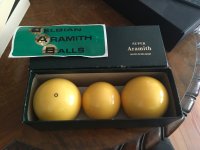
Hello. I'm new to the site. This is a very informative forum and the genuine friendships and generosity between contributors is wonderful. The reason I'm here is that I recently got a set of 2 1/16" clay agate balls. Pictured below.

I can't find any history of these. View attachment 794101K2K alludes to turn of the century but exactly when and what gives them their unique colors? Any information or even book recommendations would be greatly appreciated.

Thanks!
These balls are "speckled," not "agate." Speckled balls look like a Robin's egg, one color like a blue 2 ball with white specks. Your balls to look to have a tiny amount of other color specks as you may notice on your 9 ball. But on most of your balls you need reading glasses to see anything but white specks. Agate balls do not have specks within an overall solid color. Agates are made totally of ground-up bits of multiple colors. Early 1900's Agate balls may have been an agatized mix of red and white, possibly with small amounts of other colors making an overall red or pinkish-looking design. An example set like that sold very high a few years back, in the thousands. But some nearly identical balls sold for much less as the ground up bits were so tiny that the material looked like ground beef "hamburger balls" rather than "confetti" balls.
Other Agate balls resembled the traditional 8 different ball colors that had all 8 color bits (or 9 including white bits) - a green 6 resembled a solid green ball because in addition to the other colors, much more green bits were added to create an overall green look.
Your speckled balls are also not early 1900's ....they are in 1950's catalogs and we're listed as "molded balls" and were also sold in nearly identical non-speckled sets. I have a 1950's catalog that lists molded balls in 7 or 8 different sizes, but your speckled balls were made in fewer sizes. Your balls are just as nice looking as they would be if they were the only known set. But luckily for those that want to display a set, they are on eBay frequently for relatively cheap. The most beautiful pool ball set ever made, true Agate colors with thin Compo-Ivory, Brunswick style numbers in 2-1/4" full size have sold for at least $5,000.00. Be happy in a Buddhist billiard monastery that you have never seen them. Because you would have taken out a second mortgage to outbid the man who bought them.
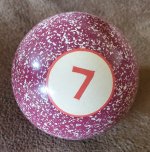
There is a set out there that are 2-1/4" and are white-speckled with red rings and red numbers. There is only one known complete matching set. I have only seen two loose single balls like them - check out this near-mint #7. Imagine what that set would sell for!
 

Attachments
  • 20260225_135309.jpg
    20260225_135309.jpg
    281.4 KB · Views: 14
Last edited:
These balls are "speckled," not "agate." Speckled balls look like a Robin's egg, one color like a blue 2 ball with white specks. Your balls to look to have a tiny amount of other color specks as you may notice on your 9 ball. But on most of your balls you need reading glasses to see anything but white specks. Agate balls do not have specks within an overall solid color. Agates are made totally of ground-up bits of multiple colors. Early 1900's Agate balls may have been an agatized mix of red and white, possibly with small amounts of other colors making an overall red or pinkish-looking design. An example set like that sold very high a few years back, in the thousands. But some nearly identical balls sold for much less as the ground up bits were so tiny that the material looked like ground beef "hamburger balls" rather than "confetti" balls.
Other Agate balls resembled the traditional 8 different ball colors that had all 8 color bits (or 9 including white bits) - a green 6 resembled a solid green ball because in addition to the other colors, much more green bits were added to create an overall green look.
Your speckled balls are also not early 1900's ....they are in 1950's catalogs and we're listed as "molded balls" and were also sold in nearly identical non-speckled sets. I have a 1950's catalog that lists molded balls in 7 or 8 different sizes, but your speckled balls were made in fewer sizes. Your balls are just as nice looking as they would be if they were the only known set. But luckily for those that want to display a set, they are on eBay frequently for relatively cheap. The most beautiful pool ball set ever made, true Agate colors with thin Compo-Ivory, Brunswick style numbers in 2-1/4" full size have sold for at least $5,000.00. Be happy in a Buddhist billiard monastery that you have never seen them. Because you would have taken out a second mortgage to outbid the man who bought them.
There is a set out there that are 2-1/4" and are white-speckled with red rings and red numbers. There is only one known complete matching set. I have only seen two loose single balls like them - check out this near-mint #7. Imagine what that set would sell for!
Hunger strike, that is some interesting information. Can you take a picture of the catalog page that shows these balls?
I would have guessed they were from around 1900 like in Mark and Connie Stellinga's book
17854495263378850272008899088227.jpg
 
Hunger strike, that is some interesting information. Can you take a picture of the catalog page that shows these balls?
I would have guessed they were from around 1900 like in Mark and Connie Stellinga's bookView attachment 920547
My catalog is Varela's from Kansas City, I will be on the road for months but other guys with catalogs can verify what I wrote. Many small dealers sold the "molded balls." As much as I respect the effort put into that book, please note how many items are decribed as being from the 1890's such as the Bulldog shake bottle (actually 1930's.) If you look at the set below yours in the book, the red agate parlor balls with black rosette number plugs, those are early 1900's. The sets are next to each other in the photo, anyone can plainly see the difference in age and style. I am just trying to help and be informative as it gains me nothing to misinform others - I have what I would guess to be in the top three pre-phenolic ball collections out there. If you want a set in your style to be rare, there is a small sized but identically designed set that is rare as hen's teeth. We should all be happy with all our sets. Except paper-label balls. They are trash and not worthy of display. Be happy, you have a cool set that is fortunately not out of reach for anyone who wants a set for under $100.
 
My catalog is Varela's from Kansas City, I will be on the road for months but other guys with catalogs can verify what I wrote. Many small dealers sold the "molded balls." As much as I respect the effort put into that book, please note how many items are decribed as being from the 1890's such as the Bulldog shake bottle (actually 1930's.) If you look at the set below yours in the book, the red agate parlor balls with black rosette number plugs, those are early 1900's. The sets are next to each other in the photo, anyone can plainly see the difference in age and style. I am just trying to help and be informative as it gains me nothing to misinform others - I have what I would guess to be in the top three pre-phenolic ball collections out there. If you want a set in your style to be rare, there is a small sized but identically designed set that is rare as hen's teeth. We should all be happy with all our sets. Except paper-label balls. They are trash and not worthy of display. Be happy, you have a cool set that is fortunately not out of reach for anyone who wants a set for under $100.
I'm not the guy with the ball set, although I do have that set. In the 1-7/8” I believe.
I also was not questioning your honesty or reason for your earlier statement about the ball set. I was interested in your resource about the ball set. I'm more of a visual type person. I was just trying to be a part of the conversation to get something constructive out of it.
At some point when you're done traveling I hope you can share some pictures of your collection and some knowledge to help others, like myself properly identify other older ball sets.
Safe travels
 
I'm not the guy with the ball set, although I do have that set. In the 1-7/8” I believe.
I also was not questioning your honesty or reason for your earlier statement about the ball set. I was interested in your resource about the ball set. I'm more of a visual type person. I was just trying to be a part of the conversation to get something constructive out of it.
At some point when you're done traveling I hope you can share some pictures of your collection and some knowledge to help others, like myself properly identify other older ball sets.
Safe travels
Sounds great... sorry I didn't realize that you were not the op guy. I probably have more than one molded ball catalog but I have seen several that have no photos.
 
Thank you for reviving this topic, hunger strike. I'm eager to learn more about these balls. I think most assumptions that they're from the 1890's are based on the book that Hard Knock Cues kindly attached. I have not found a lot of other information. I have attached a shot of the cue to show the cracking pattern. To me, the material suggests it is earlier than the 1950's but I can't be certain. They seem much older to me.
 

Attachments

  • DSC01669.JPG
    DSC01669.JPG
    66.1 KB · Views: 10
Thank you for reviving this topic, hunger strike. I'm eager to learn more about these balls. I think most assumptions that they're from the 1890's are based on the book that Hard Knock Cues kindly attached. I have not found a lot of other information. I have attached a shot of the cue to show the cracking pattern. To me, the material suggests it is earlier than the 1950's but I can't be certain. They seem much older to me.
I'm definitely interested in learning more as well. Although I have several older sets it's hard to determine what's clay and what's early composite sometimes. I guess most of those older balls could be considered molded as they used a mold to press them. Looking forward to more info and broadening my horizons.
 
Back
Top