4-6 point cues with colored veneers and linen wraps are my favorite

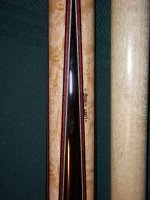
Some of them appear to have super sharp points. This one for example. It is a Handmade Custom though.
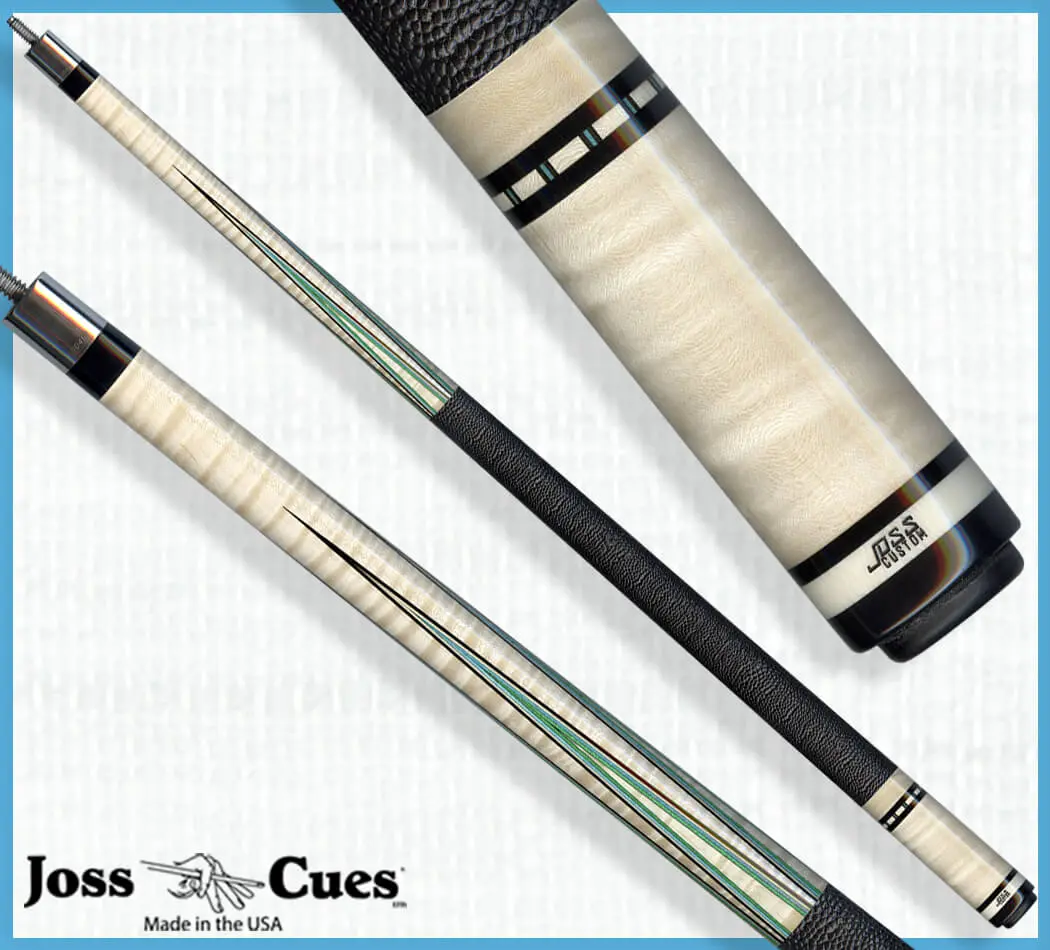
I was referring to the Joss cues on PoolDawg.
I know that Joss can and will make custom cues with sharp points, but most production aren't
 
I was referring to the Joss cues on PoolDawg.
I know that Joss can and will make custom cues with sharp points, but most production aren't

Oh, I like this one.


The last outer veneer point is rounded off, but the inner points and veneers look sharp.
 
Oh, I like this one.


The last outer veneer point is rounded off, but the inner points and veneers look sharp.
I don't like the thin points with the large gap between them at the base. I don't know why Joss (and others) make these
 
Oh, I like this one.


The last outer veneer point is rounded off, but the inner points and veneers look sharp.

That’s the one I got. I like it. I see what skor is saying on the skinny points. But for whatever reason it doesn’t seem that noticeable in person. That kind of thing can bother me, but on this cue it doesn’t.
 
That’s the one I got. I like it. I see what skor is saying on the skinny points. But for whatever reason it doesn’t seem that noticeable in person. That kind of thing can bother me, but on this cue it doesn’t.
I have a TS with somewhat thin gapped points, not as "bad" as the Joss but still enough to wish it wasn't like that....

tscruggs_002.jpg


tscruggs_003.jpg
 
That’s the one I got. I like it. I see what skor is saying on the skinny points. But for whatever reason it doesn’t seem that noticeable in person. That kind of thing can bother me, but on this cue it doesn’t.

Yeah, I like the wider points and veneers, where I can imagine them coming together below the wrap. Like on a Titlist cue for example.
 
I'd hazard a guess that it's both the type of tooling used and there's probably less chance of the points being uneven when the points aren't as sharp.

Even if I'm completely wrong, it would probably be a good discussion on Ask the Cuemaker.
It's the construction method. Round tipped points are inlaid rather than "spliced" in. One could argue that short splice points are still inlaid simply because the point wood doesn't extend below the A joint. But short splice points are a installed in a way that is exponentially more similar to full splice than the inlaid points like most production cues have. The pockets for either type of construction can be made using CNC, though.
 
It's the construction method. Round tipped points are inlaid rather than "spliced" in. One could argue that short splice points are still inlaid simply because the point wood doesn't extend below the A joint. But short splice points are a installed in a way that is exponentially more similar to full splice than the inlaid points like most production cues have. The pockets for either type of construction can be made using CNC, though.

What @skor is saying is that it is possible to create a cnc pocket that results in a nearly perfectly sharp point. There are at least two ways of doing this. One is not truly full CNC, as it would be for person to hand-cut the sharp angles with the sharp instrument of his choice.

Another would be to use an angled cutter, likely an engraving bit, to finish the pocket and to taper-cut the edges with the bit cutting up and out at all corners. This would result in the pockets being very similar to a true point for a short distance at the point. The inlay would be cut with a matching bevel.

I expect there are several reasons the large companies choose not to do this. First, not enough people really care. Second, they might not have the cad/cam expertise to do this. Third, it is another step that requires at least one more tool change in the point and will take more time. Fourth, the inlay is more delicate and requires more care when installing.
 
Billy Stroud showed me how he would finish the rounded point with a razor knife to create a sharp point. Pretty easy actually. Then put in the inlayed point. You could not tell when it was done that it was not a splice unless you look closely.

The way to tell is at the pointed end in the point. On a splice each venner is a little different as it comes to a point due to the taper.
On an inlayed point they are unchanged.and the same.
As the cue is tapered the spliced point gets shorter. Inlayed points stay the same length as the cue is tapered. That is why they line up so perfectly, they are inlays. Spliced points if done correctly will line up perfectly as well.

I once refinished a Joss East cue and found the tips of the points were painted or inked on to make them come out even. The outside venner was black so this was almost undetectable.

On inlays in Ebony black tinted epoxy can be used to give the appearance of a more perfect fit. Tricks can be used.
I was at the BCA show once and picked up a Richard Black cue and took out my magnifer. He grabbed the cue from my hand and said "A cue must be examined at arms length with the naked eye".
He was probably right. A cue can look perfect from a small distance. Few cues could probably stand up to being examined with a loupe.
 
Billy Stroud showed me how he would finish the rounded point with a razor knife to create a sharp point. Pretty easy actually. Then put in the inlayed point. You could not tell when it was done that it was not a splice unless you look closely.

The way to tell is at the pointed end in the point. On a splice each venner is a little different as it comes to a point due to the taper.
On an inlayed point they are unchanged.and the same.
As the cue is tapered the spliced point gets shorter. Inlayed points stay the same length as the cue is tapered. That is why they line up so perfectly, they are inlays. Spliced points if done correctly will line up perfectly as well.

I once refinished a Joss East cue and found the tips of the points were painted or inked on to make them come out even. The outside venner was black so this was almost undetectable.

On inlays in Ebony black tinted epoxy can be used to give the appearance of a more perfect fit. Tricks can be used.
I was at the BCA show once and picked up a Richard Black cue and took out my magnifer. He grabbed the cue from my hand and said "A cue must be examined at arms length with the naked eye".
He was probably right. A cue can look perfect from a small distance. Few cues could probably stand up to being examined with a loupe.
The Richard Black story is funny. I'm guessing he knows exactly where all of the non perfect areas (I hesitate to call them flaws) are on the cues he builds but most normal people will probably never notice. Its the same with the racecar chassis' I build, I know every area that I don't consider "perfect" but the owners never or rarely notice, sometimes even when I point something out.
 
The Richard Black story is funny. I'm guessing he knows exactly where all of the non perfect areas (I hesitate to call them flaws) are on the cues he builds but most normal people will probably never notice. Its the same with the racecar chassis' I build, I know every area that I don't consider "perfect" but the owners never or rarely notice, sometimes even when I point something out.
Black was right in that there is a reasonable level to examine anything. I used to in the early 80s buy and sell gold, silver and occasionally diamonds. Even diamonds have a reasonable exceptince of flaws. A diamond used to be, maybe still is, called flawless if flaws could not be detected under a 10x magnifier. Put it under a scope maybe 100x it may shows a number of tiny flaws.
That gold buying in the early 80s was very short lived. It took about a year for laws to be passed to catch up with this new gold buying enterprise.
People made millions though while it lasted.
 
The Richard Black story is funny. I'm guessing he knows exactly where all of the non perfect areas (I hesitate to call them flaws) are on the cues he builds but most normal people will probably never notice. Its the same with the racecar chassis' I build, I know every area that I don't consider "perfect" but the owners never or rarely notice, sometimes even when I point something out.
I remember this bill schick from a long time ago, the fact this was done by hand, i thought was amazing.
The photography was so good, stuff you would not of seen unless you can zoom in. Anyway amazing cue.

 
And btw, to the topic of the thread, all the cues I've had built, none have inlays, (unless in the rings) im all about points and rings. With nice wood, is enough for me.
Look at the modern trend, guys are just as happy with decals and painted butts, that look like exotic wood, or a very thin veneer version with fancy designs.
 
Last edited:
Back
Top