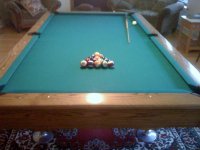
1-Pocket Break Question

I agree spin makes aiming this exacting shot a little harder, but I can't agree that there's no need for it except to protect from the corner ball shot. The other benefit of it is to bring the CB to rest as close to the side rail as possible in order to limit your opponent's control of the CB. This makes it more difficult for him to use backspin or sidespin, which can limit his return shot choices and effectiveness. If the break shot is the most important one in 1 pocket, your opponent's first shot after the break is arguably the next most important one.

pj
chgo

I agree the break shot is the most important shot, and the answer is equally important. many of the younger players ask me to show them how to break,( after I give them a lot of weight) when I do, most discard the idea when I say no side just a firm stroke thru. I tried to post a wei table layout but no luck, first try on this site.
PS; I said no one would agree with me.
 
Last edited:
Actually, the inside serves a purpose. You can Hit the balls Harder if you use more - the reverse english on the botom rail Kills the cueball, the amount of top you use serves three purposes - one, to minimize deflection caused by the inside you use, and two, on a new enough cloth it kills the cue a tad off the bottom rail as well. The other is the fact you are nearly a perfect scratch on a one pocket break, until the top takes, and you curve into the bottom rail.

Most who break this way play the ball in their pocket, Ilike getting it close enough there is danger for the opponent immediately following the break.

I understand you thoughts on this subject. It's only a scratch if you hit the head ball to thin, and I do use some force thru the CB. Also hitting the head ball too thin is what forces the corner ball out on your opponents side. I'm not really interested in making a ball (although I'll take it ) I want to keep my opponent behind the stack, and I don't ever want the corner ball to come out.
PS; I said nobody would agree with me. And yes I have played thousands of games.
 
I understand you thoughts on this subject. It's only a scratch if you hit the head ball to thin, and I do use some force thru the CB. Also hitting the head ball too thin is what forces the corner ball out on your opponents side. I'm not really interested in making a ball (although I'll take it ) I want to keep my opponent behind the stack, and I don't ever want the corner ball to come out.
PS; I said nobody would agree with me. And yes I have played thousands of games.

I agree with your observations about the opponents ball coming out, but I think its more from the angle of the hit rather than the spin. On decently clean balls Ive had little trouble with that - Adjusting the cue away from the rail helps, because of the obs. you made - too much of ball 2 = scratch/ball poppin out/2nd kiss problems.

I understand you have probably mastered your technique, without totally disagreeing(Safe better than sorry - I agree with your safe option if it works for you) I still have to recommend to try about 1/2 to 2/3 tip inside, with mximum top. The top will decrease the deflection and allow you to aim more accurately. Plus, the top causes the cue to snag and go away from the pocket. The snag slows whitey down, and the spin left on it kills off the bottom rail. This is how you safely play a harder break in one hole....
 
the rack

Make sure all the balls (your side) are frozen. If you're still scratching with the row frozen, forget the first ball and break on the second.

I know I shouldn't do this, but it's raining like crazy here, I'm bored. Can't get to the ball hall. I have a lot of unconvential ideas about the break, I think you rack them frozen for your opponent for your own protection. When my opponent wants to rack his own, I say fine you can rack for both of us. When they're having trouble freezing them for me I say " thats fine don't worry about it they're OK"
 
I agree with your observations about the opponents ball coming out, but I think its more from the angle of the hit rather than the spin. On decently clean balls Ive had little trouble with that - Adjusting the cue away from the rail helps, because of the obs. you made - too much of ball 2 = scratch/ball poppin out/2nd kiss problems.

I understand you have probably mastered your technique, without totally disagreeing(Safe better than sorry - I agree with your safe option if it works for you) I still have to recommend to try about 1/2 to 2/3 tip inside, with mximum top. The top will decrease the deflection and allow you to aim more accurately. Plus, the top causes the cue to snag and go away from the pocket. The snag slows whitey down, and the spin left on it kills off the bottom rail. This is how you safely play a harder break in one hole....

Yes I agree about the angle of the hit, it's the spin that causes me to miss my target and hit too thin. One more try at the WEI layout, if it comes thru you'll see I can live with my result. Of course not all will be like this, but I won't scratch or have the corner ball come out. If one leaks up and they can tip of it and play safe they haven't moved any balls away.

CueTable Help

 
When they're having trouble freezing them for me I say " thats fine don't worry about it they're OK"

That's a mistake. Even a small gap can cause the ball behind the gap to move before the cue ball gets to it, or at the same time. This can kick the cue ball out and into the corner pocket. BTW, as a courtesty to my opponent I always rack with the 1 ball on the spot and the 8 ball as the second ball. This gives the most contrast. The opposite would be something like the 6 ball on the spot and the 8 ball second.

Always learning............Paul
 
1st ball vs 2nd ball break

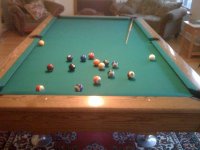
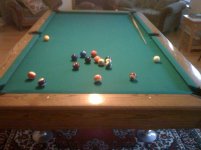
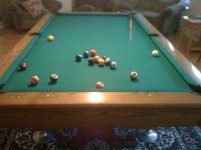
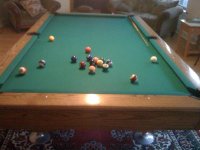
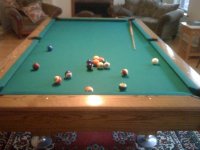
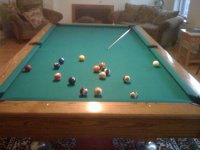
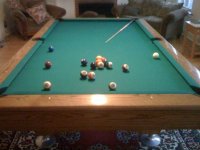
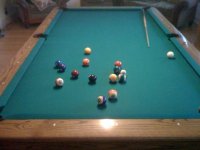
I hit a bunch of 1st ball and 2nd ball breaks and took snapshots of the results to compare the difference. I'm posting the 4 most typical of each so we can compare. I racked the balls in numerical order (top to bottom, left to right as you face the rack when racking) so we can see where each ball in the rack goes.

Please post whatever consistent differences you notice between the two kinds of breaks.

pj
chgo

Here are the 1st ball breaks:

1pkt brk - 1st ball #A.JPG
1pkt brk - 1st ball #B.jpg
1pkt brk - 1st ball #C.jpg
1pkt brk - 1st ball #D.JPG
 
1st ball vs 2nd ball break

Here are the 2nd ball breaks:

1pkt brk - 2nd ball #A.JPG
1pkt brk - 2nd ball #B.JPG
1pkt brk - 2nd ball #C.JPG
1pkt brk - 2nd ball #D.JPG
This last one is a little atypical - the 15 ball is frozen to the foot rail next to the pocket (just out of the picture at the bottom right).
 
Last edited:
1st ball vs 2nd ball break

Except for where I hit the rack, I broke the same way each time: CB 1 inch from the side rail on the head string, normal flat-on-the-rail bridge, 2:00 o'clock top right english.

Here's the break setup:

1pkt brk - start.JPG
 
This is the 1 pocket break that just about every 1 pocket player uses (Corey is probably the player who uses it the least).

The most common danger of the 1 pocket break (aside from scratching) is that the nearest corner ball will end up too near your opponent's corner pocket, selling out a shot:

CueTable Help


An alternative break that minimizes this danger (but doesn't spread as many balls toward your own pocket) is to use the same technique but one ball farther down the side of the rack (just clipping the second ball rather than the head ball):

CueTable Help


pj
chgo
i thought that you had to strike the head ball in one pocket?? please correct me if i am wrong....i am still learning how to play this game.
 
The first things I notice about the 2nd ball break are:

1. I rarely get balls close to my pocket.

2. The corner ball moves less (about half as much).

3. More balls move, but they move shorter distances.

4. The "clutter" between the stack and the foot rail seems greater, maybe complicating the answering shot?

As expected, the 2nd ball break is more defensive than the 1st ball break, having less risk and creating fewer threats for the opponent. The 1st ball break is slightly riskier but noticably more offensive. On balance I like the 1st ball break - I guess that's not much of a surprise.

pj
chgo
 
Last edited:
The first things I notice about the 2nd ball break are:

1. I rarely get balls close to my pocket.

2. The corner ball moves less (about half as much).

3. More balls move, but they move shorter distances.

4. The "clutter" between the stack and the foot rail seems greater, maybe complicating the answering shot?

As expected, the 2nd ball break is more defensive than the 1st ball break, having less risk and creating fewer threats for the opponent. The 1st ball break is slightly riskier but noticably more offensive. On balance I like the 1st ball break - I guess that's not much of a surprise.

pj
chgo

Very good job with the pics. Thanks for the trouble. Here's a little more of my craziness, try breaking with you bridge hand on the table surface, get comfortable, last couple fingers on the rail if you need, in order to be in the proper spot. You can make your bridge a little tighter, it's more solid and also helps me hit my target better. I'm sure no one will agree with this either.
Rod.
 
Your just trying to feather the head ball with inside english. If you can get a ball on the shortrail near your hole and a ball on the longrail near your hole and have the cueball float near the first diamond shy of the side pocket with the stack keeping your opponent from making contact with the two forementioned balls. He (or she) ain't gonna like it! If you really enjoy onepocket stop by onepocket.org it's a great site with many great players.
 
Very good job with the pics. Thanks for the trouble. Here's a little more of my craziness, try breaking with you bridge hand on the table surface, get comfortable, last couple fingers on the rail if you need, in order to be in the proper spot. You can make your bridge a little tighter, it's more solid and also helps me hit my target better. I'm sure no one will agree with this either.
Rod.

Sounds like you use a closed bridge, which I find harder to aim with. I have tried moving the ball away from the side rail (maybe 6 inches) to see if that would help control the corner ball, but I get less movement toward my pocket that way and I don't aim it as well (both because the head ball must be hit thinner, I think). In terms of aggressive/defensive balance I think that falls somewhere between the 1st ball break and the 2nd ball break.

pj
chgo
 
i thought that you had to strike the head ball in one pocket?? please correct me if i am wrong....i am still learning how to play this game.

NO, Its not required, people miss the head ball often, although not trying to.
 
Good job with the pictures Patrick. More than a few of those breaks look very strong. Are you left handed?
 
This is the break that Buddy Hall describes Hubert Cokes advocates

Your just trying to feather the head ball with inside english. If you can get a ball on the shortrail near your hole and a ball on the longrail near your hole and have the cueball float near the first diamond shy of the side pocket with the stack keeping your opponent from making contact with the two forementioned balls. He (or she) ain't gonna like it! If you really enjoy onepocket stop by onepocket.org it's a great site with many great players.

Philw:

This is precisely the break that Buddy Hall would reminisce Hubert Cokes advocating -- he (Hubert, a.k.a. "Daddy Warbucks") would call this break "one high, one low" (that is, one near your hole on the long rail, one near your hole on the short rail). And yes, as long as that corner ball didn't leak out towards your opponent's pocket, and those "one high, one low" balls are eclipsed (hidden) by the pack, your opponent "doesn't have to" like this break!

-Sean
 
I've really started enjoying playing 1-pocket. Unfortunately my break sucks. Does anyone have any videos, examples of what to strive for during the one pocket break? I know the break is supposed to be an advantage to the breaker but for me it is just the opposite.....:frown::frown::frown:

I have struggled with my 1 hole break also. Even if you watch a pro match there will be at least 1 flubbed break attempt it seems.

After watching a Bert Kinster (sp) video he did a break where he skims the second ball back and hits the 3rd ball. This works much much better for me. It seems easier to control and the chances of me scratching or selling out the corner ball are greatly reduced. It also doesnt put the head ball just below the side and give your opponent the opportunity for an easy escape by banking a ball into the stack and doubling you up down table.
 
Back
Top