2 questions about shaper materials....

chefjeff

If not now...
Silver Member
I'd appreciate some info on shapers if you have it...thanks in advance.

I have a Willard shaper and I'd like to know exactly what material(s) it is that does the actual shaping. It is brass and silver colored and is the stuff inside the nickle shaped dimple..What is that stuff?

Also, a friend has an "It's George" shaper that is made of something else. It is really aggressive when using and can damage a tip in a heartbeat. It looks like broken glass except it is a chrome-like metal.

Anyone know what those materials are?

Thanks,

Jeff Livingston
 
I have a George, willard, and a bunch of other shapers. I love the George over all of them but I wouldn't use it on a soft tip and I haven't tried it on a non layered tip. I'm not sure but I think the George material is nickel. I can't remember where I heard it so don't quote me on that.
 
I have a George, willard, and a bunch of other shapers. I love the George over all of them but I wouldn't use it on a soft tip and I haven't tried it on a non layered tip. I'm not sure but I think the George material is nickel. I can't remember where I heard it so don't quote me on that.

Thanks, junkyarddog.

Anyone else know more details?...please?

Jeff Livingston
 
Silicon Carbide (SiC)

I'd appreciate some info on shapers if you have it...thanks in advance.

I have a Willard shaper and I'd like to know exactly what material(s) it is that does the actual shaping. It is brass and silver colored and is the stuff inside the nickle shaped dimple..What is that stuff?

Also, a friend has an "It's George" shaper that is made of something else. It is really aggressive when using and can damage a tip in a heartbeat. It looks like broken glass except it is a chrome-like metal.

Anyone know what those materials are?

Thanks,

Jeff Livingston

Jeff:

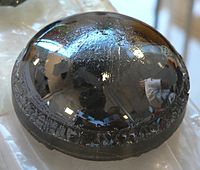
This material is silicon carbide. You can see pictures of this material in the aforementioned Wiki article, in its raw state, and you'll recognize the shiny silverish/yellowish appearance, depending on which way the light is hitting it (read the "Production" section in the Wiki article).

180px-Silicon_carbide_chunk.jpg
200px-SiC_p1390066.jpg


I'm sure you also recognize its name -- SiC (Mendeleveen molecular name) is one of the more commonly-used abrasives in the industry, and even occurs naturally as the rare mineral Moissanite. It is easily synthesized in an electric furnace.

When shattered into shards, it is extremely sharp, and looks like "metallic glass" (or even shards of raw metal, again, depending on the purity and how the light hits it), as you've noted in the above-mentioned shapers.

I'm sure this is probably all you wanted to know, and more, about SiC. :D

Hope this is helpful,
-Sean
 
Thanks, guys....very helpful info.

I still haven't figured out what the It's George is made of. It seems much rougher and sharper than the silicone carbide stuff.

Does this stuff ever wear out? My Willard is still working after many years.

Jeff Livingston
 
another possible material

Thanks, guys....very helpful info.

I still haven't figured out what the It's George is made of. It seems much rougher and sharper than the silicone carbide stuff.

Does this stuff ever wear out? My Willard is still working after many years.

Jeff Livingston

Thanks, guys....very helpful info.

I still haven't figured out what the It's George is made of. It seems much rougher and sharper than the silicone carbide stuff.

Does this stuff ever wear out? My Willard is still working after many years.

Jeff Livingston

The materials are generally available in different grits. Another one that I think would be excellent to use on a shaper is a metal or mineral that is brazed on the shoes of the horses used by the police and others on pavement. It makes the shoes last a lot longer and makes them bite into the pavement. Starts with a "B" I believe, maybe boron? I suspect a little searching would turn up just what that material is.

Hu
 
Silicon carbide can wear many faces

Thanks, guys....very helpful info.

I still haven't figured out what the It's George is made of. It seems much rougher and sharper than the silicone carbide stuff.

Does this stuff ever wear out? My Willard is still working after many years.

Jeff Livingston

Jeff:

I'll bet you that the It's George abrasive material is also silicon carbide. Do not overlook the fact that SiC can be made into any consistency, from a fine powder, to a grit, to extremely sharp broken shards. It is how it is prepared, that determines the consistency -- if it's ground with pressure, you get grit. If it's impacted, you get shards.

Since SiC is harder than any metal and most other abrasives, no, it won't wear out -- the only things that can "damage" SiC are even harder boron carbide / boron nitride, diamond, or other Superhard materials. The only thing even remotely presenting a "scare" to SiC as far as a cue tip is concerned is the cue tip chalk itself, and even then, "chalk" as we call it, isn't even chalk (calcium carbonate) at all. It's a mixture of silica and aloxite (aluminum oxide). It'll still dull regular metals, but doesn't stand a chance against SiC.

If you're not convinced, you might want to contact the makers of the "It's George" tip tool and inquire. Depending on how you introduce yourself (i.e. not as someone who wants to rip-off the design), you'll probably get your answer. You seem to be really emphatic that the It's George tip tool and construction is revolutionary or magical, but I'm sure that once you get confirmation from an authoritative source (i.e. the manufacturer), you'll be pleasantly surprised at the commonality/recognizability (if that's a word?) of its construction and materials.

P.S.: oh, and btw -- it's silicon, not silicone. The former is a naturally-occuring element, the latter is a man-made rubber-like polymer. Very, very different materials. :D

Hope this is helpful,
-Sean
 
Last edited:
Back
Top