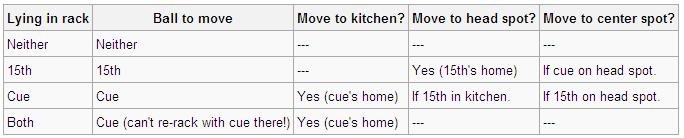
I often encounter situations during the re-rack where either the 15th ball, cue ball, or both are in the rack. There is a BCA table of rules that tells you what to do and where to place the balls, but it is hard to memorize. Here I introduce an analogy I made up that I feel is easy to remember as a procedure rather than a table:
----
The cue ball lives in the kitchen.
The 15th ball lives in the head spot.
A ball must return home if he is "caught" hanging out in the rack area (during re-rack).
Only one ball may be selected to go home.
Upon returning home, if a ball sees that his house has someone else in it, he gets scared and goes somewhere else instead.
----
That's it. Using this logic, all of the BCA rules are covered (see attachment):
I've also added this to the Straight Pool wikipedia page.
----
The cue ball lives in the kitchen.
The 15th ball lives in the head spot.
A ball must return home if he is "caught" hanging out in the rack area (during re-rack).
Only one ball may be selected to go home.
Upon returning home, if a ball sees that his house has someone else in it, he gets scared and goes somewhere else instead.
----
That's it. Using this logic, all of the BCA rules are covered (see attachment):
I've also added this to the Straight Pool wikipedia page.