
You are using an out of date browser. It may not display this or other websites correctly.
You should upgrade or use an alternative browser.
You should upgrade or use an alternative browser.
Ask the Cuemaker...cue xrays....
- Thread starter DrJ
- Start date

So did you find wharever made you think of such?DrJ said:Thank you for the really excellent info...one of the cues involved may have a crack/defect...but mainly I want to look at the construction to help identify who may have made them...the x-ray machine involved is used for inspecting electronic assemblies, so I'm hoping it'll serve for this purpose also...hopefully, if the machine is available next week, and the pics work out, I'll have something to post then....
You know....it could be screwed into the weight bolt as how it's normally done but my observation is that the weight bolt was installed prior to installing the buttcap as no weight bolt cavity continuation is visualized around the stem of the rubber bumper screw. So this leads me to believe that the bumper is screwedribdoner said:Quick Quiz
The bolt which secures the rubber bumper is screwed into the XXXXXXXXX?
Pos rep to first correct answer
onto the buttcap.
Again, the boxed area shows lower density and is most likely air as the outside of the cue shows air to display in a lighter sepia shade on this fluorograph.
Attachments
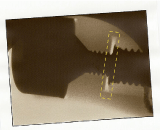
Last edited:

Adam, I'm going to guess it is phenolic but I really don't know. I was surprised to see the furniture bolt coming from the forearm in a disassembled Balabushka at Ginacue a few years ago. Ernie pointed out how the points had been made even with black india ink. This was a 5 veneer cue.
Martin
Martin
ribdoner said:Quick Quiz
The bolt which secures the rubber bumper is screwed into the XXXXXXXXX?
Pos rep to first correct answer
DrJ said:I haven't taken any of the cues apart yet...so I'm not sure...but I always assumed that the hex screw holding the bumper was screwed into the weight bolt....
As in Health Care, the Radiologist offers his impression on the radiographpresented and the Attending Physician takes apart (oops
), I mean, does the physical examination on the patient.Very interesting study presented though. Your butt-end image shows that this cue isn't consumer-weight-adjustable. This leads me to think that GB maintains his Balance point (BP) or had to bring the cue's weight up to a customer's request.
Below are edited images that show how the fluorograph images would have possibly been had the cue been made "weight-adjustable" by the consumer.
Attachments
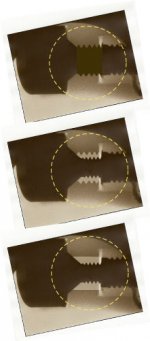

A handfull of makers used a threaded sleeve which the rubber bumper retaining bolt screwed into. Those who did this includes, but is not limited to, GB, STROUD, TASC., etc.
The threaded metal sleeve was called a "tang". These cues tended to resonant in a unique and pleasing (to me) manner.
I would speculate they fell out of favor because tangs tended to add weight and not many consumers appreciated (or missed) the extra manufacturing step.
Pos rep to those who played
Happy New Year
The threaded metal sleeve was called a "tang". These cues tended to resonant in a unique and pleasing (to me) manner.
I would speculate they fell out of favor because tangs tended to add weight and not many consumers appreciated (or missed) the extra manufacturing step.
Pos rep to those who played
Happy New Year

blusystems
Banned
Glad I was around for this, Happy New Year
Having viewedthe actual photo of a like specimen http://www.discountpoolcues.com/originalbalabushkarubberbumpers.htm and being able to co-relate the densities to the actual materials I'd say that your fluoro image shows faithful reproduction of the construction system.DrJ said:Check out the "Bumper and Weight Bolt" link of this other cue I found:
http://www.discountpoolcues.com/originalbalabushkehomepage.htm
Then...I wonder if the "contrast adjust knob" on the fluoroscope was sometimes just adjusted to be blurring out details, and making some things really hard to analyze....
Seeing the actual specimen is real important when reading radio/fluorographs of cues. Cue radiograph interpretation is a little trickier than human radiograph interpretation. In medical radiographs, there is a basis..Normal Human Anatomy. Cues on the other hand may show similar external features but internal construction systems vary from cuemaker to cuemaker. Thank you for that link and great thread.
As in where a knife handle is attached?ribdoner said:A handfull of makers used a threaded sleeve which the rubber bumper retaining bolt screwed into. Those who did this includes, but is not limited to, GB, STROUD, TASC., etc.
The threaded metal sleeve was called a "tang". These cues tended to resonant in a unique and pleasing (to me) manner.
I would speculate they fell out of favor because tangs tended to add weight and not many consumers appreciated (or missed) the extra manufacturing step.
Pos rep to those who played
Happy New Year
So this "tang" and its purpose, weapon, completes the relational link of the cue to a katana! Thank you for sharing that info.
bandido said:As in where a knife handle is attached?
Your welcome! Thank you for sharing your wealth of knowledge and keep making your DYNO cues.
Happy New Year, Adam

x-ray
In my opinion I think this is a waste of time and resources. To most of you, I seriously doubt that you could interpret any real value to them. One needs trainning in this field. Light and dark areas have meaning as well as the obvious. As far as alignment goes everything is altered to some degree once internal parts are installed and then turned again. If everything looks good, feel good, hit good, Why x-ray it. X-ray is a Diagnostic tool. for sake of cues it would be very obvious if an insert, screw, or pin was broken.
So I beg the question WHY??
In my opinion I think this is a waste of time and resources. To most of you, I seriously doubt that you could interpret any real value to them. One needs trainning in this field. Light and dark areas have meaning as well as the obvious. As far as alignment goes everything is altered to some degree once internal parts are installed and then turned again. If everything looks good, feel good, hit good, Why x-ray it. X-ray is a Diagnostic tool. for sake of cues it would be very obvious if an insert, screw, or pin was broken.
So I beg the question WHY??

bubsbug said:In my opinion I think this is a waste of time and resources. To most of you, I seriously doubt that you could interpret any real value to them. One needs trainning in this field. Light and dark areas have meaning as well as the obvious. As far as alignment goes everything is altered to some degree once internal parts are installed and then turned again. If everything looks good, feel good, hit good, Why x-ray it. X-ray is a Diagnostic tool. for sake of cues it would be very obvious if an insert, screw, or pin was broken.
So I beg the question WHY??
To learn more about construction techniques of others, and the results of said construction techinques.
Kelly
You are right that one needs training in the field to fully take advantage of this science. I'm lucky to have formal training and been an assistant to a number of Radiologists. There too are some very sharp cookies out there that can understand what they're looking at with a simple intro to the science.bubsbug said:In my opinion I think this is a waste of time and resources. To most of you, I seriously doubt that you could interpret any real value to them. One needs trainning in this field. Light and dark areas have meaning as well as the obvious.
Just for shits and giggles!bubsbug said:As far as alignment goes everything is altered to some degree once internal parts are installed and then turned again. If everything looks good, feel good, hit good, Why x-ray it. X-ray is a Diagnostic tool. for sake of cues it would be very obvious if an insert, screw, or pin was broken.
So I beg the question WHY??
Serious answer:
Now that statement (in bold) is one reason why radiography can help somebody who cares of how he builds his cue. X-ray, as you said, is a diagnostic tool. But that's just half of the story because radiography, too, is an inspection tool. It is not exclusive to determining the source of problems encountered but also to determine if ones production technique is optimal. I personally have developed my cuemaking technique with the aid of radiography from whence I started in 1986. The product of combining what I discovered while employing radiography, knowledge picked-up from other wood related industries, current technology, feedback from longtime cue dealers, collectors, other pool playing afficionados (amateur and pros) and my own shop and actual playability testing is my current cuemaking system.
But you're right. X-ray imaging, alone, is worthless that's why the OP asked for assistance.
Last edited:
Ok! Why stop there though! X-ray machines in our day in age is old technology. Let get the cat scan and MRI machines envolved. Let's add $2000 to every cue that undergo these procedures that are sold. lets give cuemakers a formal title and degree.
I too have very limited education in this field. No where near the training that you have. But I do have questions concerning x-raying a celloulos material, ie wood. much different then dence bone. I would venture to bet that I could actually break a forearm Maybe a greenstick fracture and excluding a raidiolgist, I bet that you wouldn't be able to tell the difference betwee the fracture and some serious cheeking. Wood is porous. Imagine a sipping straw. Microscopicly wood is nothing more than a bunch of straws grouped together. I just see limited use thats all.
Then again I would do anything for shits and giggles!! If I could do it for free!!
I too have very limited education in this field. No where near the training that you have. But I do have questions concerning x-raying a celloulos material, ie wood. much different then dence bone. I would venture to bet that I could actually break a forearm Maybe a greenstick fracture and excluding a raidiolgist, I bet that you wouldn't be able to tell the difference betwee the fracture and some serious cheeking. Wood is porous. Imagine a sipping straw. Microscopicly wood is nothing more than a bunch of straws grouped together. I just see limited use thats all.
Then again I would do anything for shits and giggles!! If I could do it for free!!