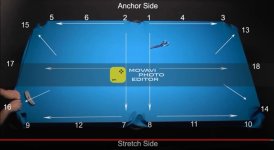
Cloth stretch index.

Probably by following the stretching order shown in the photo and the stretching index of the felt used, everywhere on the table, the work will be excellent and even on the ends of the table, that's what I I understood. Since I'm not an expert, I'll go everywhere with measurements instead of feel.
Opera Instantané_2023-07-31_034932_www.youtube.com.png
 
Probably by following the stretching order shown in the photo and the stretching index of the felt used, everywhere on the table, the work will be excellent and even on the ends of the table, that's what I I understood. Since I'm not an expert, I'll go everywhere with measurements instead of feel.View attachment 738944
15, 16, 17, 18 are done before 13 and 14.
 
Probably by following the stretching order shown in the photo and the stretching index of the felt used, everywhere on the table, the work will be excellent and even on the ends of the table, that's what I I understood. Since I'm not an expert, I'll go everywhere with measurements instead of feel.View attachment 738944
If you stretch and stick 13, 14 first, you're preventing the ability of stretching the cloth from corner to corner first, by only being able to stretch from the center to the corner. That means the center if the clothbis only stretched in length, and not side to side as well. Get your corner pocket grain of cloth pulled back and straight into each corner before you stretch for length. Then when you do stretch for length, all you need is a straight back pull, and it's much easier if you start that pull close to each corner pocket first, working your way to the center of the slate, you have more leverage that way.
 
15, 16, 17, 18 are done before 13 and 14.
Good, that make
If you stretch and stick 13, 14 first, you're preventing the ability of stretching the cloth from corner to corner first, by only being able to stretch from the center to the corner. That means the center if the clothbis only stretched in length, and not side to side as well. Get your corner pocket grain of cloth pulled back and straight into each corner before you stretch for length. Then when you do stretch for length, all you need is a straight back pull, and it's much easier if you start that pull close to each corner pocket first, working your way to the center of the slate, you have more leverage that way.
Ok very good I understand very well, Thanks a lot for these precious details!
 
What about corner to corner?Same max stretch?
If you're talking about the end of the slate, the corners are only stretched towards the pocket to straighten the weave of the cloth, then stop at the stretch index line for end stretch. At first the 4 corner pockets are easy, then as you close of the first end stretch it gets a little harder, but when you go to the other end, and stretch that cloth, that can be a bitch!! That stretch right there will tell you if you need to take out and 1/8" inch of your side to side stretch, or if you feel you can stretch past your line on the second end, then go back and add an additional 1/8" stretch to your side to side to side stretch. That is how you dial the cloth in for perfect installs. But, that stretch index only works for that specific cloth, and that specific slate. Once that is a known number, then you can calculate the stretch for any size table with that specific cloth, by knowing how much per inch it will stretch!!!
 
So when marking the short rails ends for stretch do you half the stretch index on each end or use full index to stretch end to end?
If your stretch side to side is 1 3/8" then both ends of the slate get the same 1 3/8" stretch. Think twice as long compared to side to side.
 
I also noticed in your Youtube video you anchored 13 and 14 before 15 16 and 17 18? You did go back and stretch 13 and 14 more though.
Watch it again, but watch the full recover of a Valley table. I changed up the stretch order on the ends of the slate because something I've done for almost 40 years I started realizing it wasn't as easy for newcomers. So, by stretching the 4 corner pockets first, it makes it much easier to achieve the same outcome, just easier.
 
Last edited:
Watch it again, but watch the full recover of a Valley table. I changed up the stretch order on the ends of the slate because something I've done for almost 40 years I started realizing it wasn't as easy for newcomers. So, by stretching the 4 corner pockets first, it makes it much easier to achieve the same outcome, just easier.
Gotcha!
 
We stretch our 860, 2 inches on the short side and 1 3/4 inches at each end of the long side, and it's perfect, very little play after a while and equally on both sides. Stretching more on the long side than the short side is WRONG.
 
YkjyrZG.jpeg

This will serve you better. Glen will concur, he now stretches the corners on the ends first.
The side stretch will feel a bit light, and the temptation to go more there than the ends should be resisted with Simonis. Unlike some cloths, it stretches the same in both directions, and you want it to be balanced. You know you have the right index when your end pulls are needing some muscle.
Another nice tip on a table with deep side pocket cuts is to close off your side pockets before you pull the ends. I find I can get away with a little less slack this way. Watch the grain in front of the pocket closely and pull it straight when you do this.

 
From everything I've read here, everyone stretches the length more than the width, and that's a mistake. If the length is stretched more than the width, the width will loosen quickly, and that's a fact. This is because the width is greater than half the length. 57 x 107 is an example. At first, I stretched like the professionals here, and I quickly realized it was wrong. I just wanted to share this for anyone who might find it useful.
 
YkjyrZG.jpeg

This will serve you better. Glen will concur, he now stretches the corners on the ends first.
The side stretch will feel a bit light, and the temptation to go more there than the ends should be resisted with Simonis. Unlike some cloths, it stretches the same in both directions, and you want it to be balanced. You know you have the right index when your end pulls are needing some muscle.
Another nice tip on a table with deep side pocket cuts is to close off your side pockets before you pull the ends. I find I can get away with a little less slack this way. Watch the grain in front of the pocket closely and pull it straight when you do this.
Please excuse the watermark. Just trying to do my part to help just a little and thanks for updating as I'm getting ready to do my table. Very much appreciated!
 

Attachments

  • Stretch Diagram.jpg
    Stretch Diagram.jpg
    45.2 KB · Views: 14
From everything I've read here, everyone stretches the length more than the width, and that's a mistake. If the length is stretched more than the width, the width will loosen quickly, and that's a fact. This is because the width is greater than half the length. 57 x 107 is an example. At first, I stretched like the professionals here, and I quickly realized it was wrong. I just wanted to share this for anyone who might find it useful.
Pool tables are twice as long as they are wide. The reason the stretch index is the same on the 3 sides other than the anchor accounts for this.
You're pulling the side half as much as the ends.
 
Back
Top