dear diary: a 14.1 journey to nowhere

That's ok. Just means you'll continue to run 20-30 balls.
i know!!! it’s a real bummer.

you might have missed the part where i talk about trying to slow down. I go back and forth.

My last practice sesh i was averaging 30 seconds a shot.

i stare and i stare and i measure angles and tangent lines and set my cue on the rail and all that shit and then i miss the hanger.

by the way, 20-30 balls is a GREAT day for me i think i usually run like 6 or 10 probably.

my first assessment was probably the correct one. i’m either too dumb or not patient enough to get good at this

and thats okay 😀

in the meantime, i intend to take the friendly advice from some of the folks in here who care and continue to apply it to my practice, hoping one day something clicks.

but if it doesnt, its just a ball rolly stick game and idgaf
 
i know!!! it’s a real bummer.

you might have missed the part where i talk about trying to slow down. I go back and forth.

My last practice sesh i was averaging 30 seconds a shot.
I don't really agree with playing the game slowly for the sake of it. The most important thing is finding a nice rhytm.
i stare and i stare and i measure angles and tangent lines and set my cue on the rail and all that shit and then i miss the hanger.

by the way, 20-30 balls is a GREAT day for me i think i usually run like 6 or 10 probably.
Making sure to leave insurance balls, using small, controlled cue ball movements and focusing on end patterns will get you way beyond where you are.
my first assessment was probably the correct one. i’m either too dumb or not patient enough to get good at this

and thats okay 😀
I don't think brains really comes into it much. It's just about a few basic principles, and once you incorporate them, the game becomes instinctive. If you can't play instinctively, you'll never get to the highest level. You'll wear yourself out from overthinking. If you spend a little time thinking about insurance balls and end patterns, you'll spot them without thought soon enough.
in the meantime, i intend to take the friendly advice from some of the folks in here who care and continue to apply it to my practice, hoping one day something clicks.

but if it doesnt, its just a ball rolly stick game and idgaf
I wish you all the best with your 14.1 journey. It's a game which can be enjoyed at any level and which has stood the test of time. There is a drill called the "brainwash drill" but it has various other names, which consists of spreading out all the balls and trying to run them without the cue ball touching a rail. Jim Rempe recommended it. Maybe you'll like it. It helps the patterns stand out, I think.
 
IMG_4169.png

paging @Straightpool_99

whats the smart end pattern here? I got through it but it felt dumb.
 
View attachment 897283
paging @Straightpool_99

whats the smart end pattern here? I got through it but it felt dumb.
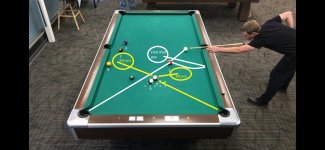
You've allready kind of messed up here by leaving the 3. This means it won't be a stop shot pattern probably. The 3 is a worthless ball in this scenario. I might shoot it first, if you are close to straight in in the diagonal lower pocket, with low left trying to get straight in on the 7 again. Then 7, 4, 1, 15 and then 10. The 1 guarantees a nice angle on the 15 to get nicely on the 10. Otherwise the pattern wouldn't be any good. The position on the 10 is a lot more forgiving than the illustration shows, I just didn't want to mess up the picture too much.

If you don't have that angle, there are still a couple of patterns here, none of which are foolproof and all of which will vary according to the exact angle you get on the balls. To me, the 3 ball is the big joker here. It hasn't really got a good ball leading to it, and it does not easily lead to any other ball without perfect position. You see, the 7 leads to the 4 and the 1 leads to the 15, which in turn leads to the 10. The only ball that gives sort of natural position to the 3 is the 15, but then you have to get a very good position on the 3 to get to the 10. You see the problem? If you shoot the the 15-10-3 as your last three, you have a terrible key ball.
 

Attachments

  • pattern2.jpg
    pattern2.jpg
    108.7 KB · Views: 10
You've allready kind of messed up here by leaving the 3. This means it won't be a stop shot pattern probably. The 3 is a worthless ball in this scenario. I might shoot it first, if you are close to straight in in the diagonal lower pocket, with low left trying to get straight in on the 7 again. Then 7, 4, 1, 15 and then 10. The 1 guarantees a nice angle on the 15 to get nicely on the 10. Otherwise the pattern wouldn't be any good. The position on the 10 is a lot more forgiving than the illustration shows, I just didn't want to mess up the picture too much.

If you don't have that angle, there are still a couple of patterns here, none of which are foolproof and all of which will vary according to the exact angle you get on the balls. To me, the 3 ball is the big joker here. It hasn't really got a good ball leading to it, and it does not easily lead to any other ball without perfect position. You see, the 7 leads to the 4 and the 1 leads to the 15, which in turn leads to the 10. The only ball that gives sort of natural position to the 3 is the 15, but then you have to get a very good position on the 3 to get to the 10. You see the problem? If you shoot the the 15-10-3 as your last three, you have a terrible key ball.
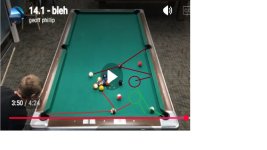
I sent this still in particular because when i watched it back i wondered why i didnt take the 3 first.

seemed more important to get rid of the 1, and i didnt think of the 3 as “useless” until i watched it back. i guess thats something if i’m on the right track. i took a week off before this, and it was my second of the day.

Here’s the tragedy of a rack:

 
I sent this still in particular because when i watched it back i wondered why i didnt take the 3 first.

seemed more important to get rid of the 1, and i didnt think of the 3 as “useless” until i watched it back. i guess thats something if i’m on the right track. i took a week off before this, and it was my second of the day.

Here’s the tragedy of a rack:

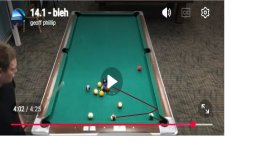
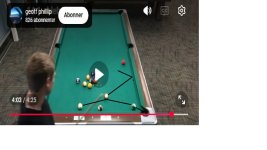
It turned out ok although the second rack wasn't the best. After the 7 (which you should have shot softly) you should have taken the 14, as it was blocking several other balls from going to the pocket. Killing the cueball on the 14 ball shot, giving you an angle on the 15, would have given you a chance of going into the cluster with the 11 for insurance, but the 14 could lead to several other possible shots as well.

Ending up where you did, the 13 was an odd choice for the final shot...There was another, creative shot here that not all people see. Using the 15 to break up the cluster, as shown in the illustration. You're probably going to have to shoot a long shot from the rail anyway, might as well try to set up the rack for after you pocket whatever long shot (probably the 11) you have to shoot after that. There is a another out of the box shot here which I also included. You should practise these shots, they come up more often than you think. There is also an easy masse or half ball jump shot on the 14, if your are good at those, the masse being the better of the two IMO. The conservative and probably highest percentage option is to shoot the 12 and drift up table however long you need to get a shot at the 14. I included the others to show you some things you should practise, because very few people do and it will give you a huge edge in the long run.

As to your comment about the 3 being a problem: Balls in the middle area of the table are typically useless in 14.1. "Balls in space". They're not problem balls usually (But they can be, particularly when your intended breakball is blocking the lower pocket for them). Balls in the middle of the table are not really any good for end pattern play, except in very special circumstances. They can be pocketed at any time and need not be saved, as they have no intrinsic value, other than being used to get rid of other problems.

Priority of play, as taught to me when I was beginning, by a 200 ball runner:
1. Remove balls that block other balls from going into the pocket "Clear pocket lanes".
2. Break up clusters.
3. Balls on rails (frozen) and other lone problem balls.
4. Balls that are not part of the end pattern. (HERE IS WHERE THE "BALLS IN SPACE" HAVE TO BE REMOVED)
5. End pattern.
 

Attachments

  • pattern3.jpg
    pattern3.jpg
    77 KB · Views: 8
  • out of the box.jpg
    out of the box.jpg
    89.7 KB · Views: 9
  • out of the box2.jpg
    out of the box2.jpg
    78.9 KB · Views: 7
Last edited:
I really like pocketing the 14 with a kiss from the 11 in that situation. I wouldn't have seen it playing myself, but I think it's kinda easy and a really good option with the 15 and the 3 as insurance balls.

In my opinion the initial break shot (2nd rack with the 6) should have been played either a lot harder or as soft as you played it but with a strong follow shot (I don't like playing with draw when I hit the lower part of the rack).
 
Back
Top