Do you have an English Problem.

Cornerman said:
Although related, in this case, I really mean "pivot point." You don't have to bridge at the pivot point. You just have to pivot at the pivot point. You can bridge anywhere you want. You would only pivot at the bridge point (backhand english) if your pivot point happens to be at or near your bridge length. A lot of cues are nowhere near this point. A lot are.

I think there was a misleading post recently that seemed to suggest that the bridge hand has to coincide with the pivot point. It doesn't have to. If the pivot point is, say, 20", you'd pivot at 20" which determines your new line of aim. Shoot normally along that line with whatever bridge length you want.


To get a good idea of what, how much compensation you are talking about with a 314, you would pivot at your grip hand, and move the front of the cue. Some people have called this "front-hand english). Most 314's that I've tested have a pivot point well above 30". So, grabbing the wrap at the top of it (the A-joint) and using front-hand english, that's probably close enough to the "correct" squirt compensation line." Shoot normally on that line.

Fred

I'm a little confused about how I could reliably pivot the cue around a certain point without that point being my bridge, since the bridge is the only point where the cue is anchored to anything solid. Are you suggesting I look down at the 30" mark on my cue, and with both hands un-anchored, pivot the cue about this point for a precise tip placement, somehow ensuring that A) my rotation occurs around that point and that B) absolutely no translational movement occurs with respect to this point? I don't see it working.

As far as front-hand english goes, I'm 6'2" with long arms. I can't grip the cue at the top of the wrap and have a normal stroke. I grip the cue at the butt sleeve. Even if the butt sleeve were an appropriate pivot point for my cue, I don't see how I can rotate the cue about that point since it's free-floating in space. I can move my front hand, but who's to say my back hand didn't move? I think it's very easy for the back hand to move as much as an inch without you noticing while you're concentrating on moving your front hand. If your weight shifts at all from one fot to the other, your back hand has probably moved an inch. Any minute change in the position of your upper arm relative to the shoulder will move your back hand. Since you're putting your trust in your pivot instead of sighting down the cue, you just don't know if your back hand moved.

So I don't subscribe to any "align and then pivot" method. I prefer just to align, with whatever tip placement the shot demands, and include adjustments to my aim in that alignment if needed. And with a low-deflection shaft, the adjustment can be small, and in my mind a great deal more reliable than a pivot.

-Andrew
 
Last edited:
Billy_Bob said:
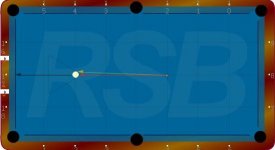
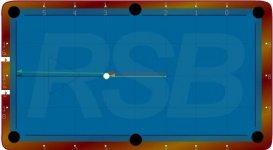
Shoot just the cue ball at the far center diamond with a center hit. Then try left english, then right english. Try different speeds. The cue ball is probably off 1/2 inch to an inch by the time it gets down there. This is called cue ball deflection or squirt.

I fixed this problem by getting a Predator 314 shaft. Now I can aim dead center, then while leaving my back hand in place, just slide my bridge hand left/right and the cue ball will go to the same spot as a dead center hit.

So that is one problem fixed...

Then next is that a spinning cue ball will alter the path of the object ball with a cut shot. What basically is happening is the cue ball, when hitting the object ball, has a bit of friction when contacting. This causes the ball to "slide" a bit. When using outside english, the friction is reduced. When using inside english, there is more friction.

So you need to adjust your aim when using english on a cut shot. Set up an object ball 1/2 inch off the rail near the side pocket. Then cut it into the corner pocket with a center hit. Then try outside english. Then inside english. Mark exact locations of CB and OB so you can shoot same exact shot over and over. Also mark spot on rail to be sure CB is going to same exact spot when using english.

Can you point to some reading on this topic? I don't understand why the friction would be different with the CB spinning oe way vs the other. The actual contact point of the two balls should be the same. Also I think I know what squirt and deflection is but maybe a actul defination would help also.
Thanks
 
Andrew Manning said:
I'm a little confused about how I could reliably pivot the cue around a certain point without that point being my bridge, since the bridge is the only point where the cue is anchored to anything solid. Are you suggesting I look down at the 30" mark on my cue, and with both hands un-anchored, pivot the cue about this point for a precise tip placement, somehow ensuring that A) my rotation occurs around that point and that B) absolutely no translational movement occurs with respect to this point? I don't see it working.
If we were at a table, you'd see how easy it is. Maybe the words are just a little confusing. I believe that many people don't understand the steps for aim and pivot. You many need to print this. I encourage it.

You only pivot at the pivot point.

So, say your stick has a 20" pivot point. Here are the steps:

1. Take your set position (cue tip very close to the cueball) using center ball and align to wherever centerball would be to make the shot. Use whatever bridge length you feel comfortable with for that shot.

2. Take your bridge hand and slide it to 20", the pivot point of the stick.

3. Pivot the stick so that the tip is pointed at the desired english, using your backhand as the mover, and the bridge hand as the pivot. This is your new line of aim for squirt dominant shots.

4. Slide your bridge hand back to whatevever bridge length you want. Whether you want to stand back up, or redo whatever you need to do, use the new line of aim from #3. Stroke your cue on this line.

All the wording makes it sound harder than it really is. The movements are minimal, and for the most part, I don't stand back up. I just pivot, and shoot on the new line (after I slide my bridge hand to wherever is necessary.)

For a Predator 314, if your pivot point is at, say 40 inches, then:

1. Take your set position (cue tip very close to the cueball) using center ball and align to wherever centerball would be to make the shot.

2. Take your grip hand and slide it to 40". This would be just ahead of the wrap.

3. Pivot the stick so that the tip is pointed at the desired english, using your front hand as the mover, and the grip hand as the pivot. This is your new line of aim for squirt dominant shots with this particular pivot point.

4. Slide your grip hand back to wherever you normally would on the butt to whatever is comfortable for that shot. Whether you want to stand back up, or redo whatever you need to do, use the new line of aim from #3. Stroke normally along that new line.

As far as front-hand english goes, I'm 6'2" with long arms. I can't grip the cue at the top of the wrap and have a normal stroke.
Again, you wouldn't stroke in this setup. You only pivot in this setup. Stroking on the new line determined by the setup/pivot is accomplished in a normal fashion, using a normal bridge length and normal grip.

Fred
 
Do You have an English problem?

I no think so. I think I have much good english. Many American talk strange anyway. But no me. I speaked like I have been live here since borne a little baby so much year ago.

;)
 
Well I am back and put to use some of the Tips from this a.m. Had some success's, and I can see I will be doing a lot of practice to master Inside English...
 
Bluey2King said:
Can you point to some reading on this topic? I don't understand why the friction would be different with the CB spinning oe way vs the other. The actual contact point of the two balls should be the same. Also I think I know what squirt and deflection is but maybe a actul defination would help also.
Thanks
Throw is a little more complicated than the posters are letting on. And sInce it can vary from zero to almost six degrees, it cannot be ignored on moderate to longish shots, and sometimes even on short shots. Here are the factors which affect how much throw you get.

1)Cut angle. Roughly speaking, throw increases with cut angle. This is a fairly general trend but there are exceptions. A notable exception occurs with stun shots (little or no topspin or backspin on the cueball at the moment of impact). Here throw increases dramatically up to around a half-ball hit and then starts falling off at greater cut angles. Exactly where this transition occurs depends on shot speed. The use of sidespin also generates exceptions.

2)Topspin or backspin (follow or draw). The more of either you put on the cueball, the less throw you get. Or more accurately, the throw is oriented more in the vertical direction as opposed to the sideways direction. SInce it's the latter which affects the shot, we can say, loosely speaking, that throw essentially diminishes with increasing topspin or backspin. That's why it's safer to "roll" the cueball on those long difficult shots.

3)Sidespin (english). Both inside and outside english can increase or decrease throw depending on the amount of english and factors (1) and (2) listed above. It's hard to come up with a generalization here, but if there is a fair amount of follow or draw on the cueball, outside english tends to reduce throw and inside english tends to increase it. This depends on cut angle somewhat as well as on the amount of follow or draw spin on the cueball.

4)Speed of the shot. Hard shots can produce significantly less throw than soft shots, but there are exceptions. For instance, hitting it centerball and hard will usually result in the cueball not developng much topspin. This is a stun shot and these type of shots produce the most throw. But between stun shots at various speeds, the harder ones produce less throw.

To answer your question, essentially two things affect throw: the direction of the friction force (this is where the cut angle and spin come into play) and how fast the surface of the cueball is moving relative to the surface of the object ball at the contact area. The latter is a function of all of the factors listed above. According to experimental evidence, the amount of friction you get is highly dependent on the relative surface speed between the balls. It's the greatest when this speed is small, and the least when this speed is large, and the variance is about a factor of ten.

Stun shots are the most treacherous as far as throw is concerned. With them, throw varies the most with sidespin. For a straight shot, it only takes about 1/3 of maximum english to produce maximum throw, which can be nearly six degrees. This is six inches of sideways movement for every cue length of travel (57"-58"). As the cut angle increases from zero, the difference in english spin producing no throw and that which produces maximal throw decreases, ultimately reaching zero for a 90 degree cut.

If you have some math background, here is a article on it. You can skip the math and look at the graphs, but even these may be hard to interpret for someone unfamiliar with the notation.

http://www.engr.colostate.edu/~dga/pool/technical_proofs/new/TP_A-14.pdf

Jim
 
Bluey2King said:
Can you point to some reading on this topic? I don't understand why the friction would be different with the CB spinning oe way vs the other. The actual contact point of the two balls should be the same. Also I think I know what squirt and deflection is but maybe a actul defination would help also.
Thanks

Make fists with your hands. Then place the fists together. Now rotate both fists upward like gears turning. Next rotate one upwards while keeping the other still. This is friction from one rotating object while the other is not rotating. If using outside english, it would be like both hands rotating upwards. If using inside english, it would be like holding one hand still.

Reading on throw...
http://groups.google.com/group/rec....rd&q=throw&qt_g=1&searchnow=Search+this+group

Reading on squirt (cue ball deflection)...
http://www.sfbilliards.com/Shepard_squirt.pdf
 
Cornerman said:
4. Slide your bridge hand back to whatevever bridge length you want. Whether you want to stand back up, or redo whatever you need to do, use the new line of aim from #3. Stroke your cue on this line.
Hey Fred, what effect does your bridge have on your effective pivot point if you're bridging between the cue's intrinsic pivot point and the tip? Intuitively, it seems that your bridge hand is somewhat anchoring your cue at the bridge location, and that the "effective pivot point" would be much closer to your bridge hand, depending on how firm you bridge the cue.
 
jsp said:
Hey Fred, what effect does your bridge have on your effective pivot point if you're bridging between the cue's intrinsic pivot point and the tip? Intuitively, it seems that your bridge hand is somewhat anchoring your cue at the bridge location, and that the "effective pivot point" would be much closer to your bridge hand, depending on how firm you bridge the cue.


The firmness of your bridge should make no (little?) difference because of the non-rigidity of your skin and muscles. Plus, if you bridge past 6" or so, your hand wouldn't be part of the squirt equation as far as the latest understanding of squirt is concerned. IMO, this is the key issue with the "Myth Buster." He has a rigid V in the setup that would add false weight to the squirt equation. His red dot/black dot are designed to beat the Myth Buster. The rest of the cues are being falsely tested since the test doesn't mimick reality.

So, the squirt compensation would be based on the pivot point only. And the pivot point is based solely on the parameters of the cue. As far as the latest understanding of squirt is concerned.

Fred
 
Jal said:
Throw is a little more complicated than the posters are letting on.

I agree with you on this. That being said, I downplay throw so much on these boards because I personally believe it's the focus on throw that makes people completely oblivous to squirt and swerve and compensate incorrectly as a consequence.

Here's an easy hand-waving compensation "technique."

1. Given the same cut angle, same distance, same elevation, same magnitude of english and the same speed, then you must aim thinner using outside english compared to your compensation for inside english.

2. Subsequently, the compensation for inside english should be thicker compared to the equal shot for outside english.

I think that most people who focus on throw would think the opposite and will never get over the hump (of inside english) if they don't get this idea straight.

If a player find themselves trying to blend the speed (slower), elevation (higher), etc. to make an inside english shot, they might want to look at #2 above.

Fred
 
Last edited:
Cornerman said:
If a player find themselves trying to blend the speed (slower), elevation (higher), etc. to make an inside english shot, they might want to LUCK at #2 above.
Intended Freudian slip? ;)

BTW, thanks for your previous reponse to my post.
 
Bluey2King said:
I don't understand why the friction would be different with the CB spinning oe way vs the other.

A non-physics answer would be that the spin throw works in opposite directions. If the throw due to the cut is positive (just for reference), then the throw with outside english would be negative, and the throw for inside english would be positive.

So, the end result is that the outside english throw works to counter the cut throw, while the inside english throw works to add to the cut throw. So, the compensation is different.

Fred
 
Billy_Bob said:
I fixed this problem by getting a Predator 314 shaft. Now I can aim dead center, then while leaving my back hand in place, just slide my bridge hand left/right and the cue ball will go to the same spot as a dead center hit.

You don't "slide" your back hand over parallel to where it would be for a center ball hit? You leave it EXACTLY where it was? I don't believe that.

Imagine the red and yellow lines are a pool cue. The back hand stays the same but the bridge hand slides over. You're saying both hits will follow the black arrow? I just don't see how this is possible.
 

Attachments

  • shot.JPG
    shot.JPG
    15.8 KB · Views: 90
Hal said:
You don't "slide" your back hand over parallel to where it would be for a center ball hit? You leave it EXACTLY where it was? I don't believe that.
.
Believe it. He would be using what some call "front hand english," which would be proper for a 314. The pivot point for a 314 is typically close to the grip hand. So, you'd pivot about the grip hand.

Your WEI diagram is a bit exaggerated, but if you overlay a normal cues compensation line, you'd see a remarkable difference.

It's more like this, with the green line as the 314 compensation, and the blue line is a normal cue's compensation:

CueTable Help


The pivot point for the 314 is at A. The pivot point for the normal cue is at B.

Fred
 
Last edited:
My Thanks to Billy Bob and JAL

Thanks guys.! I am going to go read up on what you gave me now!

I was thinking last night about how the angle of the the contacting balls with one spinning and which way it is spinneing would make a difference.
Thanks lets see if I can wrap my brain around some of it.
 
I understand Fred. I've played with a 314 before but didn't notice a huge difference. Lets say that I shot these two shots with a standard shaft and then shot these two shots with a 314 shaft. What is your opinion?
 

Attachments

  • shot.JPG
    shot.JPG
    15.6 KB · Views: 103
Hal said:
I understand Fred. I've played with a 314 before but didn't notice a huge difference. Lets say that I shot these two shots with a standard shaft and then shot these two shots with a 314 shaft. What is your opinion?
The center ball shots should be the same.

For the two with right hand english, a normal cue will squirt the cueball to the left. For the 314, it will also squirt the cueball to the left, but not as much.

CueTable Help


Blue is the normal cue. Black is the 314. The angle the cueball squirts would be the angle you would shoot at if you wanted the cueball to go straight.


I think that you can shoot many shots with parallel english (moving the entire cue over) with a 314 on nearly straight in shots because the spin throw works to counter the squirt, so the the Object Ball will follow a pathcloser to the same line as a centerball shot compared to a normal cue.

For cut shots, inside english will work differently than outside english (post #30).

Fred <~~~ and then there's swerve, which is the bigger bugaboo when you reduce squirt.
 
Hal said:
You don't "slide" your back hand over parallel to where it would be for a center ball hit? You leave it EXACTLY where it was? I don't believe that.

Imagine the red and yellow lines are a pool cue. The back hand stays the same but the bridge hand slides over. You're saying both hits will follow the black arrow? I just don't see how this is possible.

It's true! But note that I use a hard Moori (Q) tip with a dime shape. Others who might use a medium or nickel tip may see different results.

When you hit with english, you are hitting the side of the ball.

There is a "battle" between the tip and the ball as to which will be pushed sideways. The more mass (weight) near the tip of the cue, the more the ball will be pushed to the side. And a Predator 314 is hollow near the tip. Very light weight. So ball wins with an english hit and pushes tip to side basically. The whole theory about this is here...
http://www.sfbilliards.com/Shepard_squirt.pdf
 
Cornerman said:
I agree with you on this. That being said, I downplay throw so much on these boards because I personally believe it's the focus on throw that makes people completely oblivous to squirt and swerve and compensate incorrectly as a consequence.

Here's an easy hand-waving compensation "technique."

1. Given the same cut angle, same distance, same elevation, same magnitude of english and the same speed, then you must aim thinner using outside english compared to your compensation for inside english.

2. Subsequently, the compensation for inside english should be thicker compared to the equal shot for outside english.

I think that most people who focus on throw would think the opposite and will never get over the hump (of inside english) if they don't get this idea straight.

If a player find themselves trying to blend the speed (slower), elevation (higher), etc. to make an inside english shot, they might want to look at #2 above.

Fred


Yesterday was PLANNED as Inside English Practice, but about the Time I got started a Guy I sometimes play with shows up, and the Practice will be done TODAY.

Tis obvious that the application of Inside English is another SKILL with its own set of Variable to MASTER, and like everything else i have learned to do in Pool BETTER it will take time, and practice.

Thanks for all the pointers, and many unanswered question have been answered, and i see the Path to Mastering INSIDE ENGLISH.....
:rolleyes:
 
Back
Top