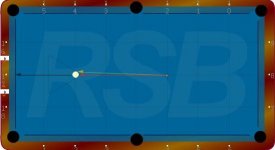
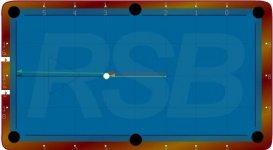
Cornerman said:Although related, in this case, I really mean "pivot point." You don't have to bridge at the pivot point. You just have to pivot at the pivot point. You can bridge anywhere you want. You would only pivot at the bridge point (backhand english) if your pivot point happens to be at or near your bridge length. A lot of cues are nowhere near this point. A lot are.
I think there was a misleading post recently that seemed to suggest that the bridge hand has to coincide with the pivot point. It doesn't have to. If the pivot point is, say, 20", you'd pivot at 20" which determines your new line of aim. Shoot normally along that line with whatever bridge length you want.
To get a good idea of what, how much compensation you are talking about with a 314, you would pivot at your grip hand, and move the front of the cue. Some people have called this "front-hand english). Most 314's that I've tested have a pivot point well above 30". So, grabbing the wrap at the top of it (the A-joint) and using front-hand english, that's probably close enough to the "correct" squirt compensation line." Shoot normally on that line.
Fred
I'm a little confused about how I could reliably pivot the cue around a certain point without that point being my bridge, since the bridge is the only point where the cue is anchored to anything solid. Are you suggesting I look down at the 30" mark on my cue, and with both hands un-anchored, pivot the cue about this point for a precise tip placement, somehow ensuring that A) my rotation occurs around that point and that B) absolutely no translational movement occurs with respect to this point? I don't see it working.
As far as front-hand english goes, I'm 6'2" with long arms. I can't grip the cue at the top of the wrap and have a normal stroke. I grip the cue at the butt sleeve. Even if the butt sleeve were an appropriate pivot point for my cue, I don't see how I can rotate the cue about that point since it's free-floating in space. I can move my front hand, but who's to say my back hand didn't move? I think it's very easy for the back hand to move as much as an inch without you noticing while you're concentrating on moving your front hand. If your weight shifts at all from one fot to the other, your back hand has probably moved an inch. Any minute change in the position of your upper arm relative to the shoulder will move your back hand. Since you're putting your trust in your pivot instead of sighting down the cue, you just don't know if your back hand moved.
So I don't subscribe to any "align and then pivot" method. I prefer just to align, with whatever tip placement the shot demands, and include adjustments to my aim in that alignment if needed. And with a low-deflection shaft, the adjustment can be small, and in my mind a great deal more reliable than a pivot.
-Andrew
Last edited: