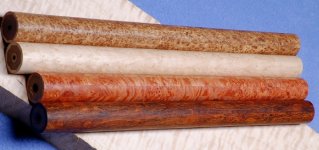
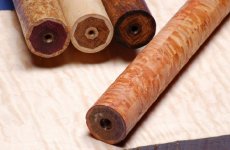
For your consideration...radially laminated forearms with figured veneer

jazznpool

Superior Cues--Unchalked!
Gold Member
Silver Member
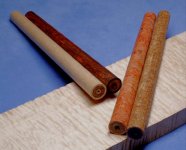
Here's a few photos that show the technology Kent Davis, a forward thinking cuemaker from San Dimas, CA is now employing to build his cue forearms. Kent says his aim is to "take the weakest part of the cue and make it strong." The pictures show 4 forearms with radial laminated cores, usually of ironwood. Kent then wraps the forearm with high figure woods and burls (here the woods are birdseye maple, pomelle/ birdseye cocobolo, rose myrtle burl, and black ash burl). Long points with veneers are usually milled in but merry widow or player cues have also been made. The cues Kent produces are very solid and have excellent feedback. I'm not aware of anyone else using this technology in the fashion that Kent "the Duke of Burl" Davis is.

Kind of a show and tell here, comments/feedback are welcome.

Martin
 

Attachments
  • KentForearm1 (2).jpg
    KentForearm1 (2).jpg
    92 KB · Views: 632
Last edited:
another pic...by the way Kent has been a lifelong woodworker. He is detail oriented and it shows in the build quality of his cues. One of Kent's solid African ebony forearm cues is pictured the background of my ad/avatar this month.

Martin
 

Attachments

  • KentForearm3 (2).jpg
    KentForearm3 (2).jpg
    93.4 KB · Views: 632
Last edited:
So he is using one of the most beautiful, rare, illegal to harvest woods.... as the core? I would think that desert ironwood would be to heavy for most cues with the size of core in the pics. I have a piece of ironwood thats 1.5" square by 6.5" and it weighs in at a pound!
 
desert1pocket said:
So he is using one of the most beautiful, rare, illegal to harvest woods.... as the core? I would think that desert ironwood would be to heavy for most cues with the size of core in the pics. I have a piece of ironwood thats 1.5" square by 6.5" and it weighs in at a pound!

I was kind of thinking the same..........DI wouldn't be my choice of woods for the core either but he must have it figured out to work for the weights.

I was wondering what one of the blanks might look like if the outer lams were too thin and when you tapered it down they would start to move back on the forearm to reveal the inner core? May be an interesting piece.
Just seems like a lot of work for a little achievement but the detail in the work sure looks premium from the pictures.
Good luck and keep experimenting.
 
BarenbruggeCues said:
I was kind of thinking the same..........DI wouldn't be my choice of woods for the core either but he must have it figured out to work for the weights..

These are his nun chuck blanks?

Fred
 
BarenbruggeCues said:
I was kind of thinking the same..........DI wouldn't be my choice of woods for the core either but he must have it figured out to work for the weights.

I was wondering what one of the blanks might look like if the outer lams were too thin and when you tapered it down they would start to move back on the forearm to reveal the inner core? May be an interesting piece.
Just seems like a lot of work for a little achievement but the detail in the work sure looks premium from the pictures.
Good luck and keep experimenting.

That could be pretty neat, kinda like a 6 pointed burl butterfly. I agree that the work looks outstanding, and I really like the one that appears to have a purpleheart core.
 
What are the size of those rounds? It appears that if it were tapered into a forearm, the sleeve would be really thin at the joint area...
 
It is purpleheart. Sometimes mangaris is also used. Core wood varies. External woods and burls vary a good deal also. The cues constructed in this way essentially play off the core IMO.

Martin


desert1pocket said:
That could be pretty neat, kinda like a 6 pointed burl butterfly. I agree that the work looks outstanding, and I really like the one that appears to have a purpleheart core.
 
Its an illusion. I think Kent's joint size is close to .848 finished. They are long enough to be cut down at the front and finished up at .860 if needed (cue would be way too stout with this kind of forearm).

Martin

hadjcues said:
What are the size of those rounds? It appears that if it were tapered into a forearm, the sleeve would be really thin at the joint area...
 
jazznpool said:
Its an illusion. I think Kent's joint size is close to .848 finished. They are long enough to be cut down at the front and finished up at .860 if needed (cue would be way too stout with this kind of forearm).

Martin


how much are they?
 
Tony, Thanks for asking but Kent Davis's forearms are not for sale at this point but may be in the future. I posted them to show a different approach to forearm construction.

Martin

Mystick Cue Fan said:
how much are they?
 
core details

The core is trademarked "ironwood" and the actual name is epay, Ipe', or tajibo. It is not illegal to harvest and the specific gravity is about 66-75 pcf (maple varies from about 50-65 pcf) . I used it because it was very stable and bonded well. The characteristics for a cue butt were suitable for the way I was shown to build a cue, and I like the way it hit. Sorry for the misunderstanding, Kent
 
Last edited:
Ipe is becoming more popular in the construction trades as well. It starting to be used as decking material bcus oof its density and resistence to bugs and rot. Its preatty heavy stuff. I can see how it would make a good core for a cue, but the weight would def be an issue.
 
jazznpool said:
Kent says his aim is to "take the weakest part of the cue and make it strong."
Martin


i'm just playing the devil's advocate here, martin......
davis is saying, i infer, take the weakest part of the cue, the forearm, and make it stronger,,,,yes?

why?

ultimately, any cue, no matter how it's constructed, is about playability(and ok, we all have a different opinion about that). so is this what the well built cue been lacking all these years,,,a stronger forearm? hands down, some of the best cues i ever hit with were made from titleist blanks, so i'm surprised there haven't been more cuemakers going in THAT direction.

sometimes, i think, people can be "burdened" with modern techniques. they feel they need to use something new or try something different just cuz the means is there. they build it, package it, tie a pretty bow on it. from a personnal viewpoint, i like my cues hitting sweeter not stronger. :)
 
Although the core wood can vary, its actually a kind of Ipe and referred to as ironwood. It is not desert ironwood as I had first stated. Sorry for the confusion. Also, I will have a good number of them for sale posted at my site in the near future, with a good variety of high figure woods and burls to choose from. Coordinating buttsleeves will be optional.

Martin

desert1pocket said:
So he is using one of the most beautiful, rare, illegal to harvest woods.... as the core? I would think that desert ironwood would be to heavy for most cues with the size of core in the pics. I have a piece of ironwood thats 1.5" square by 6.5" and it weighs in at a pound!
 
Hey Bru, I see Kent Davis is now signed on and can post here, so maybe he'll chime in. I do know that Kent plays pool at a skilled level and his forearm madness is all about producing a better (sweeter) hitting/playing cue. It doesn't stop with the forearm for Kent either. Kent is very selective with shaftwood for his cues too. For Kent its all about the end result. BTW, the African ebony Kent Davis cue in my ad/avatar is not cored at all. Kent felt the wood was well seasoned, stable and already strong enough to make a good forearm. I hope that helps...

Martin


bruin70 said:
i'm just playing the devil's advocate here, martin......
davis is saying, i infer, take the weakest part of the cue, the forearm, and make it stronger,,,,yes?

why?

ultimately, any cue, no matter how it's constructed, is about playability(and ok, we all have a different opinion about that). so is this what the well built cue been lacking all these years,,,a stronger forearm? hands down, some of the best cues i ever hit with were made from titleist blanks, so i'm surprised there haven't been more cuemakers going in THAT direction.

sometimes, i think, people can be "burdened" with modern techniques. they feel they need to use something new or try something different just cuz the means is there. they build it, package it, tie a pretty bow on it. from a personnal viewpoint, i like my cues hitting sweeter not stronger. :)
 
jazznpool said:
Hey Bru, I see Kent Davis is now signed on and can post here, so maybe he'll chime in. I do know that Kent plays pool at a skilled level
Martin

from my limited experience, re: stroud/gold/, former players prefer relatively hard hitting cues. that's fine with me because i prefer them that way as well.
 
Stability

My cue design is defiitely subjective. I am not the beginning and the end. I know that wood stabilizes as the cell walls "petrify". Possibly the reason that many titleist cues hit so well (the cell walls are strengthened by fifty years or more of curing). The cell walls are strengthened in ipe sooner from kiln drying and inherent structure. I had some very wise counseling which led me to believe that a heavy metal weight stops the vibration to the hand neccessary to feel delicate touch shots required in one pocket, straight pool and 8 ball. I use a 3/8 -10 pin into wood or phenolic to transfer the weight, power, finesse and control to the player. The majority of my cues have an average balance point of 19" from the butt with little or no weight in the back and they actually feel lighter because of balance. I hope my greatest accomplishment will be to produce a cue for the most discriminating buyer. In your service, Kent
The proof is in the pudding, and the test is in the tasting!
 
Last edited:
Back
Top