How to write "runout" in Japanese

Vahmurka

...and I get all da rolls
Silver Member
I would like to ask for help from those AZers who know Japanese and play or watch pool ;) So that they know what runout is (though I believe any forum member does know that). Could you provide me with a picture illustrating "runout" word in Japanese? The reason I'm asking for a picture is that Asian text encodings usually require special language settings in operating system to be shown properly. So could you please write this Japanese word with some fancy-looking font and make an image or screenshot.
Thanks in advance.
 
I would like to ask for help from those AZers who know Japanese and play or watch pool ;) So that they know what runout is (though I believe any forum member does know that). Could you provide me with a picture illustrating "runout" word in Japanese? The reason I'm asking for a picture is that Asian text encodings usually require special language settings in operating system to be shown properly. So could you please write this Japanese word with some fancy-looking font and make an image or screenshot.
Thanks in advance.

Vahmurka:

Have you tried Yahoo's BabelFish?

http://babelfish.yahoo.com/

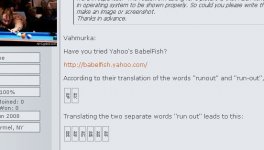
According to their translation of the words "runout" and "run-out", they both are this:

ふれ

Translating the two separate words "run out" leads to this:

動かしなさい

Now I don't speak/write Japanese at all, so obviously you'll need to get verification from someone that does, which one of these two is correct, related to pool's meaning of "running the balls out."

Hope this is at least a step in the right direction?
-Sean
 
thanks for a try Sean. That's how it looks on my laptop, hence I'm asking for a picture. Yes, I (or better my friend who needs to know that) did try some guessing around. Now he would like to know for sure.
 

Attachments

  • ro.jpg
    ro.jpg
    36 KB · Views: 895
Babelfish will give you a literal translation, but what you really need is the cultural cognate. So, we need someone to chime in that is familiar with japanese pool lingo, maybe Mullyman can help.

I'm going to take an educated guess that there is no native japanese word for run-out as billiards is not a native game. The japanese language segregates between native and non-native origins. So, it wouldn't be correct to use hiragana of ふれ (pronounced FU RE) in your first example, or the kanji (chinese characters) in the second example.

The japanese use the phonetic katagana 'alphabet' for loan words. For example, japanese style cartoons are called A NI ME , アニメ (from the english loan word, animation). Another example is japanese style curry, (KA RE), as the curry spice was introduced to japan by the west. Take notice next time you order japanese curry at a japanese restaurant, they'll take away your chopsticks and bring you a spoon (western eating implement.

So, I'm going guess its a loan word, and will be written in katakana script and sound like the english phrase for run-out.
 
Run out

The japanese word for run out is matsuwade tomorrow when I go to the poolhall I'll have someone write it in katagana or kainji.:smile:
 
マスワリ (Runout in Japanese)

I remember seeing several videos of 9-ball break and runs by Toru Kuribayashi posted a few years ago on Rabigon's channel on Youtube -- see, e.g., http://www.youtube.com/user/rabigon#p/u/23/4J28c36TqNM

The labels given in Japanese are マスワリ1連 (masuwari ichiren) for a break and run, マスワリ2連 for two consecutive break and runs, and マスワリ3連 for three consecutive break and runs.

Hope this helps.
 
Break and run is maswari or bureikuranauto as was said before. To just runout without breaking is uramasu. Not sure what you are using this for, but uramasu is only for when someone else breaks. I should be able to get a screen grab to this post.

Btw, I'm getting this from Go Go Billiards webpage.
 
The two posters before me got it right, "masuwari" and "uramasu".

A package is a "renmasu" or "renpatsu" and you can put the number before it to count the number of the package. For example, a 5 pack would be "gorenpatsu" go is 5 in Japanese. Non-pool playing Japanese probably wont understand these terms ("renpatsu" is just a general term for "in a row", but they wont understand that it means "racks in a row".

One more thing to note is that the Japanese people I know tend not to count an early combo (even an 8-9) as a break and run.

If you want any other Japanese pool slang, just ask!

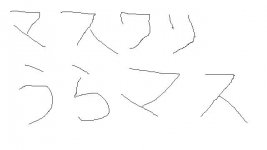
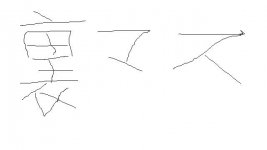
I attached an image of masuwari written on top and uramasu written on the bottom. The second image is of uramasu with ura written in kanji. Sorry, it looks crappy, I did my best on mspaint with my mouse.
 

Attachments

  • masuwari.jpg
    masuwari.jpg
    13.8 KB · Views: 765
  • uramasu.jpg
    uramasu.jpg
    12.4 KB · Views: 755
Last edited:
Masayoshi.

To try and answer Valmulka's original question, and to put it in proper context for non-playing japanese; Would this be correct, to say 9-ball runout?

(nine ball masuwari)
ナインボールノマスワリ

Would it sound natural, adding yokatta?

The two posters before me got it right, "masuwari" and "uramasu".


The two posters before me got it right, "masuwari" and "uramasu".

A package is a "renmasu" or "renpatsu" and you can put the number before it to count the number of the package. For example, a 5 pack would be "gorenpatsu" go is 5 in Japanese. Non-pool playing Japanese probably wont understand these terms ("renpatsu" is just a general term for "in a row", but they wont understand that it means "racks in a row".

One more thing to note is that the Japanese people I know tend not to count an early combo (even an 8-9) as a break and run.

If you want any other Japanese pool slang, just ask!

I attached an image of masuwari written on top and uramasu written on the bottom. The second image is of uramasu with ura written in kanji. Sorry, it looks crappy, I did my best on mspaint with my mouse.
 
A semi interesting side note is that there is only one thing that is universal to all languages - the arabic number system. 1,2,3,4,5,6,7,8,9,10 etc. We count the same all over the world. I'd like to know why it is called "arabic numbers" and how it originated, if anyone knows.
 
Masayoshi.

To try and answer Valmulka's original question, and to put it in proper context for non-playing japanese; Would this be correct, to say 9-ball runout?

(nine ball masuwari)
ナインボールノマスワリ

Would it sound natural, adding yokatta?

The two posters before me got it right, "masuwari" and "uramasu".

In terms of non-pool playing japanese people, you would probably have to explain to them the rules of nineball and that you ran from the break to the 9 without missing for them to understand. The general public in japan knows less about pool than the general public in the US.

ナインボールマスワリ probably wouldn't work because most people won't understand masuwari. Although they might understand 9 ball. Adding yokatta would mean that it was good o their b&r was good depending on the context.
 
A semi interesting side note is that there is only one thing that is universal to all languages - the arabic number system. 1,2,3,4,5,6,7,8,9,10 etc. We count the same all over the world. I'd like to know why it is called "arabic numbers" and how it originated, if anyone knows.

It's because previous numerical writing systems became really incovenient As you get larger numbers (try writing 56373737288 in roman numerals) and the Arabic numerals also have 0 which allows for complex math. Arabic numbers actually originated in india, but came to the west via the middle east, so the name stuck.

An interesting fact is that for numbers that don't get too big, Japanese people (and presumably Chinese people) use the Chinese number system a lot of the time in writing and exclusively in speaking. This looks like 一、二、三、四、etc. This system is interesting in that instead of counting digits in groups of 3, they count digits in groups of 4. For example, five million three hundred thousand would be said as 530 ten thousand.
 
wow, so many helpful answers! Thanks to all who chimed in, good to see many Japanese players flocking here at AZB. ctyhntr, I bet you've been learning Japanese language.
I have to read it twice or even more in order to get this all together. Speaking of a tattoo, the question originates from a woodcraftsman I know who decided to add some fancy inlays to several cues, and hyerogliphic "run-out" was what he had come up with. He even tried to guess it himself and did one cue, I will try to shoot a photo and ask you what that actually means ;)
On the first read, "masuwari" looks too long for a signature...
 
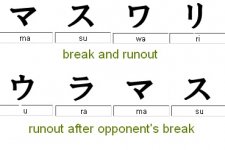
Masayoshi, could you please check if I understood this correct. I used katakana symbols table to compile this:
maswari.jpg
I'm pretty sure about "masuwari" but "uramasu" seems a bit different on your writing.
I'm curious why you write this from left to right - for Japanese is usually read from top to bottom or from right to left?

(nine ball masuwari)
ナインボールノマスワリ
okay, which of these says "9-ball"? I already can define "masuwari" :)
 
mmm good idea for tatoo :D

And this is the eventual problem in all this. IMO, kana would make a poor tattoo because it is like getting a tattoo of the phonetic spelling of runout from Websters.

Kanji tattoos are cool because they have meaning when not in a sentence. They also have original meaning.

Kana just says, I can't read this word in English, so I write it in kana so I will pronounce it right. I may still be clueless about it's meaning.

masuwari is runout in a foreign language, most likely. . .German? French?
 
Last edited:
Back in college my japanese language textbooks were all written from left to right. I think the right to left is for reserved for chinese, onyomi reading.

ナインボール
Nine Ball, or pronounced as NA I EN BO-RU

Here is the Kanji for Uramasu
URA MA SU
裏ます

Masayoshi, could you please check if I understood this correct. I used katakana symbols table to compile this:
View attachment 153873
I'm pretty sure about "masuwari" but "uramasu" seems a bit different on your writing.
I'm curious why you write this from left to right - for Japanese is usually read from top to bottom or from right to left?

okay, which of these says "9-ball"? I already can define "masuwari" :)
 
Last edited:
Masayoshi, could you please check if I understood this correct. I used katakana symbols table to compile this:
View attachment 153873
I'm pretty sure about "masuwari" but "uramasu" seems a bit different on your writing.
I'm curious why you write this from left to right - for Japanese is usually read from top to bottom or from right to left?

okay, which of these says "9-ball"? I already can define "masuwari" :)
You got it right for masuwari, but I think the "ura" part of uramasu should be in hiragana or kanji because it is a native japanese word (meaning behind or reverse).

"Masu" is the word for rack used by pool players, I think its a borrowed word, but am not sure where its from. In anycase, all the times I have seen it written, it was in katakana.
 
Back
Top