Joint and Pin Combinations

Black Cat 5791

I get all the Breaks
Silver Member
Who can explain the different hit's that are delivered by each of the joint and pin combinations?

Wood to Wood Radial Pin

Phenalic Joint Radial Pin

Stainless Joint Uni-Loc Pin

etc. etc. etc.

There's alway's talk about Soft Hit vs Firm vs Stiff. Please explain all the differences.

Black Cat :cool:
 
There isn't any. The most important part of the cue that influences the hit is the first 12 inches of the shaft.

The most important thing about the joint is that it is constructed correctly, regardless of the joint type and pin difference. Further, the joint and pin type can be used by the cuemaker to alter the balance point of the cue.


Who can explain the different hit's that are delivered by each of the joint and pin combinations?

Wood to Wood Radial Pin

Phenalic Joint Radial Pin

Stainless Joint Uni-Loc Pin

etc. etc. etc.

There's alway's talk about Soft Hit vs Firm vs Stiff. Please explain all the differences.

Black Cat :cool:
 
Didn't all that "first 12 inches" stuff come from the Predator people? Correct me if I am wrong. Wasn't it their Jacksonville tests and other testing that came up with the findings that the butt doesn't matter? Neither does the joint, nor the tip?


In fairness, they were referring to the performance of the cue. However, it may have also been in referring to how a cue feels or hits. Without a doubt, a cue "hits" or "feels" different with a different tip. To say this ends halfway down the shaft I think is wrong.

I don't think the type of joint matters, but rather what it is made of. Steel joints don't give that stiffer feeling hit because steel is hard, but because it is heavy. The same way less front end mass causes the cue tip of low deflection shafts to be displaced easier, greater mass means it isn't displaced as easily. Same with the joint. If the joint area has a lot of mass, it will not move as much or as easily. I think that's why steel joint cues have a certain feel to them. The cue doesn't vibrate and flex as much in that area as it is "transmitting" the vibrations from the shaft down into the butt. I'm sure the material matters too, just not as much. Some materials flex more than others. Although, I think that's less of a factor because phenolic is very stiff, but is lighter than steel. Just an example.


A lot of people write about how their Southwest style pin or Radial pin hits more solid. I think it's because those pins weight a lot more than regular pins. I checked on one website the weight of the Radial. A brass Radial is around 1.5 oz. That's almost as much weight as a 5/16-14 or 18 pin with a steel collar joint. 5/16 pins weigh around a half ounce or a touch more, with the typical steel collar being about an ounce, sometimes less, usually a little more.


Big pins are mainly used for balance purposes. If you don't want a butt heavy cue, you have to get some weight up front. Steel joints do that well, but if you don't like steel joints - then what? Big pin is the solution. Cue makers use other methods too, they can use other threaded rods throughout the butt to create a specific balance or weight distribution.

The other factor is in the fact that it is a fastener. Some screws have more surface area contact than others. Different threads, pitches and all of that stuff. The question is, how much does it really matter? The main way in which a pin is fastening is down the axis of the cue by pressing the shaft against the butt and holding it there tight. A 5/16-18, which is one of the least liked, does that job just fine. Enough force can be put on that pin to crush the joint and crack the butt and/or shaft. So there's nothing inherently deficient in that pin for fastening a shaft to a butt.


I think the extra ideas put behind the big pins is how they interact with the fastening of the shaft laterally. How the shaft bends, flexes or vibrates with the pin in the place that it is. The quest of some cuemakers is to eliminate as much air space or gaps as possible. The idea being that, less air = more solid. The more continuous the mating of parts, the more material of which to transfer vibration or flex which leads to how it feels.


Anyway, if I am correct in remembering that it was the Predator people who started the whole first 12" theory of how a cue performs, and perhaps even feels - then they are the ultimate hypocrites since they created the P2 cue, and later their "C4" technology. By doing so, they are claiming the butt makes a difference. They claim their butts help the cue perform better, and they also claim their methods make for better feel.

The idea used to you could screw a Predator shaft onto a Budweiser cue and it would perform exactly the same. Maybe. But it will definitely feel different. The idea that it will feel the same, because it's all in the shaft, particularly the front half of the shaft is utterly false. The performance claim may hold up though. But maybe not. I wouldn't hold what Predator did back in the 1990's as scientific fact or the word of God. They were and still are businessmen. And they were motivated by profit, not necessarily truth.
 
I was thinking back to an experiment done at one of the Texas Express tour stops, where they covered up the joints of a variety of cues.

As far as the first 12 inches, I don't remember where I heard that from, but from my experience, the ferrule and tip combinations does more to alter the hit of a cue then the joint.

JMHO
 
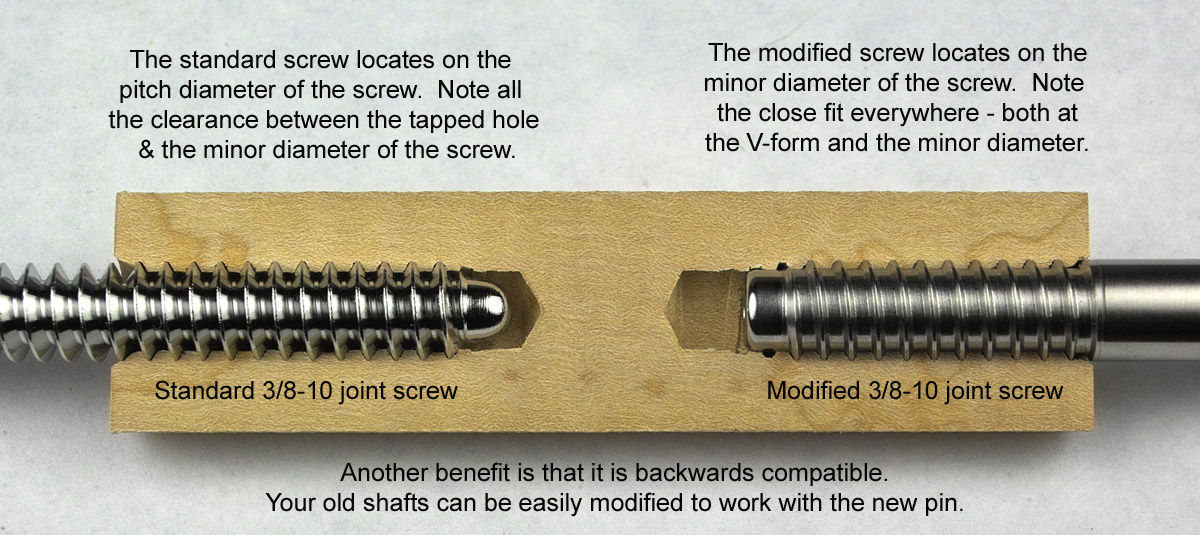
Bola Ocho: Well said I think. It brought to mind a pic I saw:

mod-pin.jpg


Obviously the shaft has to do with how the cue ball will behave, and that would be the first part of the shaft for the most part, and that has the greatest to do with performance.

The farther back you go the more it has to do with what the player feels in his right hand (if he/she is shooting right handed).

The joint would seem to be a big factor in what one feels. I think we have all experienced that.

Surface contact area, air space, weight....all factors.

The forward balance that most prefer was once achieved most classically with a steel joint and 5/16-14 pin on the vast majority of the best cues. That same weight in the same location is now achieved with the big heavy pins.

What one prefers to feel is purely personal preference I think and not really a performance matter except to say if it does not feel right it can degrade your performance.

I have seen the terms stiff and soft applied to feel in different ways and have seen them contradict each other. Not surprising since it is simply a verbalization of a perception, which can be difficult to put words to.

I have posted a question in the cue makers forum about resonance and how it might relate to performance and/or feel of a cue and never really got a good answer. Only one said that the two had nothing to do with each other, but nobody else confirmed or refuted it and I am left unsatisfied I think. http://forums.azbilliards.com/showthread.php?t=256555&highlight=resonant I don't think we will get a good answer here either. We can get a variety of opinions, but that is another matter.

I think it's a great topic of discussion, but I don't think there is a real single answer.

I for one prefer a "traditional" steel jointed cue. But I am always open to try different cues and see what they are like. As far as how it feels compared to others, I don't know what to say except that it just feels right.

 
No, nobody can because it there are so many other factors. The joint becomes much less important once you put a piece of tape over it so you can't see it.


Who can explain the different hit's that are delivered by each of the joint and pin combinations?

Wood to Wood Radial Pin

Phenalic Joint Radial Pin

Stainless Joint Uni-Loc Pin

etc. etc. etc.

There's alway's talk about Soft Hit vs Firm vs Stiff. Please explain all the differences.

Black Cat :cool:
 
I imagine if the first 12 inches of a cue were made using the same materials and the same way then the joint will provide a different hit.
 
Thanks for the input so far guy's. For my X-Mas Present to myself I decided to do something that I've been wanting to do for awhile and that was to replace the Uni-Loc on my Predator SE-3, the new configuration will be a Uni-Loc Brass Radial Pin, the Stainless Collar will Replaced with a White Duralite Collar. I'm expecting the balance to be about the same, but with a different hit and feel. This is what prompted my query. Any other replies would be great.

Black Cat :cool:
 
Back
Top