
lathe project

bubsbug

AzB Silver Member
Silver Member
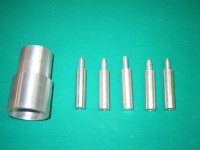
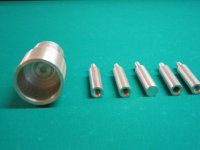
I am not as incompetent as most may think. I made these two projects two weeks ago with my big boy lathe. I did take the pins to a machine shop to be threaded, because Im not very good at it, probably because I dont know the proper technique, yes a class would be very handy so i could learn. I did tap them though.

Now a few weeks ago I got advise about how hard an adapter would be to make for a rear chuck. My Chuck is on the way so I left the o.d. a little large. Again I will probably have someone thread for me. I will probably cut the small peice off as I used this part to chuck up in the lathe. I still need to drill small holes to tighten to spine for adjustment. it is so tight going on to the spine that I need melted butter to make it go on. That right melted butter. other lubs are too thick. I put it on spun the machine at 300rps and it works great. I then turned chuck/spine by hand with a dile indicater and got .005 (.5 thousands) movement in one complete revolution. Wich I then take as only being out .0025 on each side. Someone told me that all you need was a machine that was within .001 tolarence. Well for someone who doesnt know anything this was a very very easy project. I have an adapter and new drive pins for under $15.
 

Attachments

  • 100-0027_IMG.JPG
    100-0027_IMG.JPG
    91.1 KB · Views: 366
  • 100-0030_IMG.JPG
    100-0030_IMG.JPG
    99.5 KB · Views: 321
Basic turning skills are needed

And you are doing that, but do not take lightly the advice given you. Yes, some did jump a little too hard on you maybe, but I prefer to think they have only good intentions. You can really suffer more than just raw knuckles in an instant! The lathe unlike say a table saw, seems so benign, humming away, and working smoothly, but it is deadly. I have had close calls, and I have been using them for 20 years at least, just when I relax my guard it shows me it's teeth! I was never formally trained, but I have read tons, everything I could get my hands on. The best, and a classic can be found for free at this site: http://www.americanmachinetools.com/how_to_use_a_lathe.htm
I think it is a reprint of sorts of an old SouthBend manual. If you read it a few times, and work with some of the principles they describe, your skills and safety will go way up. I have read it at least 4 times, and referred to it many more times, before doing a difficult knurl job, or some internal thread, etc! I printed and bound it for shop use. I used to have an official South Bend cloth bound book with the same info, I gave it to a longtime friend that was just entering into machining, a retiree like me, and I had concerns for his safety! So I went to the internet and printed out the book there for myself.
Do your own threading, the exercise will develop your skills that you need. That is the skilled part, not so much the billet cutting. Use a few scraps of machineable aluminum, brass, or soft steel to start. I like steel for learning myself, its cheap and easy to work with. Learn the proper way to angle your compound, and how to feed a 60 deg cutter into the work. Learn how to support the work firmly, what lubricants to cut with. How to grind HSS lathe bits, that skill will be invaluable when you learn that wood takes a way different grind to cut nice than metal. And NEVER forget that your smooth running, friendly floor lathe that cuts such pretty parts will bite your arm off if you get careless!
I think one of the most fun parts of cuemaking and using the lathe has been the learning process. Yeah, I would rather be making cues, but the more I learn the more I realize I am still learning. I struggle with some process in the craft of cuemaking, then reason out how to make a jig to hold much much closer tolerance for the next cue I make. I have several metal lathes now, and set them up to do a type of operation very well. It drove me nuts breaking down tooling to do a different step in the cue making process. If I had the shop space, I think I would have 4X as many lathes!
If I can help in any way, feel free to PM me, and we can also use the phone. I had help when starting out, and will share anything I know! Boy everyone can sure tell I was having trouble sleeping tonight, I have writers diarhea ha, ha!
 
bubsbug said:
I am not as incompetent as most may think. I made these two projects two weeks ago with my big boy lathe. I did take the pins to a machine shop to be threaded, because Im not very good at it, probably because I dont know the proper technique, yes a class would be very handy so i could learn. I did tap them though.

Now a few weeks ago I got advise about how hard an adapter would be to make for a rear chuck. My Chuck is on the way so I left the o.d. a little large. Again I will probably have someone thread for me. I will probably cut the small peice off as I used this part to chuck up in the lathe. I still need to drill small holes to tighten to spine for adjustment. it is so tight going on to the spine that I need melted butter to make it go on. That right melted butter. other lubs are too thick. I put it on spun the machine at 300rps and it works great. I then turned chuck/spine by hand with a dile indicater and got .005 (.5 thousands) movement in one complete revolution. Wich I then take as only being out .0025 on each side. Someone told me that all you need was a machine that was within .001 tolarence. Well for someone who doesnt know anything this was a very very easy project. I have an adapter and new drive pins for under $15.

Now, aren't you glad that you got a machine large enough to be able to do these tasks? That's one of the reasons I get so upset when people who have the small cue-lathes say that the larger machines may be cheaper to buy up front but the tooling costs so much more. With the bigger equipment to can make most of your tooling and jigs, much cheaper, instead of purchasing them. The more you operate the machine the closer tolerances you will be able to attain within the machines limits. Every one likes scroll chucks as they are quick and easy to use but actually, they aren't very accurate. .002-.003 TRO is about the best you can expect out of a normal scroll chuck. If a person is willing to make the investment then there are more precision chucks available but since, for the most part, we are working with wood, these tolerances are probably close enough. For installing ferrules or squaring a shaft or butt then, I believe, you need much closer tolerances. I use a 6 jaw set-tru chuck that consistently runs well under .001.

Oh, by the way, I feel that if you can install the chuck bushing with butter then the tolerance is to loose.

Dick
 
rhncue said:
Now, aren't you glad that you got a machine large enough to be able to do these tasks? That's one of the reasons I get so upset when people who have the small cue-lathes say that the larger machines may be cheaper to buy up front but the tooling costs so much more. With the bigger equipment to can make most of your tooling and jigs, much cheaper, instead of purchasing them. The more you operate the machine the closer tolerances you will be able to attain within the machines limits. Every one likes scroll chucks as they are quick and easy to use but actually, they aren't very accurate. .002-.003 TRO is about the best you can expect out of a normal scroll chuck. If a person is willing to make the investment then there are more precision chucks available but since, for the most part, we are working with wood, these tolerances are probably close enough. For installing ferrules or squaring a shaft or butt then, I believe, you need much closer tolerances. I use a 6 jaw set-tru chuck that consistently runs well under .001.

Oh, by the way, I feel that if you can install the chuck bushing with butter then the tolerance is to loose.
Dick
You are kidding, Right. I cant pot it on by hand I do have to tap with a mallet. I was going to add 4 set screws to tighten to spine. So should I scrap this one and start over. I will say one thing about tolerance. Let say I wanted to bore out a peice of 2-1/4 aluminum to 1.888. I find it rather difficult to hit that exact mark. 1.888, not 1.887 or 1.889, exactaly 1.888. Heck sometimes I find it heard to measure this number each and everytime. If you dont put the same amount pressure on the calipars, or dont measure in the same place everytime I guess there will always be tolerances. Perhaps I just need more experience. Im learning more and more everyday with a long way to go. I even called Ivy Tech state college today. Its just a start that all. I will also say one thing about dsek top equiptment as well. I have mixed feelings about both sides. I definitly think that a good shop is one with both kinds of equiptment. Thanks
 
> Sometimes,you just have to "sneak up" on your desired specs. Sometimes that means turning a rod to .002 or so over the desired measurement,and finish with a file,emery cloth,or sandpaper. As far as boring a hole to an exact measurement,I still have problems with that too. I also tightened the adjustments up on the lathe I use most often at school,and can reliably dial in .001 and get just that most of the time. Tommy D.
 
bubsbug said:
You are kidding, Right. I cant pot it on by hand I do have to tap with a mallet. I was going to add 4 set screws to tighten to spine. So should I scrap this one and start over. I will say one thing about tolerance. Let say I wanted to bore out a peice of 2-1/4 aluminum to 1.888. I find it rather difficult to hit that exact mark. 1.888, not 1.887 or 1.889, exactaly 1.888. Heck sometimes I find it heard to measure this number each and everytime. If you dont put the same amount pressure on the calipars, or dont measure in the same place everytime I guess there will always be tolerances. Perhaps I just need more experience. Im learning more and more everyday with a long way to go. I even called Ivy Tech state college today. Its just a start that all. I will also say one thing about dsek top equiptment as well. I have mixed feelings about both sides. I definitly think that a good shop is one with both kinds of equiptment. Thanks

Don't use a caliper, use a micrometer...JER
 
Just a heads up with the aluminum. I had the same idea, and took the blank to a machinist friend of mine. He handed me the aluminum back and said he wouldn't make it out of that. If you hang a fairly large chuck back there you can get some pretty good torque. He insisted on making mine out of steel. Inside metric threads and outside 2 1/4X 8. At first I thought he might be overkilling it, but then the idea of a 30lb chuck coming loose at a few thousand rpm's made me glad he had stepped in.
As Olsenview said, they look very peaceful, until they reach out and touch you.
 
adapter material choice

I agree with Steve, and I use the light chuck like used in a cueman cue lathe. I made my own adapter out of soft steel. It works good, and I never worry about it flying off to tell me that I made a mistake. Steel machines as easy as aluminum.
By the way, about getting your dimensions closer. Get some scrap steel, or whatever you have and make a series of plug gauges for your bores you commonly need to cut. Make the body right on. DNP, then step it down in a couple steps to the tip, you can make it .oo5. and .010, .025 smaller in steps. Wood is hard to measure ID with a caliper. The fibers grab the caliper blades and do not slide freely, so you get weird readings. A plug guage will speed up your work immensely for ID's. And be way more accurate! OD's are often better with a mike, though a caliper is fast and cheap. Try a micrometer and see if you do better with it. They have chinese digi micrometers nowadays, if the vernier scale bothers you, I hate reading verniers since my near vision has gone south.
 
Last edited:
BLACKHEARTCUES said:
Don't use a caliper, use a micrometer...JER

Internal bore micrometers get pretty expensive if you have a wide range of bores to measure. I use telescoping guages with my outside mics.

Oh ya, I was most impressed with bubs work ... his comment "I put it on spun the machine at 300rps and it works great. " shows the outstanding effort ... that's 18,000 rpm folks !

Dave, still a smartass
 
Back
Top