Leveling Table Without Leg Levelers?

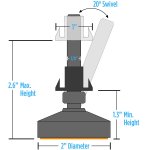
Leg Leveler Height. Plus 1/2 inch board underneath.
 

Attachments

  • leg levelers.jpg
    leg levelers.jpg
    101.5 KB · Views: 260
Leg Leveler Height. Plus 1/2 inch board underneath.

I know exactly which ones they are, only, I don't use the T-nuts to mount them for various reasons. I use the stayfast threaded inserts, same as we use as the rail bolt anchors threaded into the rails.
 
I know exactly which ones they are, only, I don't use the T-nuts to mount them for various reasons. I use the stayfast threaded inserts, same as we use as the rail bolt anchors threaded into the rails.

Thanks RKC. Even with the stafast threaded inserts, the height is still too high, right? Also, what's your recommendation...should I keep the levelers or remove them?
 
Last edited:
Thanks RKC. Even with the stafast threaded inserts, the height is still too high, right? Also, what's your recommendation...should I keep the levelers or remove them?

Ace hardware, in the specialty drawers, has leveler bolts. They're 3/8 × 16 thread, in different lengths. But, on the foot end, it has a welded 7/8" flat nut, about an 1/8" thick, that can be screwed right up to the bottom of the leg, but that makes it difficult to get a wrench on the nut, so....you can thread a 3/8" nut on the rod of the leveler, use red loctite to lock it in place all the way threaded down, then use a 9/16" open end wrench to adjust the leveler, and it's only lifting the table by 1/2" if its threaded all the way in. The legs on the table only support about 250lbs each, thats not very much weight when you think about it.
 
Ace hardware, in the specialty drawers, has leveler bolts. They're 3/8 × 16 thread, in different lengths. But, on the foot end, it has a welded 7/8" flat nut, about an 1/8" thick, that can be screwed right up to the bottom of the leg, but that makes it difficult to get a wrench on the nut, so....you can thread a 3/8" nut on the rod of the leveler, use red loctite to lock it in place all the way threaded down, then use a 9/16" open end wrench to adjust the leveler, and it's only lifting the table by 1/2" if its threaded all the way in. The legs on the table only support about 250lbs each, thats not very much weight when you think about it.

Excellent. Thank you so much! I'm going to give this a shot.
 
Huh? The floor is level in the new basement. Well, as level as a typical floor, not as level as a pool table surface.

A typical basement floor is not level, by design.

Since your table has limits, consider leveling the floor, at least in the playing area of the table.
 
A typical basement floor is not level, by design.


Since your table has limits, consider leveling the floor, at least in the playing area of the table.
Mine is both flat and level within reason, except locally where there are drains near my water heater and humidifier. I think the idea of somehow leveling an entire area of floor instead of using a few shims under a leg or two is a bit impractical. The table only cares about where the feet are.

I also don't think the OP ever said his new floor wasn't level.

Sent from my SM-G960U using Tapatalk
 
Last edited:
Ace hardware, in the specialty drawers, has leveler bolts. They're 3/8 × 16 thread, in different lengths. But, on the foot end, it has a welded 7/8" flat nut, about an 1/8" thick, that can be screwed right up to the bottom of the leg, but that makes it difficult to get a wrench on the nut, so....you can thread a 3/8" nut on the rod of the leveler, use red loctite to lock it in place all the way threaded down, then use a 9/16" open end wrench to adjust the leveler, and it's only lifting the table by 1/2" if its threaded all the way in. The legs on the table only support about 250lbs each, thats not very much weight when you think about it.

Update: I followed your directions above and everything worked out wonderfully. Thank you so much Glen
 
Happy Ending!

That sounds like a perfect ending! RKC may be a bit difficult at times but he comes through.
 
Update: I followed your directions above and everything worked out wonderfully. Thank you so much Glen

Update: The loktite super glue came loose and now the levelers don’t work. I’m going to remove the slates to get under the legs and try again using a lot more glue. Hopefully it holds this time.
 
Stud lock grade usually requires both heat and a 18" breaker bar to loosen. Try again. Pull all four bolts and remove the nuts. Clean the threads or start with new nuts and bolts. This time clean the threads with a contact cleaner. Then apply the Loc Tite. Put the bolt in a vise and crank down on the nut. Let it dry overnight. There is no way that should have come loose from lifting a table leg.

I admit I don't like RKC's attitude on many things. But he's 100 percent right on this. Stud grade holds your high HP race engines together.
 
Stud lock grade usually requires both heat and a 18" breaker bar to loosen. Try again. Pull all four bolts and remove the nuts. Clean the threads or start with new nuts and bolts. This time clean the threads with a contact cleaner. Then apply the Loc Tite. Put the bolt in a vise and crank down on the nut. Let it dry overnight. There is no way that should have come loose from lifting a table leg.

I admit I don't like RKC's attitude on many things. But he's 100 percent right on this. Stud grade holds your high HP race engines together.

Thanks for the additional info! Luckily they came loose early on before the slates and rails were fully installed. Now I just need someone to help lift the slates off and back on the frame again Otherwise, it didn't set me too far back.

I'll try your suggestions and hopefully they work.
 
Back
Top