
You are using an out of date browser. It may not display this or other websites correctly.
You should upgrade or use an alternative browser.
You should upgrade or use an alternative browser.
Medium Roast vs Dark Roast ( non cored )
- Thread starter manopr350
- Start date

Great question……..I’ll contact my cue maker who’s capable of building heavier version Kielwood shafts.
I haven’t found much difference but it was awhile ago I tried the Tsunami shafts & the 2.0 version was nice.
I was amazed by how many cue makers told me this wasn’t possible unless you added weight at the collar.
So I’m more skeptical of expert opinions as the KW shafts are in my cue case that I was told couldn’t be built.
I haven’t found much difference but it was awhile ago I tried the Tsunami shafts & the 2.0 version was nice.
I was amazed by how many cue makers told me this wasn’t possible unless you added weight at the collar.
So I’m more skeptical of expert opinions as the KW shafts are in my cue case that I was told couldn’t be built.
DeeDeeCues
Well-known member
Great question……..I’ll contact my cue maker who’s capable of building heavier version Kielwood shafts.
I haven’t found much difference but it was awhile ago I tried the Tsunami shafts & the 2.0 version was nice.
I was amazed by how many cue makers told me this wasn’t possible unless you added weight at the collar.
So I’m more skeptical of expert opinions as the KW shafts are in my cue case that I was told couldn’t be built.
Nobody suggested adding weight at the collar. They suggested adding weight inside the shaft at the base. The truth of the matter is that you likely don't possess the knowledge to figure out if this was done on your special shafts without cutting them in half.
All the cuemakers who responded to your 1237 requests all told you that wood heavy enough would be difficult to find. Every one of them is capable of making the shaft you wanted, but didn't know of a source for wood that heavy. Which brings me to my next question...how do you even know how the wood was 'torrefied'? Maybe it was just roasted...which is not torrefication.

I guess shaft x-ray coming up....Nobody suggested adding weight at the collar. They suggested adding weight inside the shaft at the base. The truth of the matter is that you likely don't possess the knowledge to figure out if this was done on your special shafts without cutting them in half.
All the cuemakers who responded to your 1237 requests all told you that wood heavy enough would be difficult to find. Every one of them is capable of making the shaft you wanted, but didn't know of a source for wood that heavy. Which brings me to my next question...how do you even know how the wood was 'torrefied'? Maybe it was just roasted...which is not torrefication.
Funny how presumptuous some people are…..Meucci doesn’t, Jacoby didn’t need to use a cored shaft, Schmelke doesn’t, SCDiver2112 doesn’t, Jim Pierce isn’t…..perhaps your crowd does but these guys build what you request because they take the time to locate and use the right blanks whereas other builders aren’t willing or able to do that or else it’s more likely it’s because they prefer to reduce the front end mass of the shaft by coring. I have referred several folks to Jim and everyone seems pretty delighted with the outcomes. He builds a really nice Kielwood shaft and he doesn’t sneakily add weight to the shaft without telling you, especially since he says it isn’t necessary….OMG doesn’t begin to convey my astonishment over this schmuck’s ignorance or obstinacy about cue making….WTF….he’s just a jerk but he’s entitled to his misinformed opinions.
BACK TO PUTTUNG THIS SIMIAN BACK ON IGNORE…….what an absolute idiot……BTW, funny post re: X-Ray.
BACK TO PUTTUNG THIS SIMIAN BACK ON IGNORE…….what an absolute idiot……BTW, funny post re: X-Ray.
DeeDeeCues
Well-known member
BACK TO PUTTUNG THIS SIMIAN BACK ON IGNORE…
I really hope there is some kind of non-racist reference I don't get here...

Dark one is a little lighter and more brittle.
Stiffness is determined by the wood itself.
Not the color.
Stiffness is determined by the wood itself.
Not the color.

CeaseLess
Active member
Is it possible, with the right wood, to make a Kielwood that hits softDark one is a little lighter and more brittle.
Stiffness is determined by the wood itself.
Not the color.
Yes. A young wide grain mapleIs it possible, with the right wood, to make a Kielwood that hits soft
CeaseLess
Active member
I own a Kielwood, my biggest issue with it is that it doesn't feel lively, is there a way to get a Kielwood to play soft and lively?Yes. A young wide grain maple
CeaseLess
Active member
What's the difference between roasting and torrification?Nobody suggested adding weight at the collar. They suggested adding weight inside the shaft at the base. The truth of the matter is that you likely don't possess the knowledge to figure out if this was done on your special shafts without cutting them in half.
All the cuemakers who responded to your 1237 requests all told you that wood heavy enough would be difficult to find. Every one of them is capable of making the shaft you wanted, but didn't know of a source for wood that heavy. Which brings me to my next question...how do you even know how the wood was 'torrefied'? Maybe it was just roasted...which is not torrefication.
DeeDeeCues
Well-known member
What's the difference between roasting and torrification?
Torrifying is done in a vacuum.
CeaseLess
Active member
What would be the difference in playabilityTorrifying is done in a vacuum.
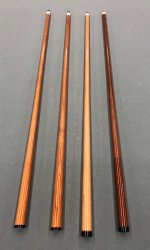

Get a regular maple shaft and stain it brown. Problem solved.I own a Kielwood, my biggest issue with it is that it doesn't feel lively, is there a way to get a Kielwood to play soft and lively?

I believe they are separate parts of the same process.What's the difference between roasting and torrification?
Moisture, sap and sugar gets removed but moisture has to be restored (3-6%) so the shaft doesn’t become brittle. The shaft is brought down to almost 0% moisture in a vacuum kiln and then brought back up to a stable 4% moisture level.
The goal is for the shaft to have 3-6% moisture that’s significantly drier than standard maple and relatively moisture resistant thus more resistant to warping, even when exposed to high humidity. I hope this answers any questions and the entire process is referred to as torrification.
The goal is for the shaft to have 3-6% moisture that’s significantly drier than standard maple and relatively moisture resistant thus more resistant to warping, even when exposed to high humidity. I hope this answers any questions and the entire process is referred to as torrification.

My experience with a Kielwood shaft, Jacoby, I only have one. The shaft, dark roast radial 30" 3.5 oz, was a little too light in balance up front for my taste. I drilled and tapped in for a short piece of 5/16"x14 pin of .3 oz to give it a slight more forward balance for my preference. My feeling is that with this combination I get the weight I want without the front end weight of a shaft that was naturally at 3.8 oz. Also I tapered it down to 12.5 mm from the 12.75 mm as received just so it matched my other shafts that I was used to.
As to whether the front end is cored or not, or does it have lower deflection than my Jacoby Ultra shafts or Rhino carbon shafts, I am not qualified enough to tell you. I will say that I shoot all three without any compensation.
I changed the tip to an Ultraskin black med like I have on my Ultra wood shafts, but changed it again to a black soft as the hit was too harsh. I am considering going softer yet to an ultraskin pro as even with the soft it is still harsh. The shaft has an incredible amount of energy transfer, even more than my carbon shafts. The shaft has a finish that feels hard and similar to a carbon shaft.
That's all I've got on my one Kielwood shaft. Your views or experiences may be different and that's fine, but these are my views on my shaft.
As to whether the front end is cored or not, or does it have lower deflection than my Jacoby Ultra shafts or Rhino carbon shafts, I am not qualified enough to tell you. I will say that I shoot all three without any compensation.
I changed the tip to an Ultraskin black med like I have on my Ultra wood shafts, but changed it again to a black soft as the hit was too harsh. I am considering going softer yet to an ultraskin pro as even with the soft it is still harsh. The shaft has an incredible amount of energy transfer, even more than my carbon shafts. The shaft has a finish that feels hard and similar to a carbon shaft.
That's all I've got on my one Kielwood shaft. Your views or experiences may be different and that's fine, but these are my views on my shaft.

20K views · 236 reactions | ❓️❓️What cue does Douglas Moore play with ❓️❓️ ❓️Why do his special made shafts hit so good ❓️ Eddie P Man O'Faith gives us an opportunity to hear directly from the extremely private cuemaker Mr. Douglas Moore! This is a
❓️❓️What cue does Douglas Moore play with ❓️❓️ ❓️Why do his special made shafts hit so good ❓️ Eddie P Man O'Faith gives us an opportunity to hear directly from the extremely private cuemaker Mr....
 www.facebook.com
A 30” KW shaft that only weighed 3.5 ozs. sure seems too light. Even a 29” shaft weight, which is pretty typical,
seems too light at 3.5 ozs. If the shaft was piloted, versus flat faced, the shaft would have been incredibly light for
Kielwood or original maple. But it all comes down to what the cue owner likes, presuming they did their homework.
seems too light at 3.5 ozs. If the shaft was piloted, versus flat faced, the shaft would have been incredibly light for
Kielwood or original maple. But it all comes down to what the cue owner likes, presuming they did their homework.