
You are using an out of date browser. It may not display this or other websites correctly.
You should upgrade or use an alternative browser.
You should upgrade or use an alternative browser.
Moisture meter
- Thread starter RocketQ
- Start date
RocketQ said:How does a moisture meter work? Could you do the same process with a multimeter?
Edit:
Does this only check the surface of the wood?
According to http://www.delmhorst.com/popups/wood_faq.html
How Does A Moisture Meter Work?
"Using the principle of electrical resistance, pin-type meters use the board as an element in a circuit by driving two pins or electrodes into it. This method works because moisture conducts electricity well and dry wood is an effective insulator.
Most pinless meters use the capacitance method, which uses the relationship between the moisture content and the dielectric properties of the wood.
Both the resistance and the dielectric properties of wood change in direct proportion to its moisture content, within a specific range."
I would think you could do this with a multi meter, but as each type of wood is going to give a different resistance, you would need the conversion factors given with most moisture meters (although you could probably find this through web research), and you would also need to know what the conversion is for resistance to moisture content, which I would think could only come from experimentation with a moisture meter and the multi meter in the same piece of wood at the same time. I would also think that you would have to place the multimeter electrodes at exactly the same distance from each other every time, or that may skew the results. Interesting idea though.

Sorry to invade your post
RocketQ - Sorry to jump in, but I am looking for a moisture meter, if you have one lying around, and want to sell or swap? I have the pin type and it went bad, but would like the have the non-pinned type If you do not have any for sale, maybe point me in the right direction. I want a good one this time that works !!!!!!!! Thanks and Merry Christmas
RocketQ - Sorry to jump in, but I am looking for a moisture meter, if you have one lying around, and want to sell or swap? I have the pin type and it went bad, but would like the have the non-pinned type
If you do not have any for sale, maybe point me in the right direction. I want a good one this time that works !!!!!!!! Thanks and Merry ChristmasA multi-meter, once you found out the resistance:moisture ratios, I think would be a far better indication than the moisture meter. Instead of having the pins an inch apart, you can put a pin into each end of the wood for a thorough test. Great idea!!! Gonna work on this one myself.

Jim I don't have one right now. Not sure if I am even going to buy one. Time is the best seasoner. Just curious how they worked good no good.billiardbum said:RocketQ - Sorry to jump in, but I am looking for a moisture meter, if you have one lying around, and want to sell or swap? I have the pin type and it went bad, but would like the have the non-pinned type
All info you have to take with a grain of salt though. I wonder do they only read the surface. Problem is the surface is going to dry faster than the core.
Shakes I read that.. I wanted more info.

I've been using the same one of these for almost 8 years. It works pretty well.billiardbum said:RocketQ - Sorry to jump in, but I am looking for a moisture meter, if you have one lying around, and want to sell or swap? I have the pin type and it went bad, but would like the have the non-pinned type
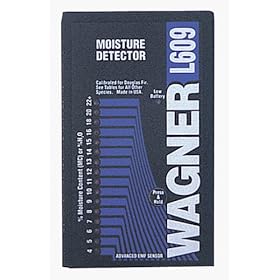
Amazon.com has them pretty cheap.
RocketQ said:Jim I don't have one right now. Not sure if I am even going to buy one. Time is the best seasoner. Just curious how they worked good no good.
All info you have to take with a grain of salt though. I wonder do they only read the surface. Problem is the surface is going to dry faster than the core.
Shakes I read that.. I wanted more info.
I'm not sure what other info you are looking for. The pin type does not check the surface, it's going to check the material between the pins. Basically the wood acts as a "fuse" if you will. You have two wires (the electrodes) that send and receive a small measured current. When you "stab" them into the wood, it acts as a resistor/conductor, and depending on how much current makes it to the receiving wire, it tells you how dry the wood is. The more current (or less resistance) the wetter the wood. I think qbilder has a good idea, but I wonder if it will be able to measure through a 18" or even 30" piece of wood. I'll have to try it out on my next order of wood before I wax the ends.
Thank Sheldon...I will get one... Happy HolidaysSheldon said:I've been using the same one of these for almost 8 years. It works pretty well.
Amazon.com has them pretty cheap.