I recently picked up this older Merry Widow and, after going through the construction pretty closely and comparing it directly with two known Rich cues I own, I’m leaning pretty strongly toward Abe Rich. I’d appreciate opinions from anyone familiar with Abe’s work, particularly if you see something that would rule him out.
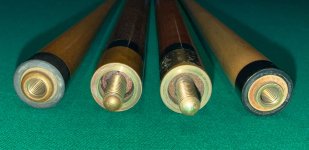
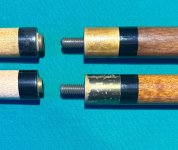
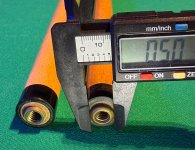
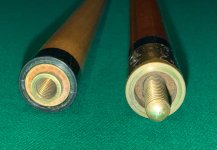
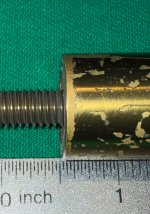
The joint is 5/16-18 and is directly compatible with both of my known Rich cues—the shafts and butts will interchange and thread properly. The cue measures approximately .830” at both the butt and shaft joint faces. The joint pin projects approximately .71” above the joint face.
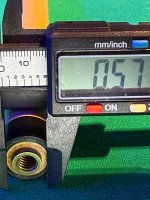
The original shaft appears to have had a wood-over-brass pilot. The wooden portion has broken away, leaving the .410” brass threaded insert exposed. There is still a very distinct witness ring on the shaft face measuring approximately .57” across where the wooden portion of the pilot appears to have broken away. The receiving bore in the butt is also approximately the same diameter. One of my known Rich shafts uses essentially the same construction, with a .410” brass insert surrounded by its intact wooden pilot.
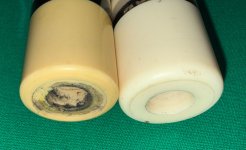
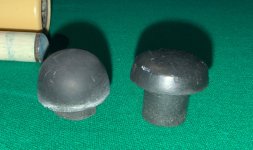
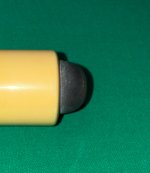
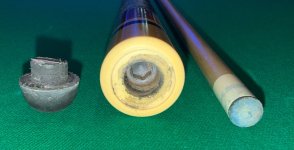
Where this cue differs noticeably from my known Rich cues is the unusually long joint pin and particularly the butt-end construction. It has what appears to be a Delrin butt cap with a separate recessed weight bolt and a solid domed push-in rubber bumper with no center screw hole. Both of my known Rich cues instead have screw-retained bumpers.
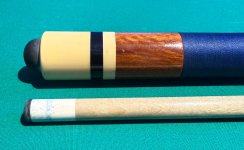
The cue is 58¾” overall including tip and bumper, with a 29” shaft measured from the joint face to the top of the ferrule, and a 29” butt measured from the joint face to the bottom edge of the butt sleeve prior to the bumper. The butt weighs 14.9 oz and the shaft 3.9 oz, for 18.8 oz total. The 1” ferrule measures 12.9 mm.
One other pleasant surprise is the overall condition. Aside from the missing wooden portion of the shaft pilot and the aging/wear to the brass joint collar, the cue is exceptionally well preserved. It also rolls dead straight—the butt, shaft and assembled cue all roll straight, without even any noticeable taper roll in the shaft.
Taken together—the Rich-compatible 5/16-18 joint architecture, original wood-over-brass pilot construction, unusually long pin, Delrin butt cap, independent weight-bolt system and solid push-in domed bumper—everything seems to be pointing me toward Abe rather than Rich Q.
Am I on the right track, or does anyone see something here that argues against Abe Rich?
The joint is 5/16-18 and is directly compatible with both of my known Rich cues—the shafts and butts will interchange and thread properly. The cue measures approximately .830” at both the butt and shaft joint faces. The joint pin projects approximately .71” above the joint face.
The original shaft appears to have had a wood-over-brass pilot. The wooden portion has broken away, leaving the .410” brass threaded insert exposed. There is still a very distinct witness ring on the shaft face measuring approximately .57” across where the wooden portion of the pilot appears to have broken away. The receiving bore in the butt is also approximately the same diameter. One of my known Rich shafts uses essentially the same construction, with a .410” brass insert surrounded by its intact wooden pilot.
Where this cue differs noticeably from my known Rich cues is the unusually long joint pin and particularly the butt-end construction. It has what appears to be a Delrin butt cap with a separate recessed weight bolt and a solid domed push-in rubber bumper with no center screw hole. Both of my known Rich cues instead have screw-retained bumpers.
The cue is 58¾” overall including tip and bumper, with a 29” shaft measured from the joint face to the top of the ferrule, and a 29” butt measured from the joint face to the bottom edge of the butt sleeve prior to the bumper. The butt weighs 14.9 oz and the shaft 3.9 oz, for 18.8 oz total. The 1” ferrule measures 12.9 mm.
One other pleasant surprise is the overall condition. Aside from the missing wooden portion of the shaft pilot and the aging/wear to the brass joint collar, the cue is exceptionally well preserved. It also rolls dead straight—the butt, shaft and assembled cue all roll straight, without even any noticeable taper roll in the shaft.
Taken together—the Rich-compatible 5/16-18 joint architecture, original wood-over-brass pilot construction, unusually long pin, Delrin butt cap, independent weight-bolt system and solid push-in domed bumper—everything seems to be pointing me toward Abe rather than Rich Q.
Am I on the right track, or does anyone see something here that argues against Abe Rich?
Attachments
-
 IMG_0684.jpeg162.2 KB · Views: 98
 -
 IMG_0685.jpeg174 KB · Views: 93
 -
 IMG_0686.jpeg282.7 KB · Views: 95
 -
 IMG_0687.jpeg459.3 KB · Views: 98
 -
 IMG_0688.jpeg382.1 KB · Views: 94
 -
 IMG_0693.jpeg212.9 KB · Views: 93
 -
 IMG_0689.jpeg275 KB · Views: 85
 -
 IMG_0698.jpeg378.7 KB · Views: 86
 -
 IMG_0692.jpeg439.4 KB · Views: 81
 -
 IMG_0701.jpeg313.6 KB · Views: 95