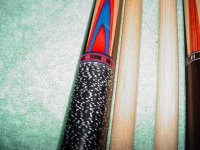
Question about butterfly spliced cues...

coryjeb

AzB Silver Member
Silver Member
I was looking into buying this type of cue. Although not my favorite style, they are appealing to me. I am wondering if there is anything "special" about this type of construction? Is it more labor intensive, less? Is it purely for looks? I guess I'm just looking for some good info. Thanks, Cory
 
Just like with regular points, it can be short spliced or full spliced. Each has it's own pros & cons. The only difference I can think of besides designed appearance is the higher need of care required for butterfly points to prevent chipping out & "fuzzing" at the tips. Butterfly points have more surface area at the tip of the point so any chipout or fraying of the wood will be much easier to see than on a sharp point. I relate it to noticing a flaw on the end of a needle as opposed to noticing a flaw on a knife edge. It's easy to spot a dent on a knife edge, but on a needle is much more difficult. So in essence I guess i'm saying it's easier to do good looking points than it is to do good looking butterflies. Besides that, no other major differences.
 
Butterfly points make for a stiffer hitting cue, at least that's what I've always been told by Billiard players who greatly desire this cue design over any other.

Dick
 
preface: I am not a cue maker or aspiring to be one, this has really just caught my interest. With that said, it would seem to me, the more times you split the wood up, the more glue? More glue = stiffer? i.e. a cue with 2 butterfly splices is actually 4 pieces of wood? Whereas a full splice is 2 pieces in your typical 4 point, bar cue/sneaky style. Would these have a similar syle hit, given same joint/ferrule/tip? Is this a way for a cuemaker to use smaller or excess or what may otherwise be waste pieces of wood since there is more smaller pieces in a cue, or is it purely by design. Is this an old technique? Thanks to those who have responded and any info is greatly appreciated.

 
Splicing the woods is a double teir objective. First, it gives a way of weighting & balancing the cue butt without having to add or subtract weight. Secondly, it allows the builder to combine the characteristics of two woods to create a "hybrid" effect. You can splice maple into ebony & get a hard hit without the excess weight. Or you can splice ebony into maple & get a smooth, mild hit without having to add weight.

Nowadays butterfly splicing is more of an asthetic technique than practical. For me, it is nearly entirely asthetic, except for cues I full splice. I sometimes make full splice butterfly blanks & make simple sneaky like cues from them. Besides those, I cut butterfly points as short splice for looks to give contrasting woods.
 
Butterflies Are Cool

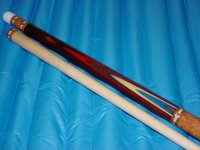
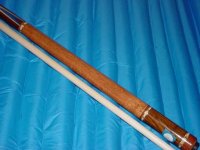
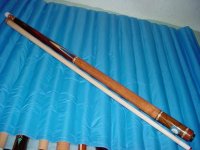
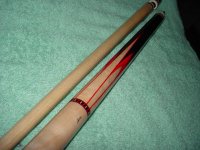
All who said they are stiffer are correct ... You don't see many here in the states because softer hitting cues with more deflective shafts are preferred for the comfort factor relating to stroking the cue ...taper ... European , South american , Eastern , Pacific rim prefer stiff , hard hitting cues that deliver plenty of feel for control , less deflection for straight shootin' ... Flat laminating the forearm indexing strategically strengthens it significantly and the result is stiffness and a solid hit ... In combination with a conical shaft taper you got one solid cue that you can play most games with ... But always remember different strokes for different folks ... I ' ve seen players with Wal-Mart cues run like they're on nuclear energy ... If you like it , it's GOOD ... These are home made ... DSC00018.JPG

DSC00019.JPG

DSC00020.JPG

Few Cue Pics 002.jpg

Few Cue Pics 141.jpg
 
Back
Top