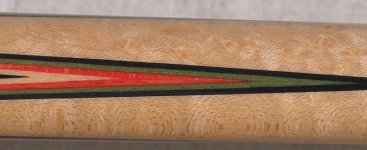
Recuts - Points or veneers?

shakes

AzB Silver Member
Silver Member
Okay, a little controversy here. Cuemakers (builders, assemblers, whatever you may be at the moment, however, I'm not looking for resellers, or collectors opinions) what do you think of the recut marketing? Personally, while I know the kind of work involved, and personally, this is what I am setting up for, I just don't understand calling a 4 point cue with 3 recuts in place a 16 point cue.

My opinion is the example cue is simply a 4 point cue with 3 recut veneers. Of course, I would probably leave off the "veneer" part of that and just say 3 recuts, but all it is to me is another veneer, with no glue line, and, typically, made with another hardwood.

So please fire away, whether you agree with me or not.

~M
 
I agree with you. Ive seen some on here selling cues saying its a 20 point or whatever. I think most people describing a cue this way are not cue builders but collecters or just average people selling one.(not trying to offend anyone) I think the same thing, It's a lot more setup and in my opinion looks nicer with recuts than glue lines in the verneers. But both types of points require skill and patience to execute properly. My 2 cents...........Dave


http://members.cox.net/albrechtcustomcues/
 
I agree with you completely Michael, and I know you make recut points, but do you call your recut cues 16 pointers, or 4 pointers with 3 recuts?

Thanks for the comments.
 
shakes said:
Okay, a little controversy here. Cuemakers (builders, assemblers, whatever you may be at the moment, however, I'm not looking for resellers, or collectors opinions) what do you think of the recut marketing? Personally, while I know the kind of work involved, and personally, this is what I am setting up for, I just don't understand calling a 4 point cue with 3 recuts in place a 16 point cue.

My opinion is the example cue is simply a 4 point cue with 3 recut veneers. Of course, I would probably leave off the "veneer" part of that and just say 3 recuts, but all it is to me is another veneer, with no glue line, and, typically, made with another hardwood.

So please fire away, whether you agree with me or not.

Just my opinion, but when I cut a "V" groove into a piece of wood & glue another piece into that groove....IT'S A POINT. Therefore if I recut a groove in the same place & glue another piece of wood into that place, I have repeated the same steps & therefore it is ANOTHER POINT. Unlike vaneers that are basicaly rapped around a SINGLE POINT...JER
 
nbll01 said:
It's a lot more setup and in my opinion looks nicer with recuts than glue lines in the verneers.

There are cuemakers using traditional veneers w/o any gluelines or crookedness/overlay in their pointwork. You usually won't find any gluelines around their inlays, either.

But both types of points require skill and patience to execute properly.

Exactly.

-Roger
 
shakes said:
I agree with you completely Michael, and I know you make recut points, but do you call your recut cues 16 pointers, or 4 pointers with 3 recuts?

Thanks for the comments.

I call it both but because 90 percent of the people don't know what it takes to do it, So they don't understand it, now that same 4 point with 3 recuts becomes 16 points.
Definitions:
Re cut is X amount of points installed, then the forearm is turned, then you index and repeat the process for the achieved amount of re cuts per point.

Re milled is using a miller, V Blocks with locks or a holder custom built to hold the square 90 degrees so it doesn't slip and cut another V groove inside to the desired thickness. Glue the next one in place or remove it and do the next ones. When their all cut and glued together, then you only cut 4 V grooves into the forearm and install them all at once.
 
shakes said:
Okay, ,,, just don't understand calling a 4 point cue with 3 recuts in place a 16 point cue.

~M

it's a marketing strategy that allows the cuemaker to charge more because calling it a 16 point sounds fancier.

i think a 4 prong/4 veneer should be called a "supinated 4 prong 32 veneer multi-section miter-cut convergence split matrix". that'd be worth an extra several hundred dollars for THE SAME DAMNED THING.
 
Last edited:
Just another (potentially endless) debate on the definition of a word with many ways to be used. (sneaky pete, "custom" cue, etc.)
Calling a 4 pronged cue with recut points more than a 4 pointed cue could get a little confusing though.
recuts generally are done to look like veneers, so saying it means more points is probably not the best way to distinguish them from standard veneered cues.
 
buddha162 said:
There are cuemakers using traditional veneers w/o any gluelines or crookedness/overlay in their pointwork. You usually won't find any gluelines around their inlays, either.

Traditional veneers HAVE a glueline. The way they are put together guarantees one.
 
Points are commonly counted as to what is clearly visible on one particular area on the forearm. So what you see at the apex is counted as one... like for a basic 4 or 6 point cue... each point is independent from the other... now if ir they are recut points, points within a point... what to call them is up for grabs... =)
 
Sheldon said:
Traditional veneers HAVE a glueline. The way they are put together guarantees one.

if they're done right, they don't have a GLUE line. there might be a barely discernable line,,,,,,maybe. :)
 

Attachments

  • gluelinecp.jpg
    gluelinecp.jpg
    62.5 KB · Views: 367
Sheldon said:
Just another (potentially endless) debate on the definition of a word with many ways to be used. (sneaky pete, "custom" cue, etc.)
Calling a 4 pronged cue with recut points more than a 4 pointed cue could get a little confusing though.
recuts generally are done to look like veneers, so saying it means more points is probably not the best way to distinguish them from standard veneered cues.

Sheldon,
You telling me there are no 20 or 40 or 60 point cues out there. :)

I happen to agree with you, BTW.

JV
 
bruin70 said:
if they're done right, they don't have a GLUE line. there might be a barely discernable line,,,,,,maybe. :)

Can we see the other three points?

There are cuemakers that really have this down to a science.. Mottey, White, Murray Tucker, Showman, Tascarella the gaps are minimal. But early on the blanks by Spain, Davis, etc.. were good but not that good. We are talking 40+ years ago and a lot has changed.

JV
 
Recut's-Points or veneers?

I have to go along with Mike Webb. It's hard to classify veneer work with recut. Not only in time, but material cost. Let's see, 2 square ft of veneer at 3.50 per square ft plus 4 points equals one 4 veneer 4 point cue.
Now a similar recut has 20 pieces of wood, some expensive and some not.
I do veneers two different ways. One(the fastest) involves gluing up a stack of veneers then running them thru a specially made saw blade that cuts a vee, glue them in the cue with the point material and turn it round.
You can also overlap the veneers and them trim them, takes a little bit longer. To remachine as Mike Webb said, it's cut glue turn, cut glue turn, etc. And you can't be off a smidge. Much more time and equipment critical. I won't even talk about my indexing set up to make sure the cue goes back in the same place every time. To cut the veneer style front you only have the cue in the machine once. Anybody who has done this, knows that getting it back to that exact same position 5 times is very hard to do. I didn't even mention having to get exact 90 degree corners on 20 pieces of wood, not 4. So I have no problem calling a remachine what every number of cuts it took. And we haven't even talked about hybrid designs. Veneer work in between remachine work.
 
Last edited:
Recuts

By the way if I can see a seam I call it a glue line, even in my cues.
Sorry but you can always see a "seam in veneer work"


Just my opinion.
 

Attachments

  • tim3.jpg
    tim3.jpg
    65.4 KB · Views: 273
Last edited:
cutter said:
I have to go along with Mike Webb. It's hard to classify veneer work with recut. Not only in time, but material cost. Let's see, 2 square ft of veneer at 3.50 per square ft plus 4 points equals one 4 veneer 4 point cue.
Now a similar recut has 20 pieces of wood, some expensive and some not.
I do veneers two different ways. One(the fastest) involves gluing up a stack of veneers then running them thru a specially made saw blade that cuts a vee, glue them in the cue with the point material and turn it round.
You can also overlap the veneers and them trim them, takes a little bit longer. To remachine as Mike Webb said, it's cut glue turn, cut glue turn, etc. And you can't be off a smidge. Much more time and equipment critical. I won't even talk about my indexing set up to make sure the cue goes back in the same place every time. To cut the veneer style front you only have the cue in the machine once. Anybody who has done this, knows that getting it back to that exact same position 5 times is very hard to do. I didn't even mention having to get exact 90 degree corners on 20 pieces of wood, not 4. So I have no problem calling a remachine what every number of cuts it took. And we haven't even talked about hybrid designs. Veneer work in between remachine work.

It's always easier for us to agree with each other as cue makers who do V points versus those who don't and of course don't forget about the back seat drivers.
Beautiful veneer work Steve.
 
Re-cuts

Two of the most common ways to veneer are stacking and mitering. If one "stacks" the veneers vs. "mitre-ing" them, you get less of the "line" as the seam is pushed to one side and is a little less noticable. Both are depicted in the prior photos. Can you tell which is which?
If not done properly, there will be an unsightly glue line in both. Done properly, IMO, there still would be the line as they are comprised of more than one part/ piece. Maybe better marketing terms would be to call it a "seam". Yeah, that's what I'll call it, a seam.......

IMO of course....

Chris
 
Poulos Cues said:
Two of the most common ways to veneer are stacking and mitering. If one "stacks" the veneers vs. "mitre-ing" them, you get less of the "line" as the seam is pushed to one side and is a little less noticable. Both are depicted in the prior photos. Can you tell which is which?
The first pic shows mitered veneers, the second one, stacked. Both are very fine examples, and appear to be of excellent quality.
If not done properly, there will be an unsightly glue line in both. Done properly, IMO, there still would be the line as they are comprised of more than one part/ piece. Maybe better marketing terms would be to call it a "seam". Yeah, that's what I'll call it, a seam.......
Sounds good to me. :D Now we can endlessly debate the difference between seams and gluelines. :p
 
Sheldon said:
The first pic shows mitered veneers, the second one, stacked. Both are very fine examples, and appear to be of excellent quality.Sounds good to me. :D Now we can endlessly debate the difference between seams and gluelines. :p

Excellent eye you have there!:D :D :D I wouldn't have expected any less:D And yes, EXCELLENT quality for both!!

Ahhh.......the cuemaking terminology debates..what fun!

Seriously though, in the past I think people tend to preface "glue lines" with "unsightly". Unsightly due to "poor construction". Not only in cuemaking but in other wood working trades as well. "Unsightly" if the veneers are of "poor construction" with a gap/glue line down the middle. ( you've seen them...the ones where it looks as though the points were pressed so tight that they separated the veneers- LOL!)

With that said, I do not refer to the line as a "glue line" because of this. When customers ask if mine are "re-cut" or "veneered", the salesman in me refers to them as "stacked veneers" and I graciously point the TIGHT "seams" out.:p
I have a better word to use now, ready for this......"over-lapped" as this best describes my method of veneering. ;) (Thanks Cutter!)

Now Sheldon...

Take care!
Chris
 
Last edited:
Back
Top