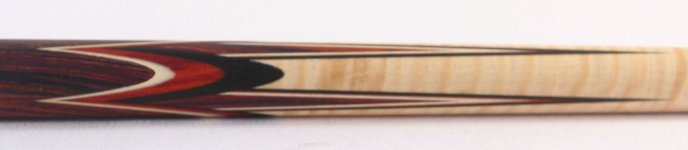
My opinion is, a point is a point. It makes no difference how you go about making a point. It's the finished product that is the point which is something that is longer than it is wide and comes to an apex. How you cut it, whether it be with a knife, a chisel or an end mill, the finished products shape determines if it is a point or not. Now it is absolutely true that a cue with 4 re-cuts per inlay times 4 would be a 16 point cue as you can sit there and count 16 points. However, the same is true with a cue that has 4 veneers per inlay times 4 inlays. This cue has 20 points or if you can see glue lines in the miters then you can double that number and say the cue has 36 points.
I, myself, have always considered a point as the finished product in the prong of a cue. If it's 4 points and 4 veneers then that's what I call it. If it's 4 points that are re-cut I call it a 4 point cue with having 3 or 4 re-cuts. I don't consider points in the butt collar to be included in the point count of a cue. I often see where cue makers make 6 or 8 points in the prong and a like number in the collar and consider this a 12 or 16 point cue and I just don't agree with this terminology. I believe the prong points and other points in the cue should be differentiated.
Dick
I, myself, have always considered a point as the finished product in the prong of a cue. If it's 4 points and 4 veneers then that's what I call it. If it's 4 points that are re-cut I call it a 4 point cue with having 3 or 4 re-cuts. I don't consider points in the butt collar to be included in the point count of a cue. I often see where cue makers make 6 or 8 points in the prong and a like number in the collar and consider this a 12 or 16 point cue and I just don't agree with this terminology. I believe the prong points and other points in the cue should be differentiated.
Dick