speed for tapering

Dave38

theemperorhasnoclotheson
Silver Member
I am having chatter problems while tapering shaft wood. If I place finger pressure in the middle of the shaft, and move it down with the carrage, it comes out smooth. I am spinning the wood at around 850rpm, is that to fast? the power feed is geared so it takes about 12-14 minutes for a full pass. My lathe is an old 40's Atlas with gears that I have to get out the wrenches, and nitrile gloves and get down an dirty everytime I need to change the feed rate, so balancing the speed of the power feed to the spindle speed is troublesome, to say the least. Any opinions, feel free to fire away. Thanks
Dave
 
Dave, are you using live tooling or a regular meltal lathe tool to make your passes? If you are using a laminate trimmer in a tool post with say a fly cutter, then you should be turning the spindle somewhere between 100 and 300 rpm. If you are using regular tooling then get a laminate trimmer.

good luck, Jimbo.
 
Dave38 said:
I am having chatter problems while tapering shaft wood. If I place finger pressure in the middle of the shaft, and move it down with the carrage, it comes out smooth. I am spinning the wood at around 850rpm, is that to fast? the power feed is geared so it takes about 12-14 minutes for a full pass. My lathe is an old 40's Atlas with gears that I have to get out the wrenches, and nitrile gloves and get down an dirty everytime I need to change the feed rate, so balancing the speed of the power feed to the spindle speed is troublesome, to say the least. Any opinions, feel free to fire away. Thanks
Dave


Yep your RPM's are way too fast you need to cut that in atleast half or slower depending on what stage your shaft is in. And how big of passes are you taking? What size bit are you using? And what direction are you cutting? I always cut from the tip end to the joint end.
 
I spin shafts at 200 rpm...
the smoothest cuts happen when you go left to right with the bit on the back of the shaft...bit spinning clockwise...
 
Last edited:
JBCustomCues said:
Yep your RPM's are way too fast you need to cut that in atleast half or slower depending on what stage your shaft is in. And how big of passes are you taking? What size bit are you using? And what direction are you cutting? I always cut from the tip end to the joint end.
Really Tip end to butt end? Using the Taper shaper, I go from Joint end to the tip end (Left to Right)...Fill me in?
 
My table saw machine spins wood at 60 RPM, the cnc at about 100, and my lathe is probably around 100-150. The only time I ever get any chatter at all, is if I let my cutters get too dull. I always use conventional cutting, and cut from small to big, but as Craig says, I think a climb cut can be a tiny bit smoother.
I would cut from big to small if my taper bar was set up differently, but I think it's best to always be pushing against the taper bar, not relying solely on springs or whatnot to keep pressure on it.
 
Last edited:
On my shaft saw machine I cut in both directions when turning blanks down. When making a shaft, I install the deco-ring and ferrule and make one last final pass cutting both ferrule and deco-ring to final size, going from ferrule to joint so that I know that the cut is at the proper depth that I want on that particular shaft. My taper bar is set so that 13.05mm at the ferrule it will cut the deco-ring at .850. I have an adjustment on my taper bar so that I can make lighter or deeper cuts on the ferrule end and the shaft still comes out at .850 at the joint but I don't do it that way. If some one wants a 12.0 mm or what ever I just lower the shaft and cut to that depth and then when getting near the joint I feather up to the 13.0mm height so that the joint deco-rings will come out at the proper diameter.
Dick
 
billiardbum said:
Really Tip end to butt end? Using the Taper shaper, I go from Joint end to the tip end (Left to Right)...Fill me in?

Hey Jim,
Well I have always cue my shafts from right to left and my butts left to right. Because I want my bit to be pushing away from wood. In my experiance when my bit is pushing into my work piece it creates chatter. On my shafts I just get a cleaner cut when I'm doing a climb cut because my cutter is pulling away from my shaft instead of pushing into it... And My shafts turn out extreamly smooth and ready for final sanding with 600 grit. Anyways thats just how I do things. I'n not saying that its right but its right for me and how my machines run best..
 
Slow your lathe down to it's slowest speed without putting it in back gear. Mount your router either vertical or horizontal with a 3/4" straight bit or vertical with a 3, 4 or 6 wing cutter and put your gear box on around 40 threads per inch and you will be surprised how much better it works. I turned thousands of pieces of wood on my old 10 inch Atlas Metal lathe like this.
 
Well, I guess I just got caught speeding:D
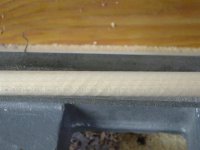
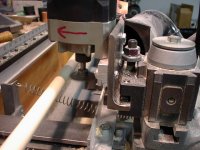
I am using a laminate trimmer, with a 6 flute cutter from cue components, and have been cutting from right to left and they came out like cottage cheese, so changed to left to right, large end on the left. It came out smoother, but with chatter if I didn't hold the shaft. Actually, it looks like more of an oscillating chatter, I included a few pics. to show it. thanks one more time for the assistance. I have some more to run off tomorrow, and will try the 40tpi like Chris recommends, at the slower speed. Right now, I'm doing .035 inch per revolution for the feed rate. Thanks for the help, and have a good week.
Dave
DSC00041.jpg

DSC00037.jpg
 
Sheldon said:
My table saw machine spins wood at 60 RPM, the cnc at about 100, and my lathe is probably around 100-150. The only time I ever get any chatter at all, is if I let my cutters get too dull. I always use conventional cutting, and cut from small to big, but as Craig says, I think a climb cut can be a tiny bit smoother.
I would cut from big to small if my taper bar was set up differently, but I think it's best to always be pushing against the taper bar, not relying solely on springs or whatnot to keep pressure on it.
I tried the small to big with my router bit spinning clockwise against the front of the shaft, going right to left, but got alot of nasty ripples and hills and valleys. I think it was bouncing the shaft wood alot more. I would think the same thing about the pressure against the taper bar going right to left with the small end on the right, would be better than reducing the pressure going left to right, but it didn't seem to work that way. I will work onthis tomorrow, thanks again,
Dave
 
Dave38 said:
I tried the small to big with my router bit spinning clockwise against the front of the shaft, going right to left, but got alot of nasty ripples and hills and valleys. I think it was bouncing the shaft wood alot more. I would think the same thing about the pressure against the taper bar going right to left with the small end on the right, would be better than reducing the pressure going left to right, but it didn't seem to work that way. I will work onthis tomorrow, thanks again,
Dave

There are many things that cause a ripple in shaft turning. On your top picture, if that barber shop look is completely around the blank and the length of it then, of coarse, your feed rate is way to fast. If it's just in areas then chances are the shaft is vibrating. A number of things cause this such as shaft rotating to fast, to much pressure between centers, using to large of a cutter with not enough cutting surfaces or the cutting surfaces are not centered onto the shaft correctly. Vibration is your enemy and once it starts it escalates. Just how long does it take you to make a pass at your present speed?

Dick
 
That 6-wing cutter has too much tool pushoff imo.
My thin kerf one cuts much smoother.
 
JoeyInCali said:
That 6-wing cutter has too much tool pushoff imo.
My thin kerf one cuts much smoother.
I will be trying the 3 bit wing cutter again, I just went back to the 6 bit one to see if this would help.

Dick,
My setup right now takes about 14 minutes for a complete pass and the 'chatter' occurs mainly in the straight section before it tapers wider, but only about 3 inches long. I really think it's the spindle speed.
 
Dave38 said:
I will be trying the 3 bit wing cutter again, I just went back to the 6 bit one to see if this would help.

Dick,
My setup right now takes about 14 minutes for a complete pass and the 'chatter' occurs mainly in the straight section before it tapers wider, but only about 3 inches long. I really think it's the spindle speed.

As slow as you are taking a pass (14 min) you could have your shaft turning at a very slow speed (50 rpm) and not get a barber pole effect. If it was me I would slow my rpms down to around 100-150 and while the machine is running see if there are any harmonic vibrations in your set-up. I noticed that your router mount is on a angle arm in a holder and this may amplify vibrations. Turning a long, thin dowel like a shaft is tough to get right. You also want your shaft to run as lightly as possible between centers. Just enough pressure so as to keep the shaft revolving. You don't want any compression pressure.

Dick
 
Dave here is my 0.02$ first how much end pressure is on the shaft? The less the better. Next on your bit fw backwards up or down the shaft shouldn't matter much with a sharp tool. Off set the cutter a little. Instead of like this O- set it O= above or below a hair say half of the thickness of the cutter. If you run the lathe backwards set it above otherwise set it below. I had this problem before the saw... Sometimes it is just a flimsy shaft. I am pretty sure the offset will work for you..
 
cueman said:
Slow your lathe down to it's slowest speed without putting it in back gear.

Hi Chris. What difference does putting it in back gear make?

Thanks,
Kelly
 
Dave38 said:
....the 'chatter' occurs mainly in the straight section before it tapers wider, but only about 3 inches long. I really think it's the spindle speed.

Is that up at the headstock end ?

Dave

< and gears can make lovely/terrible patterns in your turnings >
 
Last edited:
The sharper...the better

Thought I'd throw in my $.02 worth. I've fought this problem every time I cut shafts and I'm convinced that the MOST important factor is having a sharp tool. The center section of a 30" dowel is inherently flexible. If your cutter is the least bit dull, it will tend to "push" or "pull" the work (rather than cutting clean)...causing vibration. That's why putting your finger on the shaft solves the problem. You're absorbing this vibration. The second factor (IMHO) is chip load. As the cutter dulls (even slightly), you need to feed propotionately faster (or reduce spindle RPM) to keep the cutting edge "in cut" so you don't start the "push/pull" that I mentioned earlier (up to the point where it is just too dull).

Just my thought :rolleyes:
 
Back
Top