speed for tapering

I was having the same issues using the 6 wing cutter and I would have to stop several thousandths oversize and sand, which was a real pain. \

I put in a straight bit and turned the router sideways, using the end to make the cuts. The shafts don't feel like they're sanded when they come off, but I only have to sand them quick with 400 & up to achieve perfectly smooth shafts and I don't have to spend all day sanding them to size. I can cut them right down to where I want to be.
 
I Sell! I Sell! I Sell!

cuemaker03 said:
I sell Pre-Tapered shaft blanks for $12. each. I can leave them a little over sized so cue makers can put their own taper on them, or send them at almost finished size. Very little sanding needed.

I sell! I sell! I sell!!!!
 
Four things to check.

One: If you have too much pressure on the shaft between the centers it will cause the shaft to flex. Make sure you have just enough to hold the shaft in place.

Two: Slow the feed rate down to 30 or 40 TPI. If the feed rate is too fast it can set up a harmonic vibration in the shaft. The slower the better.

Three: Slow the shaft rotation speed way down. I get good results at speeds as low as 40 to 80 rpms.

Four: always take very small cuts.

Last but not least is IMHO i like to make a cutting pass from right to left then without changing anything a make a cleanup pass back from left to right. I have also experimented with lots of different cutters and get good results with several different types and styles. My advice is to use whatever works best for you.
 
Last edited:
Dave38 said:
Well, I guess I just got caught speeding:D
I am using a laminate trimmer, with a 6 flute cutter from cue components, and have been cutting from right to left and they came out like cottage cheese, so changed to left to right, large end on the left. It came out smoother, but with chatter if I didn't hold the shaft. Actually, it looks like more of an oscillating chatter, I included a few pics. to show it. thanks one more time for the assistance. I have some more to run off tomorrow, and will try the 40tpi like Chris recommends, at the slower speed. Right now, I'm doing .035 inch per revolution for the feed rate. Thanks for the help, and have a good week.
Dave
View attachment 52001

View attachment 52002


All of the info so far should help you cut smoother shafts. BUT if you cut this shaft with the barber pole pattern, you will continue to have problems. Try sanding the barber pole (helix), pattern smooth with 80 grit paper. Then you have a clean pallet to start with. When your router hits those raised areas it is going to bounce away & you are back with the chatter again...JER
 
I can turn them on a deluxe with success, and they come out smooth. I aggree with Dick, It looks like the feed is too fast from the pictures here. On butts I can use a router bit up pretty good without any chatter, but on shafts they are more subceptible to chatter with a dull bit, so when i do a new session I like to use a new or sharp bit, or move the bit so it cuts off an unused edge of the router bit. I don't use a wing cutter though, but rather cut off the sides of a straight bit.

I run My feed at the slowest or second to slowest speed, and make My cuts on the climb. It seems to work well for me that way.:) Greg
 
We have lift-off......

tsp&b said:
One: If you have too much pressure on the shaft between the centers it will cause the shaft to flex. Make sure you have just enough to hold the shaft in place.

Two: Slow the feed rate down to 30 or 40 TPI. If the feed rate is too fast it can set up a harmonic vibration in the shaft. The slower the better.

Three: Slow the shaft rotation speed way down. I get good results at speeds as low as 40 to 80 rpms.

Four: always take very small cuts.

Last but not least is IMHO i like to make a cutting pass from right to left then without changing anything a make a cleanup pass back from left to right. I have also experimented with lots of different cutters and get good results with several different types and styles. My advice is to use whatever works best for you.
Well, I just came in from the shop. I tried the 40tpi with the slowest belt setting on the pulleys (Around 150rpm) and used a 1/8" thick,three toothed, wing cutter. It was okay, but I had a what looked like a threaded ring all the way around and from left to right. I then went to the fastest speed for the backgeared position, (I guess around 60rpm) kept everything else the same and WOW! did it come out smooth!! It took about 12 minutes for a pass, but no chatter, barber pole effect or anything bad.
By the way, I have as little side pressure as I can get away with. I have a 1/2" dia. 'stebcenter' drive center which has a spring loaded center and a ring of teeth around the edge. It is the best I've seen for this kind of work, and for the $70 I paid for it, it better be this good:) . I just turn the tailstock handle while my finger is on the other end feeling the shaft dowel seat itself on the center drive, as soon as I feel it stop moving into the teeth, I stop and lock the tailstock spindle down.
Thanks for all the help and advice,
Dave
 
Dave38 said:
Well, I just came in from the shop. I tried the 40tpi with the slowest belt setting on the pulleys (Around 150rpm) and used a 1/8" thick,three toothed, wing cutter. It was okay, but I had a what looked like a threaded ring all the way around and from left to right. I then went to the fastest speed for the backgeared position, (I guess around 60rpm) kept everything else the same and WOW! did it come out smooth!! It took about 12 minutes for a pass, but no chatter, barber pole effect or anything bad.
By the way, I have as little side pressure as I can get away with. I have a 1/2" dia. 'stebcenter' drive center which has a spring loaded center and a ring of teeth around the edge. It is the best I've seen for this kind of work, and for the $70 I paid for it, it better be this good:) . I just turn the tailstock handle while my finger is on the other end feeling the shaft dowel seat itself on the center drive, as soon as I feel it stop moving into the teeth, I stop and lock the tailstock spindle down.
Thanks for all the help and advice,
Dave

I have one of those spring loaded centers that I use when turning square stock round. Truthfully, I don't believe it is accurate enough for precision work and the spring tension is to strong for shafts. Apparently you are moving in the right direction though. When all is tuned and working correctly the shafts can be a thing of beauty. On my shaft machine I built an enclosed, spring loaded revolving center that worked pretty good for around 10 years or so but it wasn't perfect. I had bronze bushings mounted into roller bearings so that there would be little friction when revolving. I had a .500 spring loaded drill rod sliding in the bushes. In this way it would revolve easily and be retracted easily. Problem was, this drill rod stuck out the front of the tail stock approx. 8 inch and was necked down to 8mm and with that much over hang there was just to much play ( about .005). I've now changed to a an easily adjustable spring apparatus with a 5mm bearing on the end with a 8mm center. This way the shaft does not revolve, only the center on the end so that it runs very true. I can change the spring tension in only a few seconds to fit my needs on the amount of wood I am removing. First cut takes off 6mm of wood so there needs to be more spring tension. Later, when taking light cuts, very little tension is needed.

Dick
 
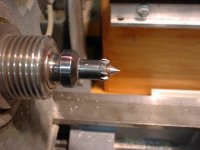
Dick, this is the type that I'm using right now. I have tried a variety of drive centers. Is there a stock off the shelf one that is accurate, small enough for shafts, and the point fits a 60* center? Or will I need to have a custom one made?
After reading you last post, it got me thinking, so I went out to the shop and put a dial indicator on the nose point, and on the body, and the body had .001 runout and the nose point had a .003 run out. I am assuming that's not good enough, is it?
Dave
DSC00009.jpg
 
Dave38 said:
Dick, this is the type that I'm using right now. I have tried a variety of drive centers. Is there a stock off the shelf one that is accurate, small enough for shafts, and the point fits a 60* center? Or will I need to have a custom one made?
After reading you last post, it got me thinking, so I went out to the shop and put a dial indicator on the nose point, and on the body, and the body had .001 runout and the nose point had a .003 run out. I am assuming that's not good enough, is it?
Dave
View attachment 52067

I have that one but it is mounted in a different holder. That is one that I use for turning square to round. I had made one but it wasn't accurate enough and I seen that one and bought it. I had originally bought it to use for making half-splice points. In this way the prong could be could be removed and installed with precision and the dowel could be canted slightly for the V-groove cuts. It wasn't accurate enough for this though so now I just use it for the rough cuts. I don't know of any that are accurate enough ready made, that wouldn't cost an arm and a leg. Good, semi-custom machine tools are usually pricey. If yours is only running .003 out it may be close enough not to give you to much trouble down the road. It's just that with turning between centers, when a piece needs to removed and other operations performed, little errors are compounded.

I've probably become entirely to anal over precision as I've got older. If I see an indicator move I freak out.

Dick
 
Back
Top