Taking the Pocket Out of Aiming

Brookeland Bill

AzB Silver Member
Silver Member
I’ve discovered that by not focusing on the intended pocket to the point that it dominates aiming has helped me tremendously. I have narrowed aiming down to strike the object ball and sending it on a path has produced better results than having to concentrate on cue ball, object ball and intended pocket. I’m interested in one goal and that’s hitting the object ball at its aiming point and forgetting the pocket. Maybe I’m not explaining it to make others understand my technique but it keeps my mind from being befuddled with information.
 
Last edited:
Here's a little-known visualization technique using the fact that the line connecting the CB-OB contact points always crosses the CB-OB center-to-center line at its midpoint. Despite its geometric validity I don't know of anybody who uses it - you could be the first.

pj
chgo

1776212845989.jpeg
 
Last edited:
Here's a little-known visualization technique using the fact that the line connecting the CB-OB contact points always crosses the CB-OB center-to-center line at its midpoint. Despite its geometric validity I don't know of anybody who uses it - you could be the first.

pj
chgo

View attachment 897667
Excellent! Jimmy Reid once posted a graphic with this concept:
 

Attachments

  • Aim - Jimmy Reid.jpg
    Aim - Jimmy Reid.jpg
    10.8 KB · Views: 39
Doesn't hold a candle to how much I don't know. :p

pj <- for instance, what the hell does "doesn't hold a candle to" mean?
chgo
The idiom "doesn't hold a candle to" means that someone or something is far inferior in skill, quality, or ability compared to another, implying they are not even competent enough for the most basic, subordinate tasks.

The phrase originated in the pre-electricity era when apprentices or assistants were tasked with holding candles to illuminate the work of skilled craftsmen; if a person "couldn't hold a candle" to their master, it signified they were unfit even for this menial role.
 
The idiom "doesn't hold a candle to" means that someone or something is far inferior in skill, quality, or ability compared to another, implying they are not even competent enough for the most basic, subordinate tasks.
Thanks - that part I knew.

The phrase originated in the pre-electricity era when apprentices or assistants were tasked with holding candles to illuminate the work of skilled craftsmen; if a person "couldn't hold a candle" to their master, it signified they were unfit even for this menial role.
That's what I was asking about - interesting. Thanks again.

pj
chgo
 
  • Like
Reactions: bbb
A little background information with a July 2008 AZ post about Jimmy Reid:
A small nit about the illustration. I think it is better to show a shot that is not a half-ball hit. Some people may see that and conclude that is part of the deal when it is not. It is better to not give the reader that chance to make a mistake.
 
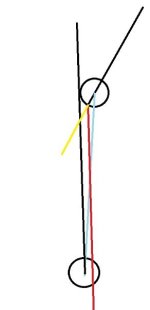
It could be bracketed with a 1/4-ball and a 3/4-ball aim, but overall I think it's easier to visualize 3 parallel lines. To me, using the angled (blue) line between ball centers helps to locate the centerline, but it makes more sense to move the end of the blue line to the right edge of the cueball, to make it parallel to the other lines--even considering the 3D view causing the lines to converge (towards a vanishing point). I know this is still all the same equal-distance/double-the-distance aiming, but is there an advantage that I don't see, with using the center-to-center line, angling *across* the midline (red)?
 
Here's a little-known visualization technique using the fact that the line connecting the CB-OB contact points always crosses the CB-OB center-to-center line at its midpoint. Despite its geometric validity I don't know of anybody who uses it - you could be the first.
I think that system, which does give the ideal line for all cuts, is not particularly useful for long shots due to the errors that creep in over those distances. It might be very useful for when the cue ball is within a couple of balls of the object ball. Most players have little experience with such close shots. Here is a drawing of a thin cut with the cue ball less than a ball from the object ball. BP is the bisecting point that is half way between the centers of the balls. CP is contact point. The BP is also half way along the path of the CP to CP.
Screenshot 2026-04-23 122451.png

But maybe it is easier to just visualize the CP-to-CP line for this shot.
 
Last edited:
Back
Top