taper bar

chumscustoms

AzB Silver Member
Silver Member
who out there has made there own taper bar for there lathe,
i am looking at a lathe this weekend and i am trying to get a idea what i will need to do .
i am hopeing for good info on mounting and material just for ideas, i have my own ideas but others are great to have also
let me know
thanks ben
 
Taper Bar Pics

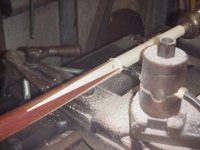
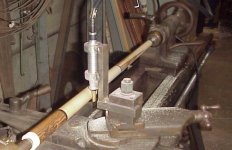
I finally got out to my shop with a camera and took some pics of the taper bar I made. The first pic (the out of focus one) is of the bar that attaches to the cross slide. I have been playing around with brushes and covers to keep dust off the bearing. The others show the taper bar Assembly which is overall 48" long. The actual taper bar is 36" long with 32" of bearing track. The cool thing about the setup is I can go from regular turning to cutting tapers in about 3 to 4 minutes. Also I have mounting holes already in the main bar for another taper bar that I am having made that has 2 tracks: 1 for straight taper 1.25" butt to .850" joint and another track with a compound taper for the shafts. You can see the additional bearing mounting holes on the cross slide bar. The bad thing so far is the dust getting in the track. I am currently working on this with better vacuum setup and a clear acrylic shield. One of the pics also shows the rear chuck which is a must, huge time saver. If you are buying a new lathe I would suggest no smaller than 13" x 40". Better to have a little extra than be a little to small.

This is an Enco 13" x 40" lathe I have had since 1987. I believe the casting is still used on a Grizzly lathe as well as some others.

Oh I just noticed on more thing: The quick change to post with router mount is a must for us one lathe guys.

Good luck,

Troy Mckune


PICT4446.jpg


PICT4449.jpg


PICT4451.jpg


PICT4453.jpg


PICT4457.jpg


PICT4447.jpg
 
Thanks for the comments.

Does anybody else have any pics of there setups? I am always looking for a better and/or more efficient way of doing things.

Troy
 
Troy Mckune said:
Thanks for the comments.

Does anybody else have any pics of there setups? I am always looking for a better and/or more efficient way of doing things.

Troy

IMHO - Don't see much way to improve on your setup - If you wanted
to mount the router to a plate that rode on precision slides -
it might feed in somewhat smoother. But is that even a concern?
How smooth does it cut?

Dale<who is green with envy>
 
If you look at the 3rd picture down from the top (looks like you are standing on the right side of the lathe looking back at the headstock). Between the Dorian Tool post and the aluminum block that mounts the bearing, there is a hole in the cross slide. There is a metric socket head cap screw that is removed for the use of the taper bar. This screw ties the cross slide to the lead screw.

Troy
 
Hey Troy, How much clearance in the slot did you allow for the bearing? Also, I'll try to get the pictures to you tomorrow. Thanks, Ray
 
Ray,

The bearing is .750". The slot was supposed to be .760" but is about .763-.765 because I had to move the bar 3 times to machine. My 9 x 42 mill really can only machine about 24" in the x axis, but having only 1 vise limited me to only about 12" before I got chatter. Where the 3 slots met i had to feather it in with light sanding. The finished bar works great and provides a smooth finish. Because of the slot width whenever you move to the right you have to pull the cross slide .013" back before you start to move left. The next bar I am having made for me by a local machine shop with a big enough CNC mill (40" in the x) will have 2 slots. One slot for butts and one for my shaft taper. The slots will be .760" +0 -.004" which should allow for hard anodizing. I included a picture of the 3d model I made below.

Troy

TaperBarDoubleSWX.jpg
 
For a smoother cut

If you mount your router verticle you will get a much smoother cut and have very little sanding to do before finishing. That is a very nice set up. One of the nicest ones ive seen on a 12x36. Good job.
 
Troy the only way I would change it would be to put the track upside down to keep the wood chips out. Looks like a heck of a set up though. Great job.
 
Thanks,

I did think about mounting the track upside down and maybe eventually I will, but it poses a few more design challenges to make. As far as mounting the router vertically, I have seen pictures of setups like Murray Tucker's that look great. Being able to use larger diameter multiflute cutters would be nice. I am happy with the finish I am currently getting, but I could probably go a lot faster with a vertical router.

Troy
 
Troy Mckune said:
Thanks,

I did think about mounting the track upside down and maybe eventually I will, but it poses a few more design challenges to make. As far as mounting the router vertically, I have seen pictures of setups like Murray Tucker's that look great. Being able to use larger diameter multiflute cutters would be nice. I am happy with the finish I am currently getting, but I could probably go a lot faster with a vertical router.

Troy


Troy,

I use to taper the way You have Yours setup, and It did work for me, but eventually I switched over to the vertical positioning, and since I have never went back.:)

Greg
 
Verticle

I also have never went back. Multiple surface cutters is the way to go reducing tool pressure. Also, produces wood chips instead of dust when making a pass. with the verticle postion you are able to use the correct style of bit if you are using your lathe for cutting point grooves.
 
Troy Mckune said:
Thanks,

I did think about mounting the track upside down and maybe eventually I will, but it poses a few more design challenges to make. As far as mounting the router vertically, I have seen pictures of setups like Murray Tucker's that look great. Being able to use larger diameter multiflute cutters would be nice. I am happy with the finish I am currently getting, but I could probably go a lot faster with a vertical router.

Troy

Stand it up and use a wing cutter and you will have less tear out issues. You can get good quality with it horizontal but you have to watch your feeds and speeds. Your taper bar looks nice. When I first started I used the 10" bar that came with my SouthBend. I'd cut about 8" and then move the bar, touch off the tool and start again. What a pain. Of course I was also using this setup to cut with. Yes that is a dremel tool with a flex shaft. It did not last long. My how times have changed.
 

Attachments

  • router1.jpg
    router1.jpg
    28.3 KB · Views: 1,687
Murray Tucker said:
Yes that is a dremel tool with a flex shaft. It did not last long. My how times have changed.

After the Dremel blew up I stepped up to a Foredom machine and mounted the hand piece vertically. Man I thought I was in high cotton with that machine.
 

Attachments

  • lathe.jpg
    lathe.jpg
    45.4 KB · Views: 1,743
My experiences are much like what Murray described. I could cut in that position too, and get good results, but I really had to play with My speeds to get things perfect. Even on handles I could pick up a hair of chatter in the middle when I would plunge cut, and didn't have My speeds pefect. Turning shafts was possible too, but again more work and playing around to get the feeds set right, and alot more hairy then turning handles. In the upright position though, I can turn handles without picking up any chatter, pretty much regardless of what speeds I run. I still try to control speed for the best possible surface, but I could run through those fast if I really wanted. The shafts are still kind of tricky, if I run slower, then I get a super smooth cut, that doesn't even need sanding, but It's more likely to pickup some chatter in the middle for some reason, as opposed to if I run It a hair faster, no chatter in the middle, but the surface is not quite as smooth as the slower speed. Nothing that 400 grit can't handle very easily though. I'm refering to the last cuts, where the shaft is thinner, and chatter is most likely to be seen, most cuts before that I can run at most speeds. I also aggree, in this position, I have had no problems with tearout to speak of. I can't say that never happened when I punge cut them.

I guess everyone's setup could be different, but these are just the little kinks I've learned to work out of Mine.:) Another thing that is key for me is getting the correct amount of tailstock pressure when turning shafts.;) The tailstock can easily bow the shaft between centers if too much is used.


Greg
 
I finally got out to my shop with a camera and took some pics of the taper bar I made. The first pic (the out of focus one) is of the bar that attaches to the cross slide. I have been playing around with brushes and covers to keep dust off the bearing. The others show the taper bar Assembly which is overall 48" long. The actual taper bar is 36" long with 32" of bearing track. The cool thing about the setup is I can go from regular turning to cutting tapers in about 3 to 4 minutes. Also I have mounting holes already in the main bar for another taper bar that I am having made that has 2 tracks: 1 for straight taper 1.25" butt to .850" joint and another track with a compound taper for the shafts. You can see the additional bearing mounting holes on the cross slide bar. The bad thing so far is the dust getting in the track. I am currently working on this with better vacuum setup and a clear acrylic shield. One of the pics also shows the rear chuck which is a must, huge time saver. If you are buying a new lathe I would suggest no smaller than 13" x 40". Better to have a little extra than be a little to small.

This is an Enco 13" x 40" lathe I have had since 1987. I believe the casting is still used on a Grizzly lathe as well as some others.

Oh I just noticed on more thing: The quick change to post with router mount is a must for us one lathe guys.

Good luck,

Troy Mckune


PICT4446.jpg


PICT4449.jpg


PICT4451.jpg


PICT4453.jpg


PICT4457.jpg


PICT4447.jpg

Very nice set up.
 
Back
Top